%201.avif)
Beginner's Guide to Do I Need a Backup Generator for My Home in Texas
Discover if you need a backup generator for your home in Texas and protect against power outages with whole-home standby solutions.


.svg)
.svg)
.svg)
Why Texas Homeowners Are Asking "Do I Need a Backup Generator for My Home in Texas?"
If you're wondering do I need a backup generator for my home in Texas, the short answer is: for most DFW homeowners, yes — and here's why it matters.
Quick Answer: Do You Need a Backup Generator in Texas?
You likely need a backup generator if any of the following apply to your household:
- You or a family member depends on medical equipment like a CPAP, oxygen concentrator, or refrigerated medication
- You work from home and cannot afford lost productivity during outages
- You experienced extended power loss during Winter Storm Uri in February 2021 or subsequent storms
- You live in a DFW suburb where summer heat or winter freezes make losing your HVAC dangerous
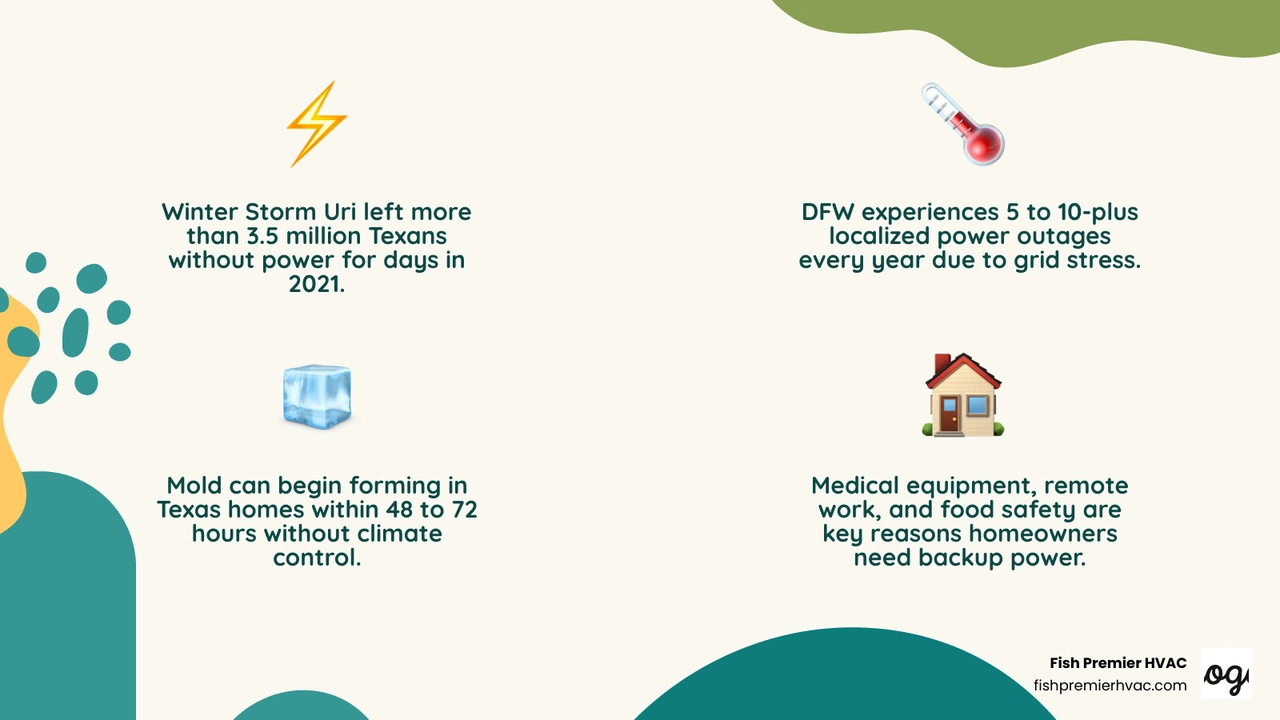
- You want to protect thousands of dollars in frozen food and prevent spoilage after just 48 hours without power
- You want to protect your home from humidity-driven mold, which can begin forming within 48 to 72 hours without climate control in Texas
That last point is no small concern. In February 2021, Winter Storm Uri knocked out power for more than 3.5 million Texas residents for multiple days — in subfreezing temperatures. Many homeowners found themselves huddled under blankets watching indoor temperatures drop to dangerous levels, with no heat, no light, and no way to keep food cold or devices charged. It was a wake-up call that reshaped how Texans think about home preparedness.
And it wasn't a one-time event. Between summer ERCOT grid stress, hurricane-season outages, and the DFW area's 5 to 10-plus localized outages every year, power interruptions have become a predictable part of life in North Texas — not an occasional surprise.
For homeowners who expect the best from every system in their home, a backup generator isn't just a safety net. It's a foundational part of whole-home comfort and protection.
Do I Need a Backup Generator for My Home in Texas?

To answer this question, we must look at how the role of the home has evolved. Our homes are no longer just places to sleep; they are high-tech sanctuaries, remote offices, and critical shelters. When the power grid fails, the modern home can quickly become uncomfortable and even structurally vulnerable.
For luxury properties across the Dallas-Fort Worth metroplex, the decision to invest in a backup generator is often less about "getting by" during an emergency and more about maintaining an uninterrupted standard of living. When grid instability strikes, having a robust plan for Protecting Your Home During Power Outages in Texas ensures that your lifestyle, your family's safety, and your property remain secure.
Texas Weather Extremes and Grid Reliability
The ERCOT grid has faced unprecedented demands in recent years. In the summer, triple-digit heatwaves force millions of air conditioners to run simultaneously, pushing the grid to its absolute limit. In the winter, severe ice storms coat power lines and freeze critical gas infrastructure.
While large-scale grid failures make national headlines, localized outages are far more common. In DFW suburbs like Keller, Southlake, and Colleyville, localized storms, high winds, and equipment failures cause five to ten outages annually. These disruptions typically last anywhere from 2 to 12 hours, but severe weather can easily push those recovery times into days. Understanding How a Whole Home Generator Protects You During Storms reveals that backup power does more than keep the lights on—it preserves your home's entire climate-control ecosystem.
Critical Situations Where Backup Power is Essential
For some families, backup power is an absolute necessity rather than a luxury. Consider these critical situations:
- Medical Equipment Dependability: If anyone in your household relies on life-support devices, oxygen concentrators, or temperature-sensitive medications, a power outage is a direct threat to health.
- Remote Work and Connectivity: With home offices serving as professional hubs, losing internet, servers, and power can mean lost income and disrupted business operations.
- Food Preservation: A closed freezer can only keep food safely frozen for about 48 hours. Beyond that, thousands of dollars in premium groceries can quickly spoil.
- Property Protection and Mold Prevention: In the humid North Texas climate, losing air conditioning during a summer outage causes indoor humidity to spike. Without climate control, mold can begin growing within 48 to 72 hours, leading to extensive remediation needs.
For comprehensive security, establishing true Power Outage Protection is the only way to safeguard your family and property against these unpredictable events.
Comparing Standby and Portable Generators
When choosing how to protect your home, you will generally look at two primary pathways: standby (whole-home) generators and portable generators. Each serves a purpose, but they offer vastly different levels of convenience, power, and security.
| Feature | Standby (Whole-Home) Generator | Portable Generator |
|---|---|---|
| Activation | Automatic via Transfer Switch (within seconds) | Manual setup, pull-start, and cable connection |
| Power Output | High (can power entire home, including central HVAC) | Medium to Low (powers selected appliances via extension cords) |
| Fuel Source | Natural Gas or Liquid Propane (infinite or large tank) | Gasoline or Portable Propane (requires manual refueling) |
| Safety | High (installed permanently outdoors, no CO risk inside) | Medium (requires strict placement to prevent CO hazards) |
| Convenience | Seamless, hands-free operation | High manual effort during inclement weather |
Standby Generators for Whole-Home Luxury
Standby generators represent the gold standard in power resilience. These units are permanently installed outside your home, much like a central air conditioning condenser. They connect directly to your home's electrical panel and are fueled by your existing natural gas line or a large on-site liquid propane tank.
The defining feature of a standby system is the Automatic Transfer Switch (ATS). When the grid fails, the ATS instantly detects the loss of power, disconnects your home from the utility line, starts the generator, and transfers your home’s electrical load to the backup system—all in about 10 to 30 seconds. This seamless transition means you don't have to lift a finger, even if you are away on vacation. To explore these systems further, take a look at the Whole Home Generator Benefits and What to Know and learn exactly How Does a Whole Home Generator Work to keep your home running flawlessly.
Portable Generators and Their Limitations
Portable generators are smaller, mobile units that must be wheeled out of storage, filled with fuel, and manually started during an outage. While they can keep basic appliances running, they have significant limitations:
- Manual Intervention: You must venture outside in heavy rain, wind, or freezing ice to set up the unit, pull-start the engine, and run heavy-duty extension cords to your refrigerator or portable heaters.
- Fuel Demands: Portable units typically run on gasoline, which means you must safely store multiple gallons of fuel on your property. During a widespread outage, local gas stations may also lose power, making refueling difficult.
- HVAC Incompatibility: Most portable generators lack the starting wattage required to run a central air conditioning system or a large heat pump. At best, they can run a small window AC unit or space heater.
- Safety Risks: Proper placement is critical. Operating a portable generator too close to open windows, doors, or inside garages can lead to deadly carbon monoxide build-up.
Sizing and Fuel Options for Texas Homes
A backup generator must be precisely matched to your home's unique energy footprint. If a generator is undersized, it will stall or shut down when high-demand appliances—like your central air conditioning—try to start up. Conversely, an oversized generator will consume more fuel than necessary, reducing efficiency.
Before making any decisions, it is essential to review What Size Whole Home Generator Do I Need to understand the technical math behind home energy loads.
How to Determine the Right Generator Size
Calculating your required generator size involves a professional load analysis. This process distinguishes between "running watts" (the continuous power an appliance needs to operate) and "starting watts" (the brief surge of power required to start electric motors, such as those in your HVAC compressor).
For example, a central air conditioner might require three times more power to start up than it does to run. To ensure your home transitions smoothly to backup power without overloading the system, we perform a detailed inventory of your essential circuits. If you reside in North Texas, reviewing customized resources like the guide on Generator Sizing Trophy Club can give you a clearer picture of how local home sizes and climate demands dictate generator capacities.
Natural Gas vs. Propane Fuel Sources
Standby generators are highly versatile when it comes to fuel, running on either natural gas or liquid propane (LP).
- Natural Gas: If your home in Westlake or Southlake is already connected to a municipal natural gas line, this is often the most convenient choice. The generator has a continuous fuel supply, allowing it to run indefinitely during extended multi-day outages without refueling.
- Liquid Propane: For homes in more rural pockets of the DFW area or neighborhoods without natural gas lines, liquid propane is an exceptional alternative. Propane is stored on-site in a large dedicated tank. It burns cleanly and has an indefinite shelf life, making it highly reliable. A typical large propane tank can easily power a whole-home generator for several days of continuous use.
Installation, Safety, and Local Regulations
Installing a standby generator is a complex, multi-phase project that requires specialized expertise. Because the system interfaces directly with your home's electrical panel and fuel lines, it is not a project for DIY enthusiasts. To understand the complete journey from delivery to activation, read our guide on Whole Home Generator Installation What to Expect.
Professional Installation and Permitting in DFW
Every DFW municipality—whether Fort Worth, Southlake, Keller, or Colleyville—has strict building, electrical, and plumbing codes. A professional installation requires:
- Proper Permitting: Securing electrical and plumbing permits from your local city hall before work begins.
- Site Preparation: Pouring a level concrete pad or installing a heavy-duty composite pad away from windows and doors to comply with local clearance codes.
- Plumbing Integration: Running professional gas lines from your meter or propane tank to the generator.
- Electrical Interconnection: Installing the Automatic Transfer Switch and connecting it to your main breaker panel.
- City Inspection: Completing a final inspection with city officials to ensure the installation is fully code-compliant.
For homeowners in Fort Worth, our tailored Whole Home Generator Fort Worth TX service ensures every local requirement is met seamlessly. Similarly, residents in Southlake can rely on our specialized Whole Home Generator Southlake TX solutions for a code-compliant, worry-free installation.
Safety Protocols and Carbon Monoxide Prevention
Safety is the most compelling reason to choose a professionally installed standby generator over a portable unit. Portable units carry inherent risks; the U.S. Consumer Product Safety Commission estimates that around 85 consumers die each year from carbon monoxide poisoning caused by gasoline-powered portable generators.
Standby generators are engineered with safety in mind. They are permanently anchored at a safe distance from your home's envelope, and their exhaust systems are directed away from windows, doors, and fresh air intakes. Additionally, standby systems prevent "backfeeding"—a dangerous scenario where a portable generator accidentally sends electricity back into the utility lines, putting utility workers at risk. To ensure your home's entire mechanical system remains safe after severe weather, always reference our Post-Storm HVAC Checklist for Texas Homeowners.
Frequently Asked Questions About Texas Home Generators
Selecting the perfect backup power system involves weighing long-term maintenance, lifestyle benefits, and financial returns. To keep your system in peak condition, regular upkeep is essential; you can learn more about scheduling and tasks in our Generator Maintenance Colonial Hills Guide.
Below, we answer some of the most common questions DFW homeowners ask when considering a generator.
Do I need a backup generator for my home in Texas to run my central air conditioning?
Yes, if you want to maintain complete comfort during our hot North Texas summers. A portable generator will rarely have the capacity to start or run a central HVAC system.
A standby generator, however, can be sized specifically to handle the heavy starting loads of your air conditioner. By pairing a standby unit with a high-efficiency HVAC system, you can keep your entire home cool and comfortable, even during a multi-day summer blackout. For luxury homes in Keller, our Whole Home Generator Keller TX services are designed to keep your cooling system running without interruption.
Do I need a backup generator for my home in Texas if I have a battery backup system?
While home battery backup systems are excellent for managing short outages and integrating with solar arrays, they have physical capacity limits. A standard battery system can typically power essential circuits—like lights, internet, and a refrigerator—for a few hours to a day.
If you experience an extended multi-day outage during a winter freeze or summer storm, a battery system may run dry. A standby generator, on the other hand, offers unlimited runtime as long as natural gas or propane is available. Many homeowners choose a hybrid approach, using batteries for quick, silent backup and a generator for long-term resilience. For those in Colleyville, our team can design a robust plan utilizing Whole Home Generators Colleyville TX to ensure you never run out of power.
How does a standby generator affect home resale value in Texas?
In the Texas real estate market, a whole-home standby generator is highly attractive to buyers. Following major grid events, many homebuyers actively seek out properties equipped with automatic backup power.
Studies show that a backup generator can add approximately 4% to the overall value of a home, with many homeowners recouping 60% to 70% of the installation value upon resale. It positions your home as a premium, secure, and resilient property. To find the ideal match for your home's value, check out the options for the Best Home Standby Generator Fort Worth TX.
Conclusion
When deciding if you need a backup generator for your home in Texas, the choice comes down to how much you value peace of mind, uninterrupted comfort, and property protection. In a region where weather extremes are normal and grid reliability is unpredictable, a standby generator is a wise investment in your home’s security.
At Fish Premier HVAC, we provide concierge-level service, offering luxury, comfort, and premium installations for homeowners who demand the absolute best. As a top-rated provider in the Dallas-Fort Worth area, we deliver comprehensive, high-efficiency home comfort solutions tailored to your unique lifestyle.
From initial load analysis to professional permitting and seamless installation, our expert team manages every detail of your backup power journey. For our neighbors in Westlake, you can explore our premium Whole Home Generator Westlake TX services to start planning your home's ultimate protection.
Ready to secure your home's comfort? Contact us today during our standard business hours (Monday-Friday, 8am-6pm), or reach out to our prompt after-hours emergency services.
Fish Premier HVAC
Expert HVAC Service For Whole Home Comfort
Fort Worth, TX | Texas License #TACLB99535E