%201.avif)
The Ultimate Guide to Sizing Your Whole Home Generator
Discover what size whole home generator do I need. Calculate load, size for AC & essentials, avoid mistakes with our DFW expert guide.

.svg)
.svg)
.svg)
Why Getting the Right Generator Size Is the Most Important Decision You'll Make for Your Home
What size whole home generator do I need is one of the most common questions homeowners ask — and the answer depends on your home's square footage, the appliances you want to keep running, and whether you want essential-only coverage or full whole-home power.
Here is a quick reference based on home size:
| Home Size | Essential Circuits Only | Whole-Home Coverage (with AC) |
|---|---|---|
| Under 1,500 sq ft | 10-12 kW | 13-16 kW |
| 1,500-2,000 sq ft | 12-14 kW | 16-18 kW |
| 2,000-2,500 sq ft | 14-16 kW | 18-22 kW |
| 2,500-4,000 sq ft | 18-22 kW | 22-26 kW |
| 4,000+ sq ft | 26-30 kW | 30-48 kW+ |
Most homes in the Dallas-Fort Worth area need between 16 kW and 22 kW to comfortably run central air conditioning alongside essential appliances during an outage.
Power outages in DFW are not rare inconveniences. Summer heat waves and winter storms regularly knock out grid power, sometimes for days. When that happens, your refrigerator stops cooling, your HVAC shuts down, and if you have a well pump or sump pump, those go silent too. For homeowners who expect their home to function at the same level of comfort and safety during an outage as it does on a normal day, a properly sized whole-home standby generator is not optional — it is essential.
The problem is that generator sizing is easy to get wrong. Go too small and your generator trips under load the moment your AC compressor kicks on. Go too large and you waste money upfront, burn through more fuel, and risk a condition called "wet stacking" where unburned fuel accumulates in the exhaust system. Getting the size right means understanding your home's actual electrical load — not just a rough square footage estimate.
This guide walks you through exactly how to calculate what you need, step by step.
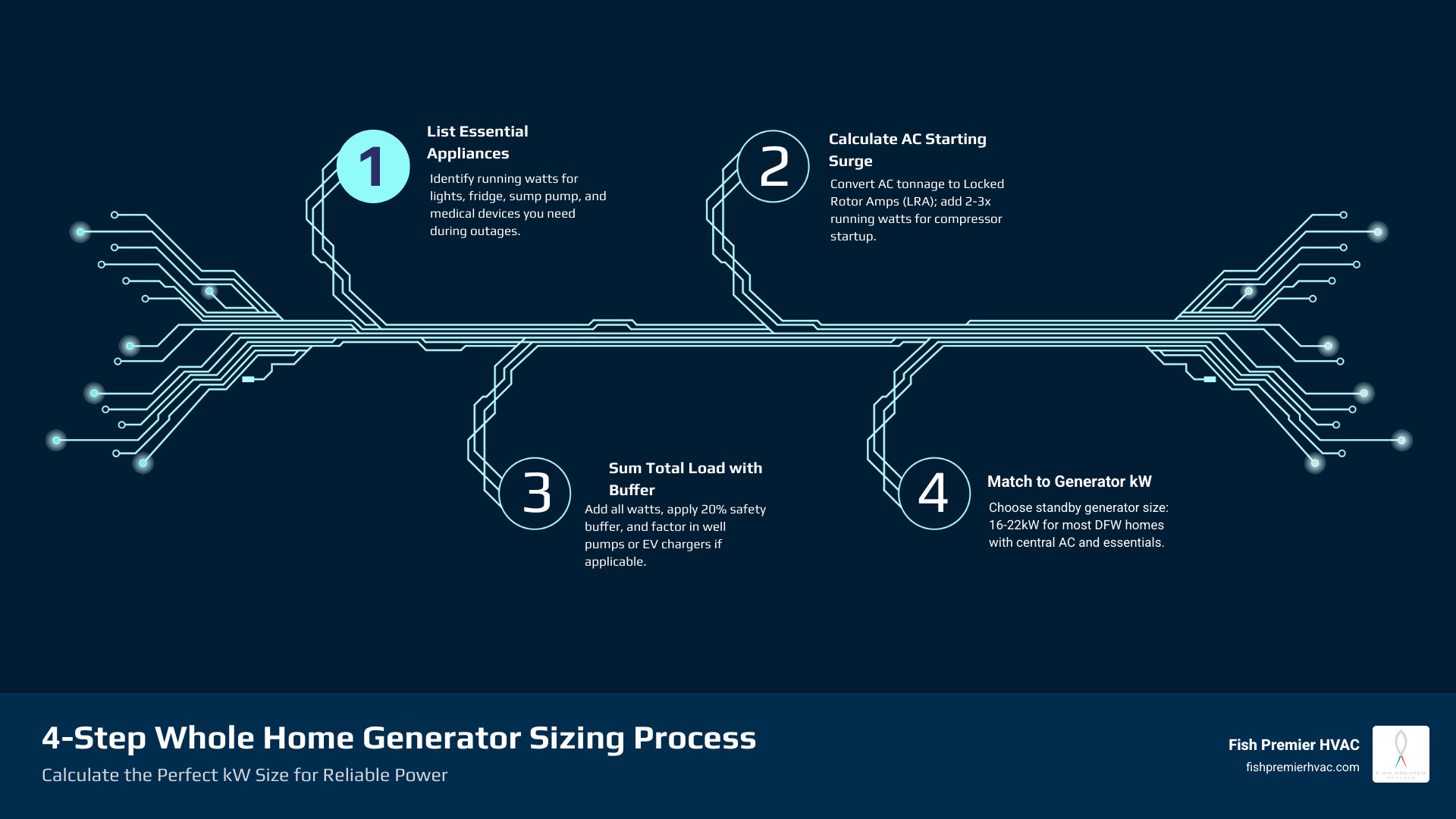
Understanding Your Power Needs: What Size Whole Home Generator Do I Need?
When we sit down with homeowners in Keller or Southlake, the conversation usually starts with a simple question: "Can I just buy the biggest one and be done with it?" While that sounds like a safe bet, the goal of professional sizing is to find the "Goldilocks" zone—enough power to handle your lifestyle without excessive waste.
To understand what size whole home generator do i need, we first have to distinguish between two types of power: Running Watts and Starting Watts.
- Running Watts (Rated Watts): This is the continuous power an appliance needs to stay on. Think of a light bulb or a television; once they are on, their power draw is steady.
- Starting Watts (Surge Watts): This is the extra "oomph" required for two to three seconds to get a motor-driven appliance started. Your refrigerator might only need 700 watts to run, but it could need 2,200 watts just to kick the compressor into gear.
If your generator doesn't have the Surge Capacity to handle these momentary spikes, it will stall or trip a breaker the second your fridge and AC try to start at the same time. This is a common point of confusion we address in our Generator Sizing Trophy Club consultations. A generator is rated by its maximum output, but for long-term health, you should never plan to run it at 100% capacity for hours on end. We generally recommend the 80% rule: your total continuous load should not exceed 80% of the generator’s rated capacity.
Determining what size whole home generator do i need for AC units
In the Dallas-Fort Worth area, air conditioning isn't a luxury; it's a safety requirement during a July heatwave. Central AC is almost always the largest electrical load in a home. Sizing a generator for AC involves looking at the "tonnage" of your unit.
A quick way to check your AC tonnage is to look at the data plate on your outdoor condenser. Look for the model number; if you see a "24," it’s a 2-ton unit; "36" is 3 tons; "60" is 5 tons.
- A 3-ton AC unit typically needs about 3,500 running watts but a staggering 10,000+ starting watts.
- A 5-ton unit can require upwards of 15,000 starting watts.
To help manage this, we often recommend "soft start" kits. These devices reduce the initial power surge (Locked Rotor Amps) needed to start the compressor, potentially allowing you to choose a smaller, more efficient generator. For our neighbors looking for a Whole Home Generator Southlake TX, ensuring the AC is properly accounted for is the difference between a cool house and a dark one.
Accounting for essential appliances and starting surges
Beyond the AC, we need to look at the "heartbeat" of your home. These are the items that keep your family safe and fed.
- Refrigerators/Freezers: 600–800 running watts / 2,200 starting watts.
- Sump Pumps: 800–1,000 running watts / 2,500 starting watts.
- Well Pumps: 1,000 running watts / 3,000 starting watts.
- Medical Equipment: Oxygen concentrators or CPAP machines generally have low draw, but they require "clean" power (low total harmonic distortion) to function safely.
- Microwave: 1,200 watts (mostly running).
When we perform a load calculation for a Whole Home Generator Fort Worth TX, we don't just add up the running watts. We take the total running watts of all essential items and then add the single highest starting wattage requirement. This ensures the generator can handle the biggest "jump" your system will ever take.
How to Calculate Your Home's Total Electrical Load
Calculating your load isn't just about reading labels on the back of your toaster. It involves looking at your home’s electrical panel. Most modern DFW homes have a 200-amp service. At 240 volts, that panel is capable of handling about 48,000 watts (48 kW). However, you almost never use all that power at once.
A professional load calculation looks at:
- Circuit Capacity: Which breakers are "must-haves"?
- Load Management: Modern generators use smart technology to "shed" non-essential loads. If the AC needs to start, the generator might temporarily pause the power to your electric water heater for a few minutes. This allows you to power a large home with a medium-sized generator.
- Transfer Switch Capability: The Generator Transfer Switch Colonial Hills is the brain of the operation. It detects the power loss and switches the load from the grid to the generator in 10 seconds or less.
The difference between essential and whole-home coverage
You have two main paths when choosing a standby system:
Essential Circuits Coverage:This setup uses a smaller generator (usually 10 kW to 14 kW) to power only the basics. We wire the generator to a specific sub-panel that handles the fridge, a few sets of lights, the internet router, and perhaps one small AC unit or furnace fan. This is a budget-friendly way to ensure you aren't "roughing it" during a storm.
Whole-Home Coverage:For many of our clients seeking Whole Home Generators Colleyville TX, nothing less than full asset protection will do. This means every light switch, every outlet, and every appliance works exactly as it does when the grid is up. This typically requires a 20 kW to 26 kW unit for average homes, and up to 48 kW for estates with multiple AC units and luxury amenities.
Generator Sizing by Square Footage and Lifestyle
While square footage is a helpful starting point, your "electrical lifestyle" is what truly dictates the kW needed. A 3,000 sq ft home with gas heating and a gas water heater needs significantly less power than a 2,000 sq ft home that is "all-electric."
| Home Square Footage | Recommended kW (Essentials) | Recommended kW (Whole Home) | Typical High-Load Items |
|---|---|---|---|
| 1,000 - 1,500 | 7 - 10 kW | 12 - 16 kW | Small AC, Fridge, Lights |
| 1,501 - 2,500 | 12 - 16 kW | 18 - 22 kW | Central AC, Sump Pump, Microwave |
| 2,501 - 4,000 | 18 - 22 kW | 24 - 30 kW | Dual AC, Pool Pump, Electric Oven |
| 4,000 - 5,000+ | 26 - 30 kW | 38 - 48 kW+ | EV Chargers, Multiple ACs, Wine Cellar |
For those in a Whole Home Generator Westlake TX setting, lifestyle often includes luxury amenities like heated pools, extensive outdoor lighting, and home theaters, all of which must be factored into the final kW recommendation.
Future-proofing your backup power investment
We always tell our clients: don't just size for the home you have today; size for the home you want tomorrow. Are you planning on adding a hot tub? Are you considering an Electric Vehicle (EV) in the next year or two?
An EV charger alone can draw 7,200 watts—that’s nearly half the capacity of a small generator. If you plan on adding smart home technology or expanding your square footage, adding a 20% "safety buffer" to your current needs is a wise move. Our Generator Installation Dallas Fort Worth Guide emphasizes that it is much cheaper to install a slightly larger unit now than to replace an undersized unit three years down the road.
Critical Factors That Influence Your Generator Capacity
Sizing is the biggest factor, but external conditions play a role in how much power your generator can actually produce.
- Climate Impact: Generators are internal combustion engines. In the extreme Texas heat, air is less dense, which can slightly reduce the engine's efficiency.
- Fuel Types: Most whole-home units run on Natural Gas or Liquid Propane (LP). LP generally provides a slightly higher BTU content, meaning the generator might have a higher kW rating on propane than it does on natural gas.
- Fuel Supply: If you are on natural gas, we need to ensure your gas meter and piping can handle the high demand of a generator running at full load. If the gas pressure drops, the generator will stall. This is why a Generator Needs Fuel System Service is a critical part of your annual maintenance.
Why professional load calculations are vital for DFW homeowners
You might find an online calculator that tells you a 14 kW unit is plenty. However, those calculators don't account for the specific "micro-climates" of North Texas or the way DFW homes are constructed.
Professional installers use the National Electrical Code (NEC) standards for load calculations. We look for:
- Altitude Adjustments: While Keller and Westlake aren't in the mountains, generators still lose about 3% of their power for every 1,000 feet above sea level.
- Safety Buffers: We never want a generator running at 100% load. It’s like driving your car at the redline on the tachometer for three days straight—it won't last. We aim for that 70-80% sweet spot.
- Total Harmonic Distortion (THD): Premium standby generators produce "clean" power, which is vital for the sensitive electronics in your modern HVAC system and smart appliances. This is a hallmark of the Best Home Standby Generator Fort Worth TX.
Common Mistakes When Deciding What Size Whole Home Generator Do I Need
We’ve seen it all—from generators that won't start when they're needed most to units that are so big they actually damage themselves over time.
Undersizing Risks:If you choose a unit that is too small, you'll experience "nuisance tripping." The moment you try to use the toaster while the AC is running, the whole system shuts down. This puts unnecessary stress on your home's appliances and the generator’s alternator.
Oversizing Inefficiencies:Believe it or not, bigger isn't always better. If a diesel or large gas generator runs for long periods with a very light load (less than 30%), it can suffer from Wet Stacking. This happens when the engine doesn't get hot enough to burn all its fuel, leading to carbon buildup in the exhaust. It’s also a waste of fuel, which can be a problem during a long-term outage where fuel supplies might be limited.
A common issue we see in Whole Home Generator Battery Keeps Dying cases is actually related to improper sizing or low-quality units that don't exercise properly, leading to battery drain.
Avoiding common pitfalls when deciding what size whole home generator do i need
- Ignoring Surges: Many DIY-ers only look at the running watts listed on the appliance tag. Always factor in that 2x-3x surge for anything with a motor.
- Maintenance Neglect: A generator is a machine that sits idle 99% of the time. Without a Generator Maintenance Colonial Hills Guide, oil can degrade, and seals can dry out.
- DIY Calculations: Your home's electrical system is complex. Guessing your load can lead to fire hazards or permanent damage to your home's wiring.
Frequently Asked Questions about Generator Sizing
Can a 20kW generator run my entire house?
For most homes between 2,000 and 2,500 square feet, a 20kW generator is the "standard" for whole-home coverage. It can typically handle a 5-ton AC unit, a refrigerator, lights, and small kitchen appliances simultaneously. However, if you have all-electric heating or multiple high-draw items like a double oven and a pool heater, you may need to step up to a 24kW or 26kW unit.
What happens if my generator is too small for my AC?
If the generator lacks the starting watts (surge capacity) to turn over the AC compressor, one of two things will happen: the generator’s circuit breaker will trip, or the generator’s engine will stall. Repeatedly trying to start an AC on an undersized generator can burn out the AC's capacitor or damage the generator's alternator.
Is it better to slightly oversize my standby generator?
Yes. We generally recommend sizing for about 10-20% more than your calculated peak load. This "headroom" allows the generator to run more quietly, reduces wear and tear on the engine, and gives you the flexibility to add new appliances in the future without needing a full system upgrade.
Conclusion
Choosing a generator is about more than just picking a number off a chart. It’s about ensuring that when the North Texas sky turns green and the winds pick up, your family stays safe, cool, and connected. At Fish Premier HVAC, we specialize in more than just equipment; we provide concierge-level service that takes the guesswork out of home comfort.
Whether you are in Keller, Westlake, Colleyville, or Southlake, our team is ready to perform a precision load calculation to answer exactly what size whole home generator do i need. We don’t just install generators; we design backup power solutions that fit your specific lifestyle and luxury home requirements.
Don't wait for the next grid failure to find out your generator isn't up to the task. Experience the peace of mind that comes with professional sizing and premium installation.
Ready to secure your home? Explore our Whole Home Generator Westlake TX services and let us help you find the perfect power match for your residence.