%201.avif)
How Texas Electricity Rates Affect Your Cooling Costs in X Simple Steps
Learn how Texas electricity rates affect your cooling costs and discover practical steps to cut summer bills with smarter plans and HVAC efficiency.


.svg)
.svg)
.svg)
Why Texas Electricity Rates Hit Hardest When You Need Cool Air Most
How Texas electricity rates affect your cooling costs is one of the most important things to understand before summer arrives in the Dallas-Fort Worth area. Here is a quick breakdown:
How Texas electricity rates affect your cooling costs — at a glance:
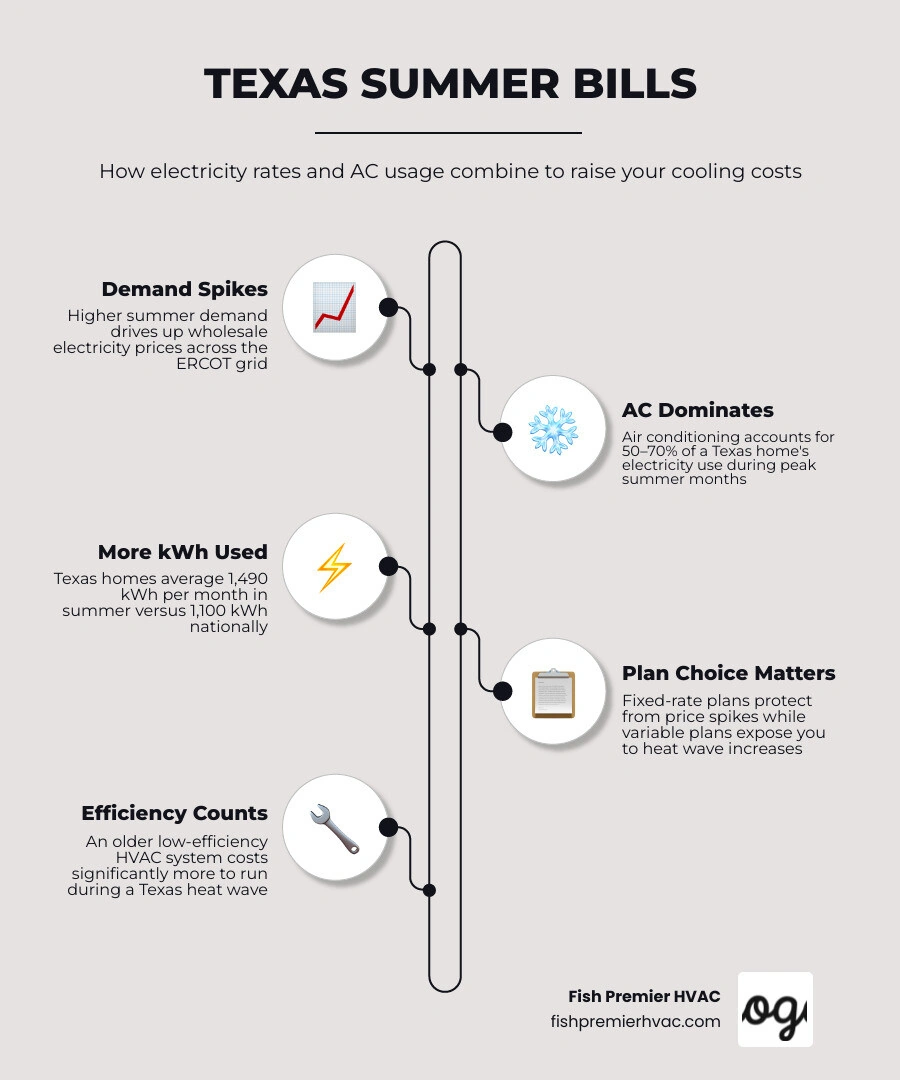
- Higher summer demand drives up wholesale electricity prices across the ERCOT grid.
- Air conditioning accounts for 50–70% of a Texas home's electricity use during peak summer months.
- Texas homes use far more electricity in summer — averaging around 1,490 kWh per month in June, July, and August, compared to roughly 1,100 kWh nationally.
- Your plan type matters — fixed-rate plans protect you from price spikes, while variable and prepaid plans can expose you to sharp cost increases during heat waves.
- HVAC efficiency directly shapes your bill — an older, low-efficiency system running during a Texas heat wave costs significantly more than a high-efficiency unit.
Every summer in Texas, the same thing happens: temperatures climb into triple digits, AC units run without a break, and electricity bills follow right behind. For homeowners in DFW's most established neighborhoods, that monthly bill can feel like a second mortgage — especially when your system is working harder than it should.
Texas operates its own unique electricity market, which means the rates you pay, the plan you choose, and the efficiency of your home comfort system all combine to determine what you actually owe each August. Understanding those connections puts you in control.
Understanding How Texas Electricity Rates Affect Your Cooling Costs
To truly master your home's energy budget, we must look at how the Texas power grid operates and how our regional consumption patterns compare to the rest of the country. As of June 2026, navigating this landscape requires a mix of market awareness and smart home management.
Average Texas Rates vs. National Averages
At first glance, Texas residential electricity rates look like a bargain. The average residential electricity rate in Texas sits at 16.11 cents per kWh, which is comfortably below the national average of 17.98 cents per kWh.
However, this lower rate is highly deceptive. Texas ranks among the highest states in the nation for residential electricity consumption per household. Because our summers are incredibly hot and prolonged, we consume massive amounts of power.
Additionally, Texas generates a substantial portion of its electricity from natural gas (roughly 40%). Because natural gas prices directly influence electricity generation costs, wholesale prices on the ERCOT grid can spike dramatically when demand surges. When millions of households in Keller, Westlake, Colleyville, and Southlake turn on their air conditioners simultaneously, the strain on the grid causes wholesale rates to climb, which ultimately impacts what retail providers charge.
Average Summer Utility Bills by Apartment and Home Size
Because of these unique market factors, the size of your living space and your choice of electricity plan play a massive role in your monthly expenses. Below is an overview of how average summer electricity usage scales across different property sizes in Texas during peak cooling months:
- Studio Apartments (under 500 sq. ft.): Typically consume 500 to 650 kWh per month.
- One-Bedroom Apartments (700–750 sq. ft.): Typically consume 700 to 900 kWh per month.
- Two-Bedroom Apartments: Typically consume 1,000 to 1,300 kWh per month.
- Three-Bedroom Apartments: Typically consume 1,300+ kWh per month.
- Typical DFW Single-Family Homes: Often average between 1,800 and 2,400+ kWh per month during July and August. Running a central air conditioner alone in a standard DFW home can easily account for a massive portion of the monthly power bill.
| Home Size / Type | Average Summer Monthly Usage (kWh) | Relative Cooling Load Impact |
|---|---|---|
| Studio Apartment | 500 – 650 kWh | Low (beneficial shared walls) |
| 1-Bedroom Apartment | 700 – 900 kWh | Moderate |
| 2-Bedroom Apartment | 1,000 – 1,300 kWh | Moderate to High |
| 3-Bedroom Apartment | 1,300+ kWh | High (especially top-floor units) |
| Standard DFW Home | 1,800 – 2,400+ kWh | Very High (requires optimal HVAC efficiency) |
Steps 1 to 4: Navigate Deregulation, Choose Plans, Track CDDs, and Decode the EFL
Managing how texas electricity rates affect your cooling costs comes down to four fundamental steps before we even look at physical HVAC hardware. By mastering the retail side of Texas power, you can shield your household from major pricing surprises.
How Texas Electricity Rates Affect Your Cooling Costs in a Deregulated Market
Texas electricity market deregulation, introduced for most of the state in 1999, means you have the power to choose your Retail Electric Provider (REP). Instead of being locked into a single monopoly utility, you can shop around for the best rates.
For renters and homeowners alike, deregulation is a double-edged sword. While it allows you to shop for competitive rates, it also means you must actively manage your contracts. Renters in places like Keller or Southlake often face a unique challenge: they have limited control over the building's insulation, window quality, or the efficiency of the pre-installed AC system. However, they still have full control over their electricity plan. Using comparison tools like the state's Power to Choose portal is essential, but you must know exactly what to look for to avoid plans designed to exploit high summer usage.
Comparing Fixed-Rate, Variable-Rate, and Prepaid Plans
The structure of your electricity contract is your primary defense against summer price volatility.
- Fixed-Rate Plans: These plans lock in your price per kWh for the duration of your contract (typically 12 to 36 months). For the vast majority of DFW residents, fixed-rate plans are the safest option because they provide total price stability. Even if ERCOT wholesale prices spike during a triple-digit August heat wave, your rate remains unchanged.
- Variable-Rate Plans: These plans allow your rate to fluctuate monthly based on market conditions. While they might offer lower rates during mild spring and fall shoulder seasons, they expose you to extreme pricing risks in July and August. We generally do not recommend these plans for summer months.
- Prepaid Plans: Also known as pay-as-you-go plans, these require you to load funds into an account that is depleted as you consume power. Prepaid plans typically run 2 to 5 cents higher per kWh than traditional fixed-rate plans. During peak summer, a balance that lasted weeks in April can disappear in just a few days, making prepaid plans an expensive option for high-usage households.
How Cooling Degree Days and July Heat Waves Spike kWh Usage
Your electricity bill is directly tied to the weather through a metric called Cooling Degree Days (CDDs). A CDD measures how much and for how long the outdoor air temperature remains above a baseline of 65°F.
For example, if the average temperature on a hot July day in Westlake is 95°F, that single day registers 30 CDDs. The higher the cumulative CDDs in a billing cycle, the longer your air conditioner must run to keep your home comfortable.
This thermal demand is why July and August bills dominate your annual energy spend. During these extreme months, ERCOT demand routinely breaks records. For example, ERCOT set a major July peak demand record of 80,148 MW on July 20, 2022, driven almost entirely by air conditioning loads across the state. When these heat waves strike, your home's daily kWh consumption can easily double or triple compared to spring.
Reading the Electricity Facts Label (EFL) to Avoid Hidden Fees
The most critical document in Texas energy shopping is the Electricity Facts Label (EFL). Every REP is required to provide one for every plan they offer.
Many providers design plans to look incredibly cheap at exactly 1,000 kWh of usage to rank highly on comparison websites. This is known as the "1,000 kWh illusion." These plans often feature conditional bill credits or steep tiered pricing. For example, a plan might offer a credit if your usage stays between 999 kWh and 1,500 kWh. However, if a July heat wave pushes your usage to 1,501 kWh, you lose that credit entirely, causing your effective rate to jump instantly.
When reading an EFL, always look for:
- Transmission and Distribution Utility (TDU) Charges: Wires companies like Oncor (which services the DFW metroplex) charge a monthly base fee plus a per-kWh delivery fee. Ensure these pass-through fees are factored into your calculations.
- Minimum Usage Fees: Some plans penalize you if you do not use a minimum amount of electricity (e.g., 1,000 kWh) during mild months.
- Tier Breakpoints: Understand exactly how your rate changes as your consumption scales from 500 kWh to 2,000+ kWh.
Step 5: Optimize Your Home and HVAC System for Maximum Efficiency
Once you have secured the right electricity plan, the final step to controlling your cooling costs is optimizing your physical home and cooling system.
Thermostat Strategies and Smart Technology
Your thermostat is the steering wheel of your energy bill. The U.S. Department of Energy recommends setting your thermostat to 78°F when you are at home during the summer, and raising it to 85°F when you are away. Every degree you raise your thermostat above 72°F can save you roughly 3% to 8% on your cooling costs.
To make these adjustments seamless, we highly recommend upgrading to smart technology. But Do Smart Thermostats Really Save Money? Yes, they typically save homeowners between 8% and 12% on summer cooling costs by automatically adjusting temperatures based on your daily schedule and real-time occupancy. For the best results in our climate, check out our guide on the Best Thermostat Settings for Energy Savings in Texas to balance luxury comfort with smart efficiency.
Additionally, always run ceiling fans in occupied rooms to create a wind-chill effect, which makes the air feel up to four degrees cooler than it actually is. Just remember to turn them off when you leave the room, as fans cool people, not spaces.
How Texas Electricity Rates Affect Your Cooling Costs Without High-Efficiency HVAC
If your air conditioning system is outdated, poorly maintained, or improperly sized, even the best electricity rate won't protect you from high bills. Running an inefficient cooling system during a hot Texas summer is like driving a luxury car with a massive fuel leak.
- The Power of SEER Ratings: The Seasonal Energy Efficiency Ratio (SEER) measures AC efficiency. Older systems in DFW homes are often rated at 10 to 14 SEER. Upgrading to a modern, high-efficiency system (which can range up to 20+ SEER) can significantly lower your cooling-related energy consumption. To see how your current system stacks up, read our analysis on whether your AC SEER Rating Costing You Money.
- The Value of Preventative Care: Neglecting your system causes its efficiency to degrade over time. Dust on coils, clogged filters, and low refrigerant levels force your compressor to work harder and run longer. We cannot emphasize enough the Benefits of Regular AC Maintenance in Texas to keep your energy draw as low as possible.
- Extending Equipment Life: Regular tune-ups do more than lower your monthly power bill; they protect your investment. Discover practical steps on How to Extend the Life of Your AC in Texas to avoid premature system failure during the hottest weeks of the year.
- Ductwork and Insulation: Many homes lose up to 20% to 30% of their conditioned air through leaks in their attic ductwork. Sealing these leaks and upgrading your attic insulation to R-38 or higher keeps the cool air inside your living space where it belongs.
- Proactive Summer Prep: Before the extreme heat hits, take a look at our comprehensive Summer Energy Saving Tips for DFW Homeowners. If you find yourself in the middle of an intense summer weather pattern, implement these proven strategies for Reducing Cooling Costs During Heat Waves.
Frequently Asked Questions About Texas Cooling Costs
When is the best time of year to lock in a fixed electricity rate in Texas?
The best time of year to lock in a fixed electricity rate is during the spring (March to May) or fall (September to November) shoulder seasons. During these months, moderate temperatures mean statewide demand for heating and cooling is at its lowest. Retail Electric Providers offer their most competitive rates during these low-demand windows. Avoid shopping for a new contract in July, August, or January, when extreme weather spikes wholesale market volatility and drives up advertised retail rates.
How can renters manage high summer cooling costs in Texas apartments?
Renters can significantly reduce their summer cooling bills by focusing on low-cost, high-impact habits:
- Block Direct Sunlight: Keep blinds, shades, or blackout curtains closed on south- and west-facing windows during the afternoon to block radiant heat.
- Seal Air Leaks: Use simple, removable draft stoppers at the base of exterior doors and apply temporary weatherstripping around drafty windows.
- Upgrade Lighting: Replace heat-emitting incandescent lightbulbs with cool-running LEDs.
- Leverage Smart Technology: Install a compatible smart thermostat (with landlord approval) or use a programmable unit to manage temperatures while away.
- Look into Rebates: Check out our guide on How to Apply for Energy Rebates in Texas to find tenant-applicable programs.
How do TDU delivery charges impact your total summer electric bill?
Transmission and Distribution Utility (TDU) charges are pass-through fees collected by the utility company that maintains the physical poles, wires, and meters in your area (such as Oncor in the Dallas-Fort Worth metroplex). These charges are approved by the Public Utility Commission of Texas and include a fixed monthly base charge (typically around $5.00 to $6.00) plus a per-kWh delivery fee (usually around 3.5 to 4.5 cents per kWh).
Because the delivery fee is charged on every single kilowatt-hour you consume, your TDU charges will naturally scale up during the summer alongside your increased AC usage. To learn more about how these local utility structures interact with efficiency programs, read our detailed breakdown of Oncor and Texas Energy Rebates for Homeowners.
Conclusion
Managing how texas electricity rates affect your cooling costs requires a combination of smart consumer choices and high-efficiency home comfort systems. By selecting the right fixed-rate plan, decoding your Electricity Facts Label, and optimizing your daily thermostat habits, you can keep your summer energy bills under control.
At Fish Premier HVAC, we believe that staying cool in the Dallas-Fort Worth area shouldn't require sacrificing your peace of mind or your home's luxury comfort. We specialize in providing concierge-level service and premium, high-efficiency heating and cooling installations for discerning homeowners across Keller, Westlake, Colleyville, and Southlake.
Whether you need a comprehensive system analysis, an upgrade to a premium high-efficiency AC, or advanced indoor air quality solutions like air scrubbers and home scenting, our expert team is ready to deliver. We operate Monday through Friday from 8:00 AM to 6:00 PM, and we are always available for after-hours emergency services to ensure your home remains a comfortable sanctuary all summer long.
Ready to experience whole-home luxury and ultimate cooling efficiency? Schedule premium HVAC services with Fish Premier HVAC today, or call our Fort Worth office (Texas License #TACLB99535E) to speak with a home comfort specialist.