%201.avif)
What to Expect During Your Whole Home Generator Installation
Discover whole home generator installation what to expect: from sizing and permits to step-by-step setup, testing, and maintenance for reliable power.


.svg)
.svg)
.svg)
What Whole Home Generator Installation Looks Like From Start to Finish
Whole home generator installation what to expect is a fair question — and the short answer is: a well-managed process that typically spans three to six weeks from your first consultation to the moment your system goes live.
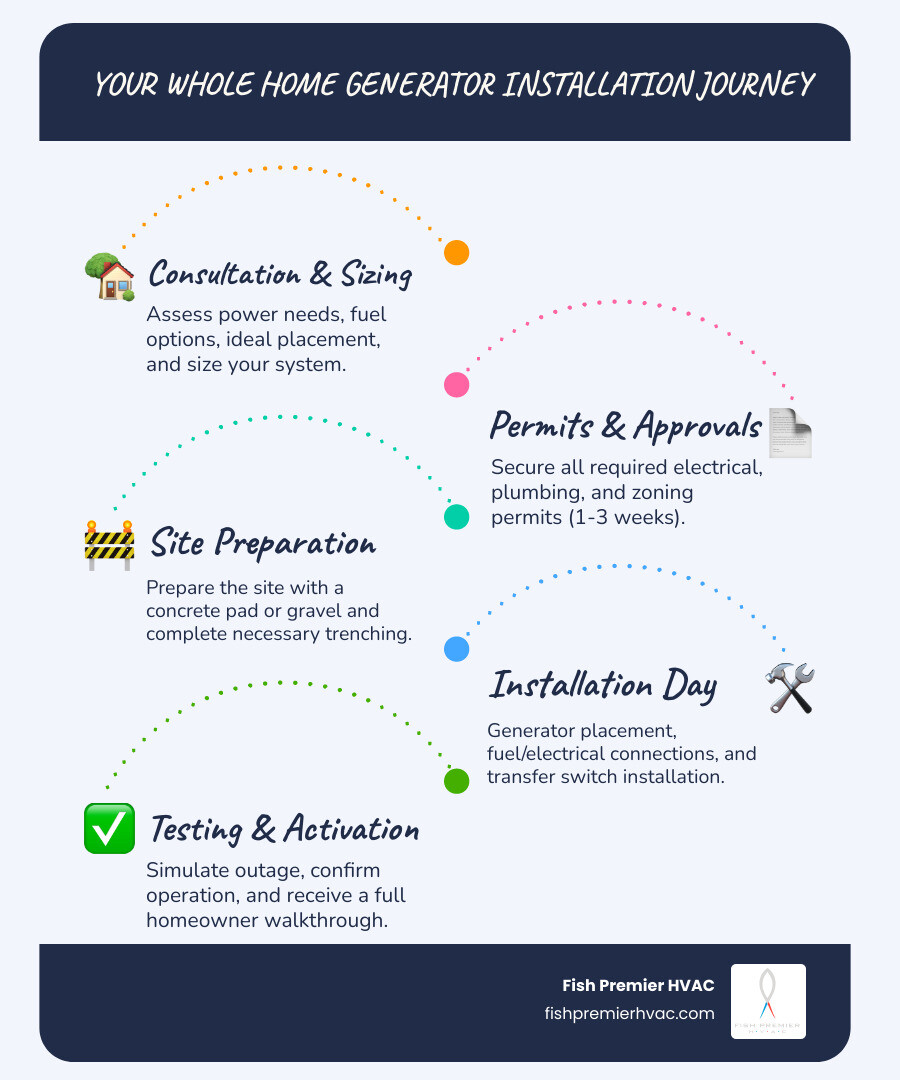
Here is a quick overview of what that process looks like:
- Initial Consultation - A technician visits your home to assess your power needs, fuel options, and ideal placement (1-2 hours)
- Sizing and Equipment Selection - Your system is sized based on your home's electrical load and the circuits you want covered
- Permits and Approvals - Your installer pulls the required electrical, plumbing, and zoning permits (this typically takes one to three weeks)
- Site Preparation - A concrete pad is poured or pea gravel is laid, and any trenching for fuel and electrical lines is completed (one to two days)
- Installation Day - The generator is placed, fuel lines are connected, the transfer switch is installed, and electrical connections are made (one full day)
- Final Testing and Activation - A simulated outage confirms automatic operation, and you receive a full homeowner walkthrough
Most homeowners are surprised by how little disruption the actual installation causes. Your power will only be off for a few hours during the transfer switch connection — and the rest of the work happens outside your home.
That said, the weeks leading up to installation day involve real coordination: permitting, utility work, site prep, and equipment logistics. Knowing what to expect at each stage makes the whole experience far smoother.
Choosing the Right System for Your Home
When we talk about Power Outage Protection in the Dallas-Fort Worth area, we aren't just talking about keeping a few lights on. We are talking about maintaining the luxury and comfort of your home during the most unpredictable North Texas weather. Whether it’s an ice storm in February 2026 or a summer grid strain, your generator is your first line of defense.
The first step in our concierge-level service is helping you select the Best Home Standby Generator Fort Worth TX for your specific property. This usually comes down to two primary fuel sources:
- Natural Gas: This is the most popular choice for homes in Keller and Southlake. It connects directly to your existing utility line, meaning you never have to worry about refueling. It’s a "set it and forget it" solution that offers incredible convenience.
- Liquid Propane (LP): If you live on a larger estate in Westlake or a property where natural gas isn't readily available, propane is a powerful alternative. It requires an on-site tank, which we can help coordinate. Propane is highly efficient and stores well for long periods.
For those looking for the ultimate in reliability, we often discuss high-efficiency units and dual-fuel options. Our goal at Fish Premier HVAC is to ensure that your Whole Home Generator Fort Worth TX provides seamless energy independence without compromising the aesthetic or quiet enjoyment of your home.
The Planning Phase: Sizing, Permits, and Regulations
Before a single shovel hits the dirt, a significant amount of "behind-the-scenes" work takes place. This is where our expertise in Generator Sizing Trophy Club comes into play. You don't want a generator that groans under the pressure of your HVAC system, nor do you want to pay for more capacity than you’ll ever use.
We perform a detailed load calculation. This involves looking at the peak power requirements of your home—especially those high-draw appliances like your air conditioner, refrigerator, and pool pumps. For example, a 1,500-square-foot home might only need a 15kW to 20kW unit, while a 2,500-square-foot luxury home in Southlake likely requires 20kW to 25kW to keep everything running smoothly.
Once we’ve nailed down the size, we handle the red tape. If you’ve ever tried to pull a permit in Keller or Southlake, you know it can be a bit of a maze. Our team manages:
- Electrical and Plumbing Permits: Required to ensure the high-voltage and fuel connections meet the National Electrical Code (NEC).
- Zoning Restrictions: Every municipality has rules about where a generator can sit.
- HOA Approvals: We know the local HOAs in Colleyville and Westlake. We provide the necessary documentation to ensure your installation meets community standards.
Essential vs. Whole-Home Coverage
| Coverage Type | What’s Included | Best For |
|---|---|---|
| Essential Circuit | Fridge, HVAC, select lights, home security | Homeowners on a budget who want safety first |
| Whole-Home | Every outlet, pool pumps, multiple AC units, electric ovens | Families who want zero lifestyle interruption |
By handling the Whole Home Generator Keller TX planning process for you, we ensure that your installation is legal, safe, and optimized for your home's unique footprint.
Whole home generator installation what to expect: Site Selection and Prep
Location is everything. When determining whole home generator installation what to expect regarding placement, we follow strict safety codes and manufacturer guidelines. We can’t just tuck it behind a bush and call it a day.
In Southlake and Westlake, where property aesthetics are paramount, we work with you to find a spot that is both functional and discreet. Key criteria include:
- The 5-Foot Rule: To prevent carbon monoxide from entering your home, the generator must sit at least five feet away from any windows, doors, or soffit vents.
- The 3-Foot Rule: It needs at least three feet of clearance from any flammable materials.
- Proximity to Meters: The closer the unit is to your electric meter and gas line, the more efficient (and cost-effective) the installation will be.
- Airflow Management: Generators need to breathe. We ensure there is plenty of open space for cooling and exhaust.
Once the site is selected, we prepare the foundation. This typically involves pouring a level concrete pad or using a heavy-duty composite pad on a bed of pea gravel. If fuel lines or electrical conduits need to be buried, we handle the trenching with care, ensuring your landscaping is respected. This site prep for your Whole Home Generator Southlake TX usually takes one to two days.
The Step-by-Step Installation Day Process
Installation day is when the magic happens. While the preparation takes weeks, the physical installation often takes just a few hours to a full day. You can expect a professional crew to arrive and begin the heavy lifting—literally.
Here is the breakdown of the day:
- Placement: We move the generator onto its pad. These units are heavy, so we use specialized equipment to ensure it’s set perfectly without damaging your lawn.
- Fuel Line Connection: A licensed plumber connects the unit to your natural gas or propane supply. We test every joint for leaks and ensure the pressure is exactly where it needs to be.
- Electrical Wiring: This is the most technical part of the Generator Installation Dallas Fort Worth Guide. We run conduits between the generator and your home’s main electrical panel.
- Grounding: We drive a grounding rod into the earth to provide a safe path for any electrical surges, protecting your sensitive home electronics.
During the electrical phase, we will need to shut off your home’s power for a few hours. We always coordinate this with you in advance so you can plan accordingly. For our Whole Home Generators Colleyville TX clients, we strive to make this window as short as possible.
Whole home generator installation what to expect: The Transfer Switch
The Automatic Transfer Switch (ATS) is the "brain" of the entire system. It’s a critical component that monitors the utility power coming into your home.
When the grid fails, the ATS detects the drop in voltage and sends a signal to the generator to start. Within seconds, it disconnects your home from the utility grid and connects it to the generator. This "break-before-make" connection is vital because it prevents "backfeeding"—a dangerous situation where your generator sends electricity back into the power lines, potentially harming utility workers. Having a properly installed Generator Transfer Switch Colonial Hills is non-negotiable for safety and code compliance.
Whole home generator installation what to expect: Final Testing and Activation
We don't just walk away once the last wire is tucked in. The final phase of whole home generator installation what to expect is the commissioning of the system. We perform a simulated outage by cutting the utility power to see how the system reacts.
We check the voltage, frequency, and response time. Once we are satisfied that the system is perfect, we sit down with you for a homeowner orientation. We’ll show you how to read the control panel, explain the indicator lights, and help you set up remote monitoring on your smartphone. This allows you to check your generator's status from anywhere in the world—giving you true peace of mind.
Ensuring Reliability with Professional Maintenance
A whole home generator is a long-term investment in your home’s resilience. Just like your car or your HVAC system, it requires regular care to ensure it’s ready to roar to life the moment the sky turns dark.
Most manufacturers recommend annual maintenance, and we provide a comprehensive Generator Maintenance Colonial Hills Guide to help our clients stay on track. Our maintenance visits include:
- Oil and Filter Changes: Fresh oil is essential for engine longevity.
- Battery Testing: If your Whole Home Generator Battery Keeps Dying, it’s often due to a lack of regular testing or an aging cell. We check the charge and connections every time.
- Spark Plug Inspection: Ensuring a clean, strong spark for reliable ignition.
- Fuel System Service: If a Generator Needs Fuel System Service, it can lead to rough running or failure to start. We clear lines and check regulators.
Your generator is also programmed to run a "self-test" cycle once a week. This 10-to-15-minute run ensures the oil stays circulated and the battery stays charged. It’s a small sound that brings a lot of comfort, knowing the system is standing guard.
Frequently Asked Questions about Generator Installation
How long does the physical installation take on my property?
While the entire project from permit to power-on takes 3 to 6 weeks, the actual crew will typically only be on your property for one to two days. The physical installation of the unit and the electrical connections usually wrap up in a single 8-hour shift, assuming no major site surprises.
Will my power be shut off during the installation process?
Yes, but only briefly. We have to disconnect your home from the grid to safely install the Automatic Transfer Switch. This usually results in a power outage of two to four hours. We’ll give you plenty of notice so you can save your work and keep the fridge closed!
Who is responsible for obtaining the necessary local permits?
When you work with Fish Premier HVAC, we take care of everything. We handle the applications for electrical, plumbing, and zoning permits with the local offices in Keller, Southlake, or Westlake. We also coordinate the final inspections required by the city to ensure your warranty remains valid and your home remains insured.
Conclusion
At Fish Premier HVAC, we believe that your home should be a sanctuary, regardless of what is happening with the Texas power grid. Our concierge-level service is designed to take the stress out of whole home generator installation what to expect, providing you with a seamless, "white-glove" experience from the first phone call to the final activation.
Whether you are looking for a Whole Home Generator Westlake TX or need a high-efficiency system in Colleyville, we are here to provide the luxury, comfort, and premium residential installation you deserve. Don't wait for the next storm to realize the value of energy independence.
Ready to secure your home? Schedule your whole-home generator consultation with Fish Premier HVAC today.