%201.avif)
Best Air Filtration Options for Your HVAC System: Survival Guide
Discover the best air filtration options for your HVAC system to boost indoor air quality and protect your home comfort.

.svg)
.svg)
.svg)
Why the Best Air Filtration Options for Your HVAC System Matter More Than You Think
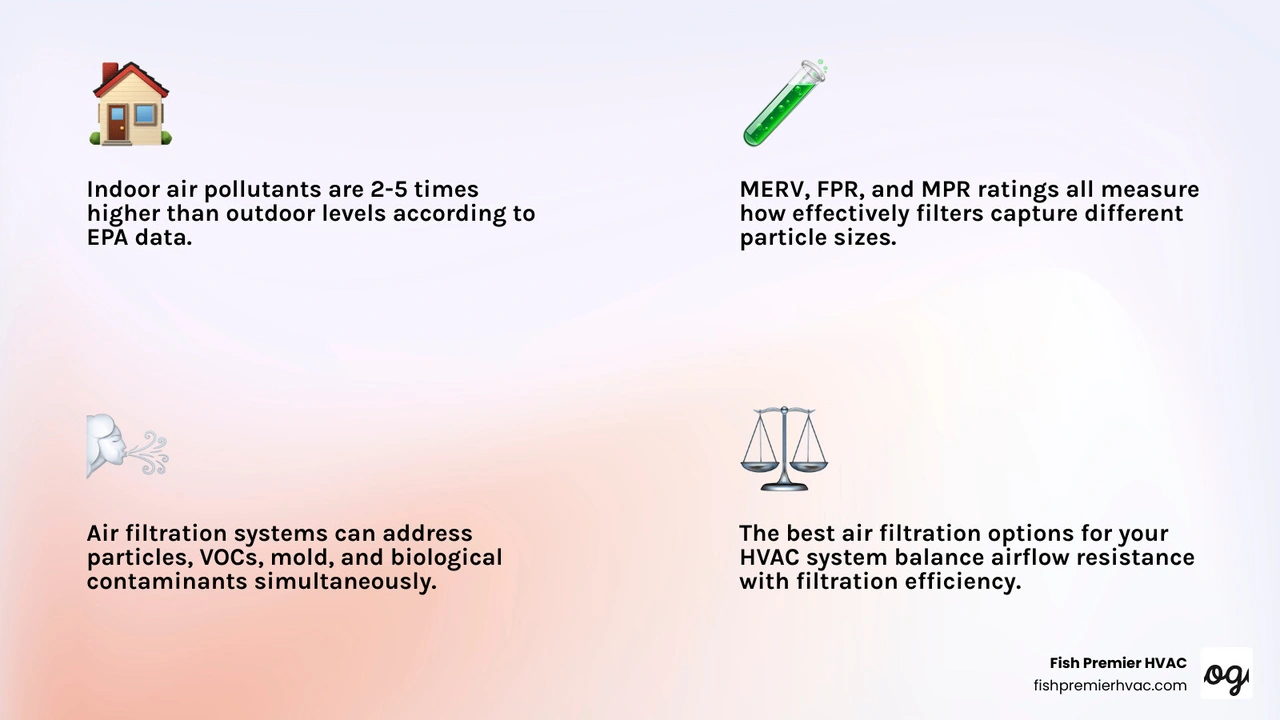
The best air filtration options for your HVAC system are not all created equal — and choosing the wrong one can quietly harm both your indoor air quality and your equipment. According to the EPA, concentrations of air pollutants inside a home can run two to five times higher than what you'd find outdoors. That means the air circulating through your vents every day may be carrying far more dust, allergens, mold spores, and chemical vapors than most homeowners realize.
Quick Answer: Best HVAC Air Filtration Options at a Glance
| Filtration Type | Best For | MERV Range | Key Limitation |
|---|---|---|---|
| Standard pleated filter | General dust and pollen | MERV 8-11 | Limited fine particle capture |
| High-efficiency pleated filter | Allergies, pet dander, smoke | MERV 13 | Requires compatible blower |
| 4-inch media filter | Long replacement cycles, high capacity | MERV 11-16 | Needs cabinet retrofit |
| In-duct UV-C purifier | Mold, bacteria, viruses on coils | N/A (germicidal) | Does not capture particles |
| PCO + carbon system | VOCs, odors, chemical gases | N/A (adsorption) | Best paired with mechanical filter |
| Whole-home HEPA unit | Maximum particle removal | HEPA (99.97%+) | Not compatible with most residential ductwork |
For most Dallas-Fort Worth homeowners, the answer is not a single product — it is a layered strategy. Your HVAC system runs through your entire home, which makes it the most powerful air quality tool you own. But only if it is equipped correctly.
The challenge is that filter ratings, technology types, and system compatibility rules can feel overwhelming fast. This guide breaks all of it down clearly, so you can make a confident, informed decision without risking damage to your system or overspending on technology you do not need.
Understanding Filter Ratings: MERV vs. FPR vs. MPR
When shopping for the best air filtration options for your HVAC system, the first hurdle is deciphering the alphabet soup of filter rating systems. You will encounter three primary rating scales on filter packaging: MERV, FPR, and MPR. Understanding how these compare is essential to selecting a filter that actually captures the microscopic particles in your home.
What is a MERV Rating?
MERV stands for Minimum Efficiency Reporting Value. Developed by the American Society of Heating, Refrigerating and Air-Conditioning Engineers (ASHRAE) under Standard 52.2, MERV is the industry-standard, globally recognized scale. It ranges from 1 to 20, measuring a filter's ability to capture particles between 0.3 and 10 microns.
- MERV 1–4: Typically basic fiberglass filters. They only catch large particles like sanding dust, carpet fibers, and lint. They do almost nothing for air quality and are only designed to keep large debris from damaging the fan motor.
- MERV 5–8: Standard pleated paper or polyester filters. These capture 80% to 95% of larger particles (3.0 to 10.0 microns), such as mold spores, hairspray, and dust mite debris.
- MERV 9–12: Mid-to-high efficiency filters. They remove 90% or more of particles down to 1.0 micron, including lead dust, humidifier dust, coal dust, and pet dander.
- MERV 13–16: High-efficiency residential and commercial filters. They capture up to 98% of particles down to 0.3 microns, including bacteria, smoke, sneeze droplets, and virus carriers.
- MERV 17–20: True HEPA-level filtration, rarely used in standard residential return grilles due to extreme airflow restriction.
What are MPR and FPR?
Because MERV is an open industry standard, major manufacturers and retailers developed proprietary scales to differentiate their products:
- MPR (Microparticle Performance Rating): Created by 3M for its Filtrete line. It measures a filter's ability to capture particles between 0.3 and 1.0 micron (the tiny particles that make up smoke, bacteria, and viruses).
- FPR (Filter Performance Rating): Developed by The Home Depot for the brands sold in its stores. It uses a 1-to-10 color-coded scale based on overall particle capture efficiency.
To help you navigate these marketing terms, look at how they align:
| MERV Rating (ASHRAE Standard) | MPR Rating (3M Filtrete) | FPR Rating (Home Depot) | Primary Target Pollutants |
|---|---|---|---|
| MERV 8 | 600 | 5 | Large dust, pollen, lint, dust mites |
| MERV 11 | 1000 to 1200 | 7 | Pet dander, mold spores, car emissions |
| MERV 13 | 1500 to 1900 | 9 to 10 | Bacteria, smoke, virus carriers, microscopic allergens |
| MERV 16 | 2800+ | N/A | Ultra-fine smoke, smog, tobacco smoke, coal dust |
The Role of Electrostatic Charges
High-quality pleated filters are often "electrostatically charged." During manufacturing, the synthetic fibers are given a permanent static charge. This charge acts like a magnet, pulling tiny airborne particles out of the airstream and trapping them in the fiber matrix without needing denser, more restrictive material.
However, in humid climates like North Texas, this electrostatic charge can degrade faster than expected. When the charge dissipates, the filter relies solely on mechanical trapping, which reduces its efficiency for sub-micron particles. If you notice persistent dust or allergy flare-ups before your filter is scheduled for replacement, it may be one of the Signs Your Home Needs Better Air Filtration.
Comparing the Best Air Filtration Options for Your HVAC System
Selecting the best air filtration options for your HVAC system requires looking beyond simple cardboard-framed filters. Modern indoor air quality (IAQ) science categorizes home air pollutants into three distinct families: particulates (dust, dander, pollen), gaseous contaminants (volatile organic compounds, or VOCs, cooking odors, chemical fumes), and biological pathogens (viruses, bacteria, mold spores).
Standard mechanical filters are excellent at capturing particulates, but they are entirely useless against gases and odors. Gaseous molecules are smaller than 0.01 micron, allowing them to pass effortlessly through even a MERV 16 filter. To address these, advanced filtration systems incorporate activated carbon or molecular gas-phase adsorption layers. Carbon filters use chemical adsorption to attract and lock away VOCs from household cleaners, paints, and new furnishings.
When designing a comprehensive system, combining mechanical filtration with active purification yields the best results. To understand how these systems protect your family, it is helpful to look at the broader Whole House Air Filtration Benefits for Homeowners and evaluate our professional Air Purification Services to customize a solution for your home.
Media Filters: The Best Air Filtration Options for Your HVAC System to Balance Airflow
If you want to upgrade your home’s air quality without installing complex electrical components, deep-seated media filters are the absolute gold standard.
1-Inch vs. 4-Inch Filters: The Surface Area Secret
Most standard homes are built with 1-inch return air grilles. While convenient, 1-inch pleated filters have a massive engineering limitation: a very small surface area.
When you increase a filter’s thickness to 4 inches (or even 5 inches), you are not just making it thicker; you are dramatically expanding its surface area through deep, accordion-style pleating. A typical 4-inch media filter has six to eight times more surface area than a standard 1-inch filter of the same length and width.
This massive surface area provides three major benefits:
- Lower Airflow Resistance: Because the air has a much larger surface area to pass through, a 4-inch MERV 13 filter actually places less strain on your blower motor than a 1-inch MERV 13 filter.
- Higher Dust-Holding Capacity: It can hold a tremendous amount of dust and debris before it begins to restrict system airflow.
- Extended Lifespan: While a 1-inch filter needs to be replaced every 30 to 90 days, a 4-inch media filter easily lasts 6 to 12 months before requiring a change.
To keep your system running smoothly, it is vital to know exactly When to Change Your HVAC Air Filter based on its thickness and your household's specific environment.
For homeowners in Keller, Westlake, Colleyville, and Southlake, selecting the right media is crucial. The combination of native Texas live oak pollen, regional clay dust, and summer humidity makes finding the Best AC Filter for North Texas Homes a top priority for protecting both respiratory health and high-end cooling systems.
Advanced Air Purifiers: UV-C, PCO, and HEPA Systems
For homes requiring clinical-grade air cleaning, mechanical filters can be paired with active, in-duct air purification technologies. These systems are installed directly into your existing ductwork to treat 100% of the air as it circulates.
1. Germicidal UV-C Lights
UV-C air treatment utilizes ultraviolet light at a specific germicidal wavelength (typically 253.7 nanometers) to disrupt the DNA and RNA of biological contaminants, preventing them from reproducing.
- Coil Irradiation: Installed directly over the indoor AC evaporator coil, these lamps run 24/7. They keep the damp, dark coil completely free of mold, mildew, and bacterial biofilms, which keeps your system running at peak energy efficiency.
- Airstream Disinfection: Installed in the supply or return ducts to neutralize airborne pathogens on the fly. In controlled laboratory testing, high-output UV lamps demonstrated a 99.99% reduction of molds (Penicillium citrinum and Aspergillus niger) on surfaces in just 4 hours, and up to 99.9999% reduction of bacteria like Staphylococcus epidermidis.
2. Photo-Catalytic Oxidation (PCO) and Active Air Scrubbers
PCO systems combine UV-C light with a titanium dioxide-coated catalyst. When the UV light hits the catalyst, it creates a reaction that releases hydro-peroxides and super-oxide ions into the air. These friendly oxidizers sweep through your home, actively breaking down volatile organic compounds (VOCs), chemical gases, and odors into harmless carbon dioxide and water molecules. Rather than waiting for pollutants to pass through a filter, these active systems neutralize them in the living space.
3. Whole-Home HEPA Bypass Systems
True HEPA filters are rated to capture 99.97% of particles as small as 0.3 microns. Because they are incredibly dense, installing a HEPA filter directly in a standard residential return duct would instantly choke your HVAC system's airflow, causing the evaporator coil to freeze and the compressor to fail.
To solve this, we install whole-home HEPA systems in a bypass configuration. A dedicated blower motor pulls a portion of the circulating air out of the main return duct, runs it through the HEPA filter at a safe, controlled rate, and delivers pristine, purified air back into the main stream. This provides the power of clinical HEPA filtration with zero added static pressure on your main HVAC blower.
If you are wondering whether these advanced upgrades are right for your property, take a moment to read our guide: Does Your Home Need an Air Purification System?.
System Compatibility: Protecting Your HVAC Investment
Before upgrading to a higher-MERV filter or adding an in-duct purifier, you must ensure your HVAC system can handle the modification. Modern, high-efficiency heating and cooling systems are engineered with incredibly precise airflow tolerances.
Understanding Static Pressure and Pressure Drop
Think of your HVAC blower motor like a heart, and your ductwork like arteries. The resistance to airflow within that system is called static pressure, measured in inches of water column (in. w.c.). Every filter introduces a "pressure drop" — a localized restriction that forces the blower motor to work harder to pull air through.
Standard residential systems are typically designed to handle a total external static pressure of 0.50 in. w.c. If you install a highly restrictive 1-inch MERV 13 filter on an older, single-stage blower motor, the static pressure can spike well above safe design limits. This leads to serious mechanical consequences:
- Reduced Airflow: Less air moving across your air conditioner's evaporator coil causes its temperature to drop below freezing, leading to a solid block of ice forming on the coil.
- Blower Motor Burnout: Standard permanent split capacitor (PSC) motors will run hotter and draw significantly more electricity, eventually burning out prematurely.
- Compressor Damage: Liquid refrigerant can flood back to your compressor because there wasn't enough warm air passing over the indoor coil to vaporize it, causing catastrophic compressor failure.
- Voided Warranties: Many major equipment manufacturers will deny warranty coverage for cracked heat exchangers or failed compressors if they find the damage was caused by chronic low airflow from an excessively restrictive, unapproved air filter.
How to Determine the Best Air Filtration Options for Your HVAC System Without Restricting Airflow
How do you achieve pristine indoor air quality without risking a system breakdown? The secret lies in proper system design and smart retrofits.
- Calculate the Filter Area-to-Airflow Ratio: As a professional rule of thumb, you need at least 2 square feet of filter face area for every 400 cubic feet per minute (CFM) of airflow (which is roughly equivalent to 1 ton of air conditioning capacity). If your filter slot is too small for your system's tonnage, even a MERV 8 filter can cause airflow issues.
- Eliminate Filter Bypass: Air will always take the path of least resistance. If your filter does not fit tightly inside its slot, or if the cabinet door is not sealed, dirty air will slide right around the edges. This is called filter bypass. It allows dust and hair to coat your indoor coil, drastically reducing efficiency and completely defeating the purpose of your high-quality filter.
- Upgrade to a Dedicated Media Cabinet: If your system currently uses 1-inch filters, have a professional install a dedicated 4-inch or 5-inch media filter cabinet directly into your return duct drop. Because of the deep pleats, you can safely run a MERV 11 to MERV 16 filter with a incredibly low pressure drop, protecting your equipment while maximizing particle capture.
- Leverage Variable-Speed Blowers: Modern HVAC systems equipped with variable-speed blower motors (ECM motors) can automatically adjust their speed to maintain constant airflow, even as a filter loads with dust. This makes them much more compatible with higher-efficiency filtration options.
Frequently Asked Questions About HVAC Air Filtration
What MERV rating is recommended for residential use?
For the vast majority of residential homes, a MERV 11 to MERV 13 filter is the ideal sweet spot. A MERV 11 filter provides excellent protection against common allergens, pet dander, and mold spores without restricting airflow in modern systems.
If anyone in your home suffers from asthma, severe allergies, or respiratory conditions, upgrading to a MERV 13 filter is highly recommended, as it is the minimum rating capable of capturing fine smoke particles, bacteria, and virus-carrying droplets.
Can a high-MERV filter damage my air conditioning system?
Yes, but only if the filter is too restrictive for your system's specific blower capacity or if the filter face area is too small. A 1-inch MERV 13 filter can easily restrict airflow enough to freeze coils on older, single-stage HVAC systems.
However, you can safely achieve high-MERV filtration by upgrading to a 4-inch deep media filter, which naturally boasts a much lower pressure drop due to its expanded surface area, or by installing a bypass HEPA system.
How often should UV-C bulbs be replaced in an HVAC system?
To maintain active germicidal effectiveness, UV-C bulbs should be replaced every 12 months. Although a UV lamp may continue to glow blue for several years, the germicidal UVC light wavelength degrades over time. After approximately 9,000 to 10,000 hours of continuous operation, the bulb no longer emits enough UV-C energy to effectively disable mold, bacteria, and viruses.
Conclusion
Elevating your home's indoor air quality requires a thoughtful balance between high-efficiency filtration and system safety. Whether you are looking to upgrade to deep-pleated media filters, integrate germicidal UV-C lamps, or install a clinical-grade bypass HEPA system, the key to success is professional analysis and precision installation.
At Fish Premier HVAC, we specialize in providing "Whole Home Luxury" and "Expert HVAC Service For Whole Home Comfort." Serving the premium residential communities of Keller, Westlake, Colleyville, and Southlake, TX, our concierge-level service ensures your home’s air is pure, fresh, and perfectly balanced. From high-efficiency heating and cooling systems to active air scrubbers, backup generators, and customized home scenting solutions, we tailor every installation to your lifestyle.
We are proud to be a top-rated provider in the Dallas-Fort Worth area. Our team operates under Texas License #TACLB99535E out of our Fort Worth, TX location. We are available during our standard business hours of Monday-Friday 8am-6pm, and we maintain prompt, after-hours emergency services to keep your family comfortable around the clock.
Ready to transform your indoor air into a pristine sanctuary? Contact us today to schedule a comprehensive air quality analysis or to book a professional whole-house air purifier installation in Keller, TX.