%201.avif)
How Does a Whole Home Air Filtration System Work?
Learn how does a whole home air filtration system work to deliver cleaner air throughout every room in your Dallas-Fort Worth home.

.svg)
.svg)
.svg)
Why Indoor Air Quality in Dallas-Fort Worth Demands More Than a Basic Filter
How does a whole home air filtration system work is one of the most important questions a DFW homeowner can ask — because the air inside your home may be far more harmful than what's outside.
According to the U.S. Environmental Protection Agency, indoor air pollutant concentrations are frequently two to five times higher than outdoor levels — and in some cases, up to 100 times worse. Americans spend more than 90% of their time indoors, which means the air quality inside your home has a direct, daily impact on your health and comfort.
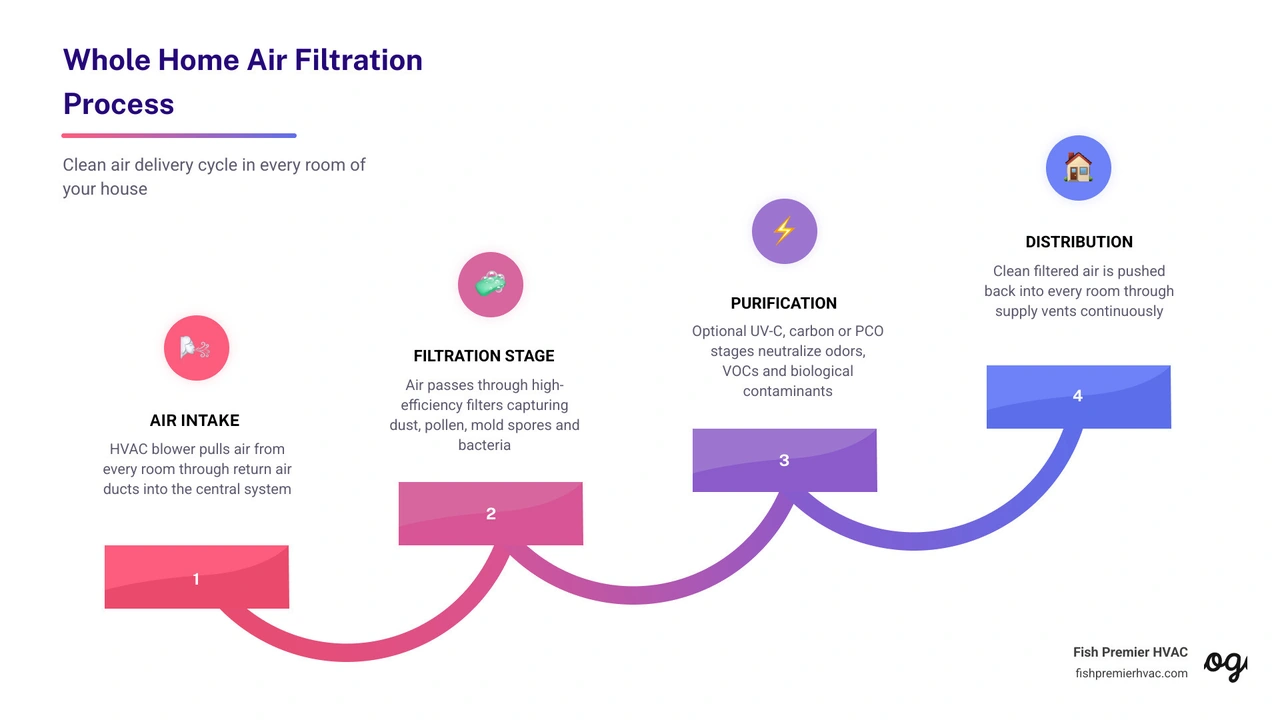
Here is a quick answer to how a whole home air filtration system works:
- Air is pulled in through your home's return air ducts as the HVAC system runs.
- It passes through a high-efficiency filter installed in the return air plenum or ductwork, trapping dust, pollen, pet dander, mold spores, bacteria, and other pollutants.
- Optional purification stages — such as UV-C lights, activated carbon, or photocatalytic oxidation — neutralize odors, VOCs, and biological contaminants.
- Clean, filtered air is pushed back through your supply vents into every room of the house.
- The cycle repeats continuously every time your HVAC system circulates air, cleaning your entire home rather than just one room.
For allergy sufferers, families with pets, or anyone living in a high-pollen area like the Dallas-Fort Worth metroplex, this whole-home approach delivers a level of air quality that a portable room purifier simply cannot match.
Understanding the science of air purification is the first step toward transforming your living space into a true sanctuary. If you are noticing persistent dust, lingering cooking odors, or seasonal allergy flare-ups indoors, it is a clear indicator that your home's current setup is falling short. To truly protect your family, you must evaluate whether your Indoor Air Quality Dallas strategy is sufficient for the unique climate challenges of North Texas.
What is a Whole House Air Filtration System vs. Portable Purifiers?
When homeowners begin researching ways to clean their indoor air, they often face a choice: do they buy a few portable, plug-in air purifiers for the bedrooms, or do they invest in a comprehensive, whole-house system?
To understand the difference, think of portable air purifiers like space heaters. A space heater is excellent for warming up a small, drafty corner of a room, but it cannot heat your entire home. Similarly, a portable air purifier only cleans the air in its immediate vicinity. Because air is constantly moving through your house as doors open, people walk by, and your central HVAC system runs, a portable unit simply cannot keep up with the continuous influx of new contaminants.
A whole-house air filtration system, on the other hand, acts as a centralized "built-in lung" for your entire property. It is integrated directly into your existing ductwork, meaning that every single cubic foot of air that passes through your heating and cooling system is scrubbed clean before it ever reaches your living spaces. This centralized approach guarantees uniform air quality, ensuring that the air in your master bedroom, downstairs living room, and upstairs playroom is equally pristine.
Additionally, portable purifiers come with several everyday annoyances:
- They take up valuable floor space.
- They generate localized white noise that can disrupt sleep or conversation.
- They require you to clean or replace multiple individual filters on different schedules.
- They struggle to address the root causes of home-wide dust and odor.
By choosing a system that integrates seamlessly with your central ductwork, you eliminate these localized issues while establishing a continuous, automated line of defense. If you are wondering whether your household would truly benefit from this level of protection, exploring whether your Does Home Need Air Purification System is a great place to start.
Understanding How Does a Whole Home Air Filtration System Work Compared to Portable Units
To truly appreciate the engineering behind whole-house filtration, we have to look at performance metrics. The industry standard for measuring the volume of clean air a system delivers is the Clean Air Delivery Rate (CADR). This rate measures how many cubic feet of clean air a system can produce per minute (CFM).
The contrast between localized filtration and whole-home systems is staggering:
- Standard 1-inch disposable filters typically have an incredibly low CADR of around 10. These basic filters are designed solely to protect your HVAC equipment's internal blower fan and coils from large dust bunnies; they do absolutely nothing to purify the air you breathe.
- Premium whole-home air cleaners (such as the advanced Trane CleanEffects system) can achieve an extraordinary CADR of up to 1,200. This means they can filter all the air in a standard-sized room multiple times an hour, delivering medical-grade purity to every corner of your home.
| Feature | Portable Air Purifiers | Whole-House Air Filtration Systems |
|---|---|---|
| Coverage Area | Single room or localized zone (typically 200–600 sq. ft.) | Entire home (every room connected to ductwork) |
| Aesthetic Impact | Visible floor units with cords | Completely hidden within HVAC ductwork |
| Noise Levels | Localized fan noise (often 35–55 dB in your living space) | Silent operation (only the gentle sound of central HVAC) |
| Maintenance | Multiple filters to change across various rooms | Single, high-capacity filter replaced once or twice a year |
| Odor & Gas Removal | Limited by small carbon filters | High-capacity carbon and PCO technologies handle whole-home |
| Equipment Lifespan | 2 to 5 years (consumer grade) | Long-lasting commercial-grade components integrated with HVAC |
This comparison highlights why luxury homeowners prefer integrated solutions. A whole-home system quietly and efficiently manages your entire indoor climate. For a detailed look at how these systems perform in our local climate, read our Whole House Air Purification Westlake Guide.
How Does a Whole Home Air Filtration System Work?

At its core, a whole-house air filtration system leverages your home’s existing forced-air heating and cooling infrastructure. Your HVAC system is already designed to cycle air throughout your home to maintain a comfortable temperature; a whole-house filtration system simply intercepts this moving air and purifies it during the cycle.
The process begins at the return air plenum or return ductwork. This is the pathway where "used" air from your living spaces is pulled back into your heating and cooling system to be re-conditioned. By installing the filtration system directly into this return line, just before the air handler or furnace, we ensure that 100% of the circulating air must pass through the purification media before it can touch your air conditioner's evaporator coils or be blown back into your home.
However, integrating a high-efficiency filter requires precise engineering. Every HVAC system is designed to operate within a specific range of static pressure — which is the resistance to airflow within the system. If a filter is too dense or poorly designed, it acts like a wall, restricting airflow and forcing the HVAC blower motor to work significantly harder. This can lead to:
- Reduced energy efficiency and higher utility bills.
- Frozen evaporator coils during the hot Texas summer.
- Premature motor burnout and expensive repairs.
To avoid these issues, premium whole-home systems utilize deep-pleated media filters (typically 4 to 5 inches thick) or electronic air cleaners. These designs provide a massive surface area, allowing them to capture microscopic particles without restricting airflow or compromising system efficiency. Sizing the system correctly to match your HVAC tonnage and CFM output is crucial, which is why choosing the Best AC Filter for North Texas Homes is a decision that requires professional expertise.
Step-by-Step Airflow and Filtration Process
To visualize exactly how does a whole home air filtration system work, let us follow a single cycle of air through the system step-by-step:
- Air Intake: Your thermostat calls for heating, cooling, or continuous fan operation. The powerful central blower motor turns on, creating a vacuum that draws air from your rooms into the return air grilles.
- Centralized Collection: This air, carrying dust, pet dander, pollen, and microscopic bioaerosols, travels through the return ducts and converges at the main return plenum.
- The Filtration Stage: The air is pushed through the whole-house purification system. Depending on your configuration, it may pass through a deep-pleated mechanical filter, an electronic charging section, or a germicidal UV light field.
- Targeted Neutralization: Microscopic particles are trapped in the physical fibers or bonded to collector plates. Meanwhile, any integrated carbon filters or photocatalytic oxidation (PCO) systems actively break down chemical odors and volatile organic compounds (VOCs) at a molecular level.
- Conditioning: The pristine, filtered air passes over your clean cooling coils or heating exchanger to reach the desired temperature.
- Even Distribution: The blower motor pushes the sanitized, comfortable air through your supply ductwork, distributing it evenly to every room in your home.
To maximize this process, we often recommend running your HVAC fan on the "ON" setting rather than "AUTO." This keeps the air circulating continuously at a low, energy-efficient speed, ensuring your air is constantly being purified even when the system isn't actively heating or cooling. If you suspect your current setup is letting too many particles slip through, it is highly likely your Home Needs Better Air Filtration to maintain a healthy indoor environment.
Core Technologies Behind Whole House Air Purifiers
Whole-house air purifiers are not one-size-fits-all. They employ a variety of advanced technologies to target different types of indoor pollutants, from large dust particles to microscopic viruses and chemical vapors.
- Mechanical Filtration (MERV and HEPA): Mechanical filters use physical, fibrous barriers to trap airborne particles. The efficiency of these filters is rated using the Minimum Efficiency Reporting Value (MERV) scale, which ranges from 1 to 16 for residential systems. While standard filters are MERV 1 to 4, high-efficiency media filters are typically rated MERV 11 to 16. True HEPA (High-Efficiency Particulate Air) filters are even more powerful, certified to capture 99.97% of particles as small as 0.3 microns.
- Electronic Air Cleaners & Ionizers: These systems use electrostatic precipitation. As particles enter the air cleaner, they pass through an electrical charging field that gives them a positive charge. These charged particles are then attracted to oppositely charged collector plates, much like iron filings to a magnet. This technology is incredibly effective at capturing ultra-fine particles without restricting airflow.
- Activated Carbon Filtration: Physical filters cannot trap gases, odors, or chemical vapors. To eliminate these molecular-sized pollutants, systems utilize activated carbon. Carbon undergoes a process that creates millions of microscopic pores, dramatically increasing its surface area. As air passes through, volatile organic compounds (VOCs) and odors are chemically bonded (adsorbed) to the carbon surface.
- UV-C Germicidal Lights: Ultraviolet light in the "C" band (specifically around 254 nanometers) is highly destructive to organic pathogens. Installed near your indoor AC coil or within the ductwork, UV-C lights penetrate the cell walls of mold spores, bacteria, and viruses, scrambling their DNA and rendering them completely harmless.
- Photocatalytic Oxidation (PCO) / Air Scrubbers: This advanced aerospace-grade technology combines UV-C light with a titanium dioxide-coated catalyst. When the light hits the catalyst, it creates friendly oxidizers (hydroperoxides and superoxides) that actively travel through your ductwork and living spaces, breaking down organic pollutants both in the air and on surfaces. To explore these advanced systems, take a look at the Best Air Scrubbers Colleyville.
How Does a Whole Home Air Filtration System Work with Different Filter Technologies?
To achieve the ultimate level of home comfort and air purity, the most advanced systems do not rely on just one technology — they combine them. By layering different filtration methods, a whole-house system can target all three classes of indoor air contaminants: particulates, biological pathogens, and chemical gases.
For instance, a premium hybrid system might first pass air through a high-efficiency MERV 13 to 16 media filter to catch large dust, pet hair, and pollen. Next, the air passes through an activated carbon layer to strip out chemical odors from cooking, painting, or new carpets. Finally, a UV-C germicidal lamp or PCO air scrubber sanitizes the air, neutralizing airborne viruses, flu droplets, and mold spores before the air is redistributed.
This multi-stage approach ensures that your home's air is not just filtered, but truly sanitized. For homeowners seeking the absolute highest standard of indoor air quality, learning more about Who Installs the Best Air Scrubbers for Residential Properties in Colleyville can guide you toward a system that offers complete, medical-grade protection.
Benefits of Whole-Home Air Filtration for Allergy and Asthma Sufferers
For the millions of Americans who suffer from chronic respiratory conditions, seasonal allergies, or asthma, a whole-house air filtration system is not a luxury — it is a life-changing investment. According to medical studies, even small reductions in indoor particulate matter (such as PM2.5, which are fine particles smaller than 2.5 microns) can lead to significant improvements in cardiovascular and respiratory health.
In the Dallas-Fort Worth metroplex, seasonal allergens like oak pollen, ragweed, and mountain cedar can make outdoor life uncomfortable for months out of the year. When you run a whole-house system, your home becomes a true safe haven. Because these systems filter 100% of the air passing through your ducts, they rapidly reduce the concentration of common triggers like:
- Pollen and mold spores carried in from outdoors.
- Pet dander and saliva proteins that cling to carpets and furniture.
- Dust mite allergens that thrive in bedding and upholstery.
- Microscopic smoke particles from cooking or nearby fireplaces.
Beyond the immediate health benefits for your family, high-efficiency filtration also provides vital protection for your HVAC system. By trapping dust and debris before it can settle on your air conditioner's delicate evaporator coils, a whole-house filter maintains optimal heat transfer and prevents dust buildup. This keeps your system running at peak energy efficiency, lowers your monthly utility bills, and can add years to the lifespan of your heating and cooling equipment. To explore options tailored specifically for North Texas homes, see our guide on Whole House Air Filtration Fort Worth TX.
Frequently Asked Questions About Whole Home Air Quality
How often do whole-house filters need to be replaced?
Unlike standard 1-inch filters that must be replaced every 30 to 90 days, high-capacity whole-house media filters are designed to last between 6 and 12 months. Because they are 4 to 5 inches thick and feature deep pleating, they have a massive holding capacity for dust and debris. In some advanced systems, commercial-grade HEPA filters can last up to 5 or 6 years before requiring replacement.
However, filter lifespan always depends on factors like pet ownership, indoor smoking, and how often your system runs. To make sure you are maintaining optimal performance, it is helpful to understand How Often Should You Change Your AC Filter in Texas and keep an eye out for the common Signs Your AC Filter Needs Changing.
Can a Whole House System Eliminate Odors and VOCs?
Yes, but only if the system is equipped with the right technology. Standard mechanical filters (even high-efficiency MERV 16 or HEPA filters) are designed to capture solid particles; they cannot trap gas molecules. To eliminate stubborn odors and chemical pollutants, your system must include an activated carbon filter or a photocatalytic oxidation (PCO) system.
These technologies are highly effective at neutralizing:
- Volatile Organic Compounds (VOCs): Harmful chemical vapors emitted by paints, cleaning products, cosmetics, and new furniture.
- Cooking Odors: Lingering smells from fish, spices, or burnt food.
- Pet Odors: Stubborn smells associated with litter boxes, wet dogs, or pet accidents.
- Tobacco or Wildfire Smoke: Microscopic chemical compounds that carry strong odors.
By chemically bonding these gases to activated carbon or breaking them down into harmless water vapor and carbon dioxide using PCO light catalysts, a whole-house system keeps your home smelling incredibly fresh. If you are concerned about invisible chemical pollutants in your home, scheduling a professional Air Quality Testing Colleyville session can provide clear answers and a customized path forward.
Do Whole House Air Purifiers Reduce Dust?
One of the most immediate, visible benefits of installing a whole-house air filtration system is a dramatic reduction in household dust. Dust is a complex mixture of shed skin cells, pet dander, outdoor soil, pollen, and microscopic fibers from clothing and carpets. When these particles remain airborne, they eventually settle on your countertops, shelves, and electronic devices, requiring constant cleaning.
Because a whole-house system circulates and filters your home’s entire air volume multiple times an hour, it captures these dusty particles while they are still suspended in the air. This means:
- You will notice a significant decrease in the amount of dust settling on your furniture.
- Your home will stay cleaner for much longer between dustings.
- Your HVAC system's internal coils will remain free of insulating dust layers, preventing system strain.
Conversely, neglecting your filtration needs can lead to a rapid decline in both air quality and system performance. To understand the risks of poor filtration, read about What Happens If You Don't Change Your AC Filter to protect your home and your investment.
Experience Concierge-Level Comfort with Fish Premier HVAC
Improving your home's air quality is a journey that requires technical expertise, premium equipment, and a commitment to detail. At Fish Premier HVAC, we specialize in delivering "Whole Home Luxury" and "Expert HVAC Service For Whole Home Comfort" to homeowners across the Dallas-Fort Worth area.
As a premier residential HVAC provider, we go far beyond standard heating and cooling. Our luxury service portfolio features high-efficiency HVAC systems, advanced air scrubbers, backup generators, and custom home scenting solutions. Whether you reside in Keller, Westlake, Colleyville, or Southlake, our concierge-level service ensures your home remains a perfectly climate-controlled, pristine sanctuary.
We operate under Texas License #TACLB99535E with convenient business hours from Monday to Friday, 8am to 6pm, alongside prompt after-hours emergency services to ensure your family's comfort is never compromised. Our highly trained technicians are known for their exceptional customer service, very prompt response times, and thorough diagnostic analysis.
Ready to transform your indoor living environment with June 2026's leading air purification standards? Contact us today to schedule your indoor air quality consultation and explore our premium Whole House Air Purifier Keller TX solutions. Let us help you breathe easier, live healthier, and enjoy the ultimate in home comfort.