%201.avif)
How to Help Your AC During a Texas Heat Wave in 5 Easy DFW Steps
Keep your AC running strong during a Texas heat wave with expert tips on thermostat settings, maintenance, and reducing system strain in DFW.

.svg)
.svg)
.svg)
When Texas Heat Hits Hard, Your AC Needs Your Help
Knowing how to help your AC during a Texas heat wave could be the difference between a cool home and a costly breakdown on the hottest day of the year. In the Dallas-Fort Worth area, summer temperatures routinely push past 100°F for weeks at a time — and your air conditioner is working harder than it was ever designed to handle.
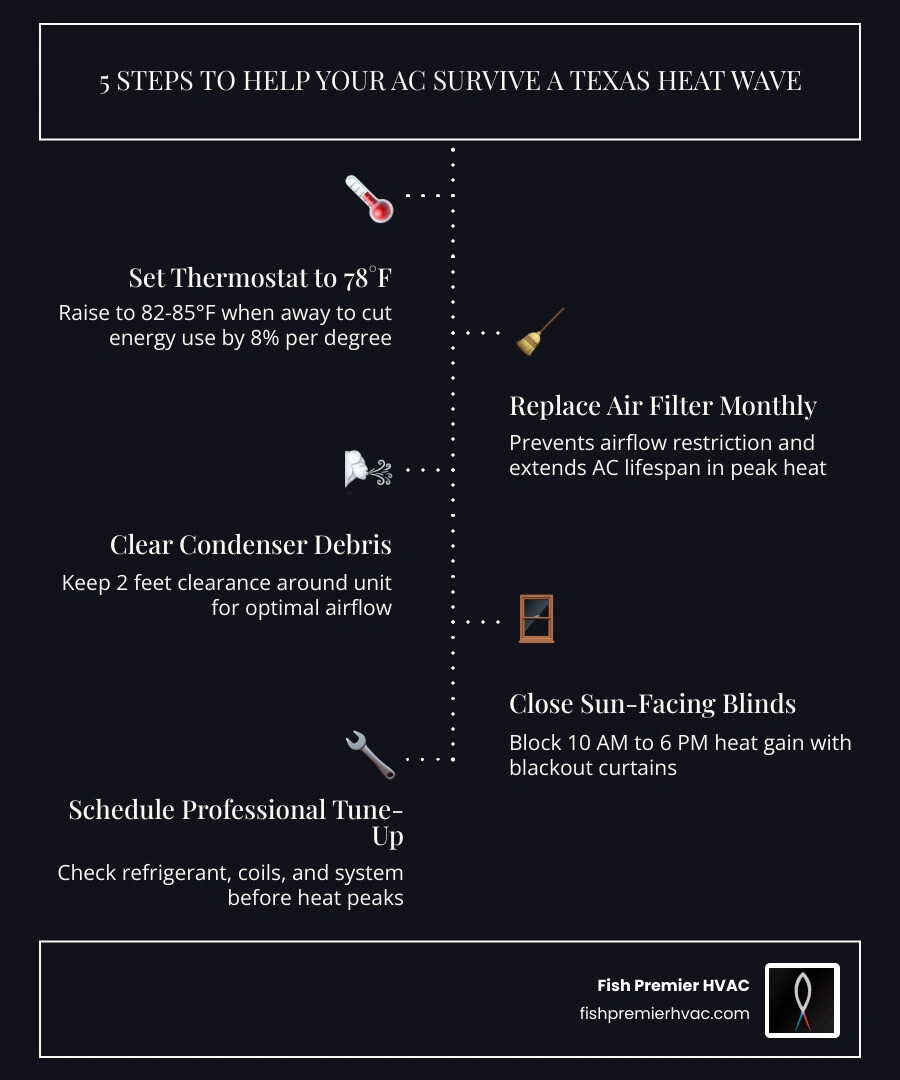
Here are five key ways to protect your AC during a Texas heat wave:
1. Set your thermostat to 78°F when you're home and raise it 7-10 degrees when you leave
2. Replace your air filter monthly during peak summer heat
3. Clear debris and maintain 2 feet of clearance around your outdoor condenser unit
4. Close blinds on sun-facing windows between 10 AM and 6 PM to reduce heat gain
5. Schedule a professional tune-up before the hottest months arrive
Most residential AC systems are built to maintain roughly a 20-degree difference between indoor and outdoor temperatures. When the mercury climbs to 105°F or higher — which is increasingly common across DFW — your system hits its limits fast. According to energy data, AC use already accounts for nearly 60% of residential electricity during Texas summer peak hours, and that number climbs sharply as temperatures rise.
The good news? A few smart habits and proactive maintenance steps can dramatically reduce the strain on your system, extend its lifespan, and keep your home genuinely comfortable — not just barely tolerable.
Optimize Your Thermostat Settings for Efficiency
In May 2026, as we look at the projected temperatures for the coming months in Keller and Southlake, the first line of defense is your thermostat. While it is tempting to set the dial to 68°F when you walk in from a sweltering afternoon, this is one of the most taxing things you can do to your system.
The Department of Energy and local experts agree: 78°F is the "sweet spot" for balancing comfort with system longevity. It might sound warm, but when paired with ceiling fans, it feels significantly cooler. It’s important to understand How Heat Waves Affect AC Efficiency. For every degree you set the thermostat below 78°F, your energy usage can increase by about 8%.
The Danger of "Heat Soak"
A common mistake DFW homeowners make is turning the AC completely off when they leave for work. In our climate, this leads to "heat soak." This is when the actual building materials of your home—the studs, drywall, and furniture—absorb the 100-degree heat. When you return and flip the AC on, the unit has to work for hours just to remove the heat from the walls before it can even begin to cool the air.
Instead, use a 7–10 degree setback. Setting your thermostat to 85°F while you are away can save you up to 10% on your cooling bill and prevents the system from having to "climb a mountain" when you get home. Smart thermostats are excellent for this, as they can use geofencing to begin cooling the home just as you leave the office. If you want your system to last through many more summers, following these settings is a great way to How to Extend the Life of Your AC in Texas.
Essential Maintenance: How to Help Your AC During a Texas Heat Wave
Your outdoor condenser unit is the unsung hero of your home. Its job is to exhaust the heat from inside your house into the outside air. However, when it is 105°F in Westlake, that heat exchange becomes incredibly difficult.
To provide the best how to help your ac during a texas heat wave support, you must ensure the outdoor unit has room to breathe. We recommend a minimum of 2 feet of clearance on all sides. Overgrown shrubs, tall grass, or decorative fences can trap hot air around the unit, forcing the compressor to work harder and hotter, which often leads to catastrophic failure.
Professional Intervention
While clearing leaves and rinsing loose dust off the coils with a garden hose (gently!) is a great DIY step, some things require a concierge-level touch. During a professional tune-up, we check refrigerant levels and electrical connections that can loosen due to the vibration of constant summer running. AC Problems Found During Tune-Ups often include small issues like a failing capacitor that, if left alone, would cause a total shutdown during a July weekend. Proper care is the only way to truly How to Maintain Your AC in Extreme Heat.
Maintaining Airflow: How to Help Your AC During a Texas Heat Wave with Filter Changes
If there is one "magic pill" for AC health, it is the air filter. In the DFW area, our air can be dusty, and during the peak of summer, your AC is moving a massive volume of that air. We recommend changing your filter every 30 days during a heat wave.
A clogged filter restricts airflow. When airflow is restricted, the evaporator coil inside your home can actually drop below freezing, causing the system to "ice up." This is a primary reason for When to Change Your HVAC Air Filter. If you have pets or live near new construction in Colleyville, your filter may even need a check every three weeks. Using a high-quality filter helps, but don't go too high on the MERV rating without checking your system's specifications, as overly restrictive filters can actually cause the same strain as a dirty one.
Recognizing Warning Signs: How to Help Your AC During a Texas Heat Wave Before Failure
Your AC will often try to tell you it’s struggling before it finally gives up the ghost. Being proactive means listening to those warnings.
• Warm Air: If you feel the vents and find the AC Blowing Warm Air, you may have a refrigerant leak or a failed compressor.
• Strange Noises: Squealing, grinding, or loud banging are never good signs. If you hear the AC Making Strange Sounds, turn it off immediately to prevent further damage.
• Rapid Cycling: If your AC Keeps Shutting Off or you wonder Why Does My AC Short Cycle, it could be overheating or reacting to a clogged drain line.
• Constant Running: While it is normal for an AC to run most of the day when it's 105°F, if the temperature inside is rising while the unit is running, you have an AC Running But Not Cooling situation that needs professional analysis.
Reduce Indoor Heat Gain and System Strain
Sometimes, the best way how to help your ac during a texas heat wave is to stop the heat from getting inside in the first place. Your AC is essentially in a race against the sun; the less heat the sun moves into your home, the less work your AC has to do.
• Windows — Impact on Home: Up to 30% of unwanted heat gain — Mitigation Strategy: Blackout curtains or reflective film
• Attic — Impact on Home: Can reach 150°F in Texas — Mitigation Strategy: Proper insulation and solar fans
• Appliances — Impact on Home: Adds significant latent heat — Mitigation Strategy: Run dryer/dishwasher after 9 PM
• Lighting — Impact on Home: Incandescent bulbs act as small heaters — Mitigation Strategy: Switch to LED lighting
The Power of Shade
Windows are the biggest "leaks" in your home's thermal envelope. Closing blackout curtains during peak hours (10 AM to 6 PM) can reduce solar heat gain by up to 77%. This is a crucial strategy for When Your AC Can't Keep Up With the Heat.
Additionally, check your ceiling fans. In the summer, they should rotate counter-clockwise to push a breeze directly down. This doesn't lower the room temperature, but it creates a wind-chill effect on your skin, making 78°F feel like 72°F. Just remember: fans cool people, not rooms. Turn them off when you leave the room to save energy.
Frequently Asked Questions
What is the best temperature for my AC during a Texas summer?
The Department of Energy recommends 78°F when you are at home. This provides a balance between staying cool and preventing the system from running 24/7 without a break. In Texas, where humidity is a factor, this temperature also allows the system to run long enough cycles to effectively pull moisture out of the air without freezing the coils.
Should I turn my AC off when I leave my DFW home?
No. Turning the system completely off allows the internal temperature of your home's structure to rise too high. Instead, set the thermostat to 82°F or 85°F. This keeps the humidity under control and ensures that your AC can bring the temperature back down to a comfortable level within an hour or two of your return, rather than struggling all night.
How does high humidity affect my AC's performance?
Texas humidity is a heavy load. A central AC system can pull 5 to 20 gallons of water out of the air on a typical July day in the DFW area. This is known as "latent heat" removal. If your system is struggling with humidity, you may notice Late Summer AC Performance Issues. High-efficiency systems with variable-speed compressors are much better at humidity control because they can run longer, lower-intensity cycles specifically designed to dehumidify the air.
Conclusion: Luxury Comfort for the Texas Heat
Surviving a Texas summer requires more than just a working air conditioner; it requires a system that is optimized for the unique challenges of the DFW climate. By following these five steps—optimizing your thermostat, maintaining your unit, changing filters, recognizing warning signs, and reducing indoor heat gain—you can protect your investment and your comfort.
At Fish Premier HVAC, we specialize in concierge-level service for homeowners who demand the best. From high-efficiency system installations in Keller to advanced air scrubbers and home scenting in Westlake, we provide the "Whole Home Luxury" experience. If your system is struggling to keep up with the current heat wave, don't wait for a total failure. We offer very prompt service and expert analysis to ensure your home remains a cool sanctuary.
Ready to experience Expert Air Conditioning Solutions? Contact us today at Fish Premier HVAC for a premium maintenance check or a consultation on a new high-efficiency system. Let us handle the heat so you can enjoy the summer.