%201.avif)
Smart Thermostat vs Programmable Thermostat: In-Depth Guide
Compare smart thermostat vs programmable thermostat comparison to choose the best climate control upgrade for your home.

.svg)
.svg)
.svg)
Is a Smart Thermostat Worth It? A Quick Answer Before We Dive In
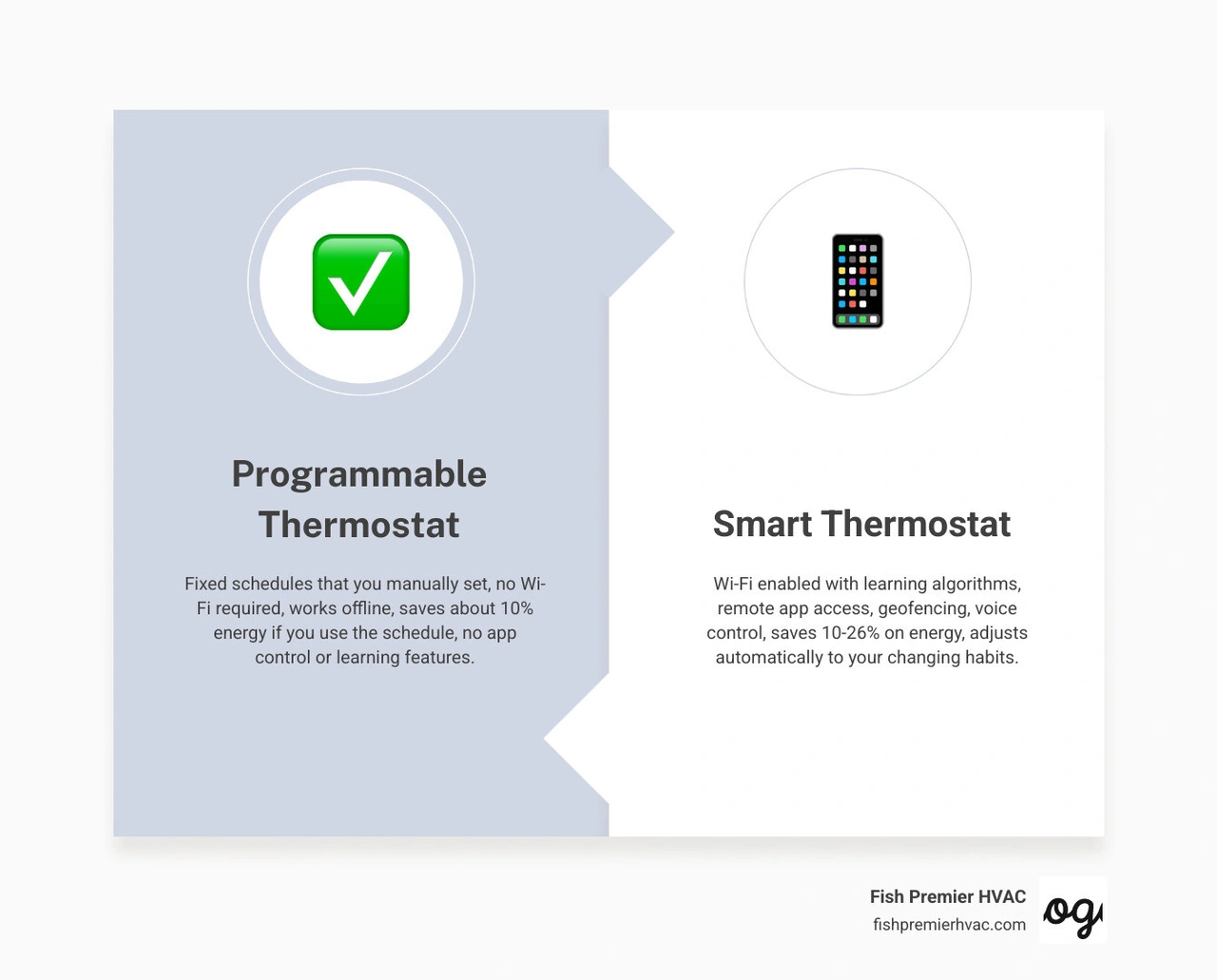
When making a smart thermostat vs programmable thermostat comparison, the core difference comes down to this: programmable thermostats follow a fixed schedule you set manually, while smart thermostats connect to Wi-Fi, learn your habits, and adjust automatically — even when your plans change.
Here is a quick side-by-side to help you decide at a glance:
| Feature | Programmable Thermostat | Smart Thermostat |
|---|---|---|
| Remote control via app | No | Yes |
| Wi-Fi connectivity | No | Yes |
| Learning algorithms | No | Yes (on most models) |
| Geofencing | No | Yes |
| Voice assistant support | No | Yes |
| Works without internet | Yes | Yes (limited) |
| Typical energy savings | ~10% | 10–26% |
| Best for | Consistent schedules | Variable or busy lifestyles |
Both types beat a basic manual thermostat for energy savings. But the right choice depends on how you live in your home — and how much control you actually want.
Choosing the right thermostat is one of the simplest upgrades a homeowner can make to improve comfort and cut energy waste. Yet it is also one of the most misunderstood. A programmable thermostat can trim heating and cooling costs by around 10% — but only if you actually use the scheduling features. According to a 2025 Consumer Reports survey, roughly 29% of programmable thermostat owners never set up a schedule at all, which means they are getting none of the savings the device was designed to deliver.
Smart thermostats solve that problem by doing much of the work for you. Energy Star-certified smart models save an average of 8% on overall utility bills, with some achieving up to 26% in heating and cooling savings depending on your home, habits, and climate. In a place like the Dallas-Fort Worth area — where summers push HVAC systems to their limits for months at a time — that difference adds up quickly.
This guide walks you through everything you need to know: how each thermostat type works, what features actually matter, and which option fits your home and lifestyle best.
Discover more about smart thermostat vs programmable thermostat comparison:
- best thermostat settings for energy savings in texas
- do smart thermostats really save money
- how smart home technology improves hvac performance
Understanding the Basics: How Each Thermostat Works
At their core, both programmable and smart thermostats act as the central command center for your heating and cooling systems. They monitor the ambient indoor temperature and signal your HVAC system to turn on or off based on your desired comfort level. However, the technology they use to achieve this comfort—and the level of convenience they offer—differs dramatically.
To understand which system is right for your home, it helps to look at the foundational components that govern modern climate control:
- Manual Override: Both systems allow you to temporarily bypass your programmed settings if you feel too hot or cold. With a programmable thermostat, you physically press buttons on the wall unit. With a smart thermostat, you can do this on the wall, through a voice command, or via an app on your smartphone from anywhere in the world.
- Digital Sensors: Modern thermostats use highly accurate digital solid-state sensors rather than the old physical bimetallic strips of manual units. This ensures your HVAC system responds to temperature fluctuations within a fraction of a degree.
- Wi-Fi Connectivity: This is the dividing line. Programmable thermostats are entirely local, self-contained devices. Smart thermostats connect to your home’s wireless network, opening up a world of cloud-based features, remote management, and real-time data sharing.
- Scheduling Features: Both options allow you to establish target temperatures for different times of the day, but how those schedules are built, adjusted, and optimized is night and day.
What Is a Programmable Thermostat?
A programmable thermostat is a digital device that allows you to pre-program temperature schedules based on the time of day and the day of the week. Once programmed, it automatically adjusts the temperature according to that fixed schedule without requiring any manual intervention.
These devices typically come in a few standard scheduling configurations:
- 7-Day Models: These offer the most flexibility, allowing you to set a unique schedule for every single day of the week.
- 5-2 Models: These let you set one schedule for weekdays (Monday through Friday) and a separate schedule for the weekend (Saturday and Sunday).
- 5-1-1 Models: These are similar to 5-2 models but allow you to program different schedules for Saturday and Sunday individually.
The primary limitation of a programmable thermostat is that it is rigid. It acts like a digital alarm clock; it knows what time it is, and it executes its instructions precisely. If you leave for work early, stay home sick, or go on an unexpected vacation, the thermostat will blindly stick to its program unless you physically walk up to the wall and press the manual override buttons.
To maximize efficiency with these units, homeowners must carefully plan their schedules. For a detailed breakdown of how to structure these routines in our hot Southern climate, check out our guide on the Best Thermostat Settings for Energy Savings in Texas.
What Is a Smart Thermostat?
A smart thermostat is a Wi-Fi-enabled climate control system that offers advanced automation, remote access, and adaptive learning capabilities. Instead of relying solely on a fixed schedule that you must input manually, a smart thermostat connects to an app on your smartphone or tablet, allowing you to control your home's temperature from anywhere.
What truly elevates a smart thermostat to "smart" status, however, is its ability to make autonomous decisions to improve comfort and save energy:
- Learning Algorithms: Some premium smart thermostats monitor your manual adjustments over the course of a week or two. If you consistently turn the temperature down to 72 degrees at 10 PM, the device learns this pattern and begins doing it for you automatically.
- Geofencing: By establishing a virtual boundary around your home using your phone's GPS, a smart thermostat can detect when you cross that boundary. When you leave for work, it automatically lowers the heating or raises the cooling to save energy. As you cross the boundary on your way back, it kicks on to ensure your home is perfectly comfortable the moment you walk through the door.
- Occupancy Sensing: Built-in motion and proximity sensors on the thermostat—and on optional remote sensors placed in other rooms—can detect physical activity. If the house is empty on a Tuesday afternoon when you are normally home, the system will temporarily switch to an energy-saving "away" mode.
By continuously analyzing data, these systems optimize your heating and cooling cycles to match your actual daily life. To see how these advancements translate to system longevity and reliability, read about How Smart Home Technology Improves HVAC Performance.
The Smart Thermostat vs Programmable Thermostat Comparison: Key Differences
When evaluating a smart thermostat vs programmable thermostat comparison, it is clear that while both aim to keep your home comfortable, they do so through entirely different user experiences.
Here is a comprehensive breakdown of how these two technologies stack up across key categories:
| Feature/Capability | Programmable Thermostat | Smart Thermostat |
|---|---|---|
| Primary Control Method | On-device physical buttons / basic screen | Smartphone app, voice control, touch screen |
| Schedule Adaptation | Rigid; must be reprogrammed manually | Dynamic; learns routines and adapts automatically |
| Remote Access | None | Full control from anywhere with internet access |
| HVAC System Alerts | None (or basic filter change reminders) | Advanced alerts (maintenance, system errors, extreme temps) |
| Energy Usage Reports | None | Detailed monthly reports with actionable savings tips |
| Sensors | Built-in ambient sensor only | Occupancy sensors, geofencing, remote room sensors |
| Smart Home Integration | None | Integrates with Alexa, Google Home, Apple HomeKit |
| Automation vs. Control | Manual scheduling control | Adaptive automation based on real-time conditions |
Feature-by-Feature Smart Thermostat vs Programmable Thermostat Comparison
To fully appreciate the differences, we must look closer at the day-to-day features that define these systems.
User Interface and Displays
Standard programmable thermostats typically feature basic, low-resolution LCD screens with physical buttons. Navigating their menus can feel like programming a VCR from the 1990s—a series of repetitive button presses that often leads to frustration (which explains why nearly a third of owners never program them).
Smart thermostats, by contrast, offer gorgeous, high-resolution touchscreens with intuitive, smartphone-like interfaces. The companion apps are designed for seamless navigation, making schedule adjustments as simple as dragging a finger across a timeline.
Voice Assistant and Smart Home Integration
If you live in a modern home in Colleyville or Westlake, you likely use voice assistants to manage aspects of your day. Smart thermostats integrate directly with platforms like Amazon Alexa, Google Assistant, and Apple HomeKit. This allows you to adjust the temperature simply by saying, "Alexa, set the thermostat to 72 degrees." Programmable thermostats operate in complete isolation and cannot communicate with any external smart devices. To explore how these integrations elevate modern properties, read more about Connected Home HVAC Colleyville.
Weather Integration and Environmental Adaptability
A smart thermostat does not just look inside your home; it looks outside, too. By pulling local weather data via Wi-Fi, a smart thermostat understands how outdoor humidity and temperature spikes will affect your indoor climate. If a sudden Texas heatwave hits, the thermostat can adjust its cooling cycles proactively to prevent your home from overheating, keeping your indoor air quality and humidity perfectly balanced. A programmable thermostat is blind to the outdoors and will run its fixed schedule regardless of whether it is 70 degrees or 105 degrees outside.
Energy Savings and ROI: Smart Thermostat vs Programmable Thermostat Comparison
The ultimate test for any thermostat upgrade is how much it reduces your energy consumption and whether it pays for itself over time.
While a programmable thermostat can theoretically save you up to 10% on heating and cooling, those savings are entirely dependent on human behavior. You must manually program the setbacks, and you must remember to adjust them when your schedule changes. If you leave the system running on its normal schedule during a week-long summer vacation, those potential savings vanish.
Smart thermostats remove the human error factor. Because they use geofencing and occupancy sensors, they ensure your HVAC system is never cooling an empty house. If you forget to set the thermostat to "away" before heading to the airport, the system detects your absence and does it for you.
On average, smart thermostats that meet Energy Star criteria save users about 8% on their utility bills. However, high-performance smart thermostats designed for central HVAC systems can save up to 26% on energy costs. For a home with high energy usage during the peak of summer, this level of efficiency can pay back the price difference between a smart and programmable model in as little as 8 to 12 months.
To dive deeper into the financial math of these upgrades, read our article: Do Smart Thermostats Really Save Money.
Installation, Compatibility, and Practical Considerations
Before choosing a thermostat, you must understand the physical and technical requirements of your home’s HVAC system. Not every thermostat works with every heating and cooling setup, and the installation process can vary from a quick DIY project to a job requiring professional expertise.
The C-Wire (Common Wire) Requirement
The most critical technical factor when upgrading to a smart thermostat is the presence of a C-wire (Common Wire).
Traditional programmable thermostats run on low voltage and are often powered by simple AA or AAA batteries, or they draw minimal power directly from the heating and cooling control wires. Smart thermostats, however, feature continuous Wi-Fi connections, color touchscreens, and advanced sensors that require a steady, continuous stream of 24-volt AC power. This power is delivered through the C-wire.
If you remove your old thermostat and find a blue or black wire connected to the "C" terminal, your home is ready for a smart thermostat. If there is no C-wire, you have a few options:
- Power Extender Kits (PEK) / Add-a-Wire Kits: Many smart thermostat manufacturers include an adapter kit in the box that allows you to utilize your existing wiring to deliver power.
- C-Wire Adapters: These plug into a nearby standard wall outlet and run a thin wire directly to the thermostat.
- Professional Wiring: An HVAC professional can run a new, multi-conductor thermostat cable from your indoor HVAC unit to the thermostat location.
HVAC System Compatibility
While standard forced-air heating and cooling systems are compatible with almost all modern thermostats, specialized systems require careful attention:
- Heat Pumps with Auxiliary/Emergency Heat: These require thermostats that can manage multi-stage heating and cooling. Standard programmable thermostats must be specifically rated for heat pumps, or they may run the highly inefficient auxiliary electric heat strip unnecessarily.
- Variable-Speed Systems: High-efficiency, variable-speed HVAC systems communicate continuously with their proprietary thermostats to modulate compressor speeds. Generic smart thermostats may struggle to support these advanced communicating features, reducing the system's overall efficiency.
- Line-Voltage Systems: If your home uses high-voltage electric baseboard heaters or radiant wall heaters, standard low-voltage smart or programmable thermostats will not work and could be dangerous. You will need a dedicated line-voltage thermostat.
DIY vs. Professional Installation
For a straightforward, like-for-like swap on a system with an existing C-wire, many homeowners can complete the installation in under 30 minutes. The process involves turning off the power at the circuit breaker, labeling the existing wires, mounting the new backplate, connecting the wires to the matching terminals, and snapping the new faceplate into place.
However, if your system lacks a C-wire, involves a complex multi-stage heat pump, or includes zoned dampers that control airflow to different parts of the house, professional installation is highly recommended. Miswiring a thermostat can short-circuit the control board on your indoor furnace or air handler, resulting in costly repairs.
Smart Home Integration and Ecosystems
If you are building a cohesive connected home, your smart thermostat should serve as a cornerstone of your home automation ecosystem.
Modern smart thermostats are designed to integrate seamlessly with major smart home platforms:
- Matter Compatibility: Matter is the latest unifying smart home standard. Choosing a Matter-certified smart thermostat ensures it will work seamlessly across Apple HomeKit, Google Home, Amazon Alexa, and Samsung SmartThings without any proprietary hub requirements.
- Ecosystem Routines: Integration allows you to build complex automation routines. For example, you can create a "Goodnight" scene that simultaneously locks your smart deadbolts, arms your security system, turns off your smart lighting, and lowers the smart thermostat to your ideal sleeping temperature.
- Zoned Airflow Integration: In larger homes, smart thermostats can work in tandem with motorized dampers and remote room sensors to balance temperatures between upstairs and downstairs areas.
For homeowners in Keller who want to maximize comfort across multi-story properties, integrating these smart controls is a game-changer. Learn more about how we design these setups by reading about Integrated Smart HVAC Keller.
What Happens When the Wi-Fi Goes Down?
A common concern among homeowners considering a smart thermostat is what happens during an internet or power outage.
If your Wi-Fi connection goes down, your smart thermostat will continue to function as a local thermostat. It will still run its currently active schedule, and it will still respond to manual temperature adjustments made directly on the wall unit.
However, you will temporarily lose the following features until the connection is restored:
- Remote control via your smartphone app
- Voice assistant control
- Real-time local weather updates
- Geofencing adjustments
Once your home's Wi-Fi network comes back online, the thermostat will automatically reconnect to the cloud and resume its full smart functionality without requiring any manual resetting.
Which Thermostat Is Best for Your Lifestyle and Home Setup?
Choosing between a smart and programmable thermostat ultimately comes down to your daily routine, your comfort preferences, and your home's specific infrastructure.
When a Programmable Thermostat Makes More Sense
A programmable thermostat is an excellent, reliable, and cost-effective choice if you meet the following criteria:
- Highly Predictable Routine: If you leave the house at 8:00 AM and return at 5:00 PM Monday through Friday, and spend your weekends on a consistent schedule, a programmable thermostat is perfect. You can set your routine once and let the system run.
- Desire for Simplicity: If you prefer straightforward, "offline" technology and do not want to manage another smartphone app or worry about firmware updates, the physical buttons and simple screen of a programmable model are ideal.
- No Wi-Fi or Spotty Internet: If your home is in a rural area with unreliable internet, or if you prefer to keep your home's climate control completely disconnected from the cloud due to data privacy concerns, a programmable thermostat is the safest option.
- Rental Properties: Landlords often prefer programmable thermostats because they are simple for tenants to use without requiring them to set up personal accounts or connect the device to a local Wi-Fi network.
When a Smart Thermostat Is the Superior Choice
Upgrading to a smart thermostat is the best decision if your lifestyle aligns with these scenarios:
- Variable or Unpredictable Schedules: If you travel frequently, work irregular shifts, or have a busy family with constantly changing afternoon plans, a smart thermostat’s geofencing and remote access will save you significant energy and keep your home comfortable.
- Tech-Savvy Households: If you already use voice assistants, smart lighting, or home security systems, a smart thermostat integrates perfectly into your existing home automation ecosystem.
- Uneven Temperatures in the Home: If you have rooms that run significantly hotter or colder than the rest of the house, a smart thermostat paired with remote temperature sensors can prioritize comfort in the rooms you are actually using.
- Desire for Proactive Maintenance: If you want peace of mind, a smart thermostat's ability to send alerts when the system detects unusual runtimes or extreme temperature drops can help you catch HVAC issues before they turn into emergencies.
For homeowners in the Fort Worth area looking to take complete control over their home's environment, integrating these systems is a natural next step. Read more about your options for Home Automation HVAC Fort Worth.
Frequently Asked Questions About Thermostat Upgrades
Do smart thermostats require a C-wire?
While a C-wire (Common Wire) is highly recommended for stable, continuous power, it is not always strictly required. Some smart thermostats are designed to work without a C-wire by "power stealing" small amounts of electricity from your heating or cooling wires when the system is running. However, this can cause compatibility issues or strain your HVAC system's control board over time.
If your home lacks a C-wire, you can use a Power Extender Kit (PEK) or have an HVAC professional install a C-wire adapter to ensure clean, continuous power without risking system damage.
Can I install a smart thermostat on my own?
Yes, most smart thermostats are designed with DIY installation in mind. Manufacturers typically include detailed step-by-step instructions, labeled wire stickers, and video guides in their smartphone apps.
However, if your existing wiring is complex, if you have a multi-stage heat pump, or if you do not feel comfortable working around low-voltage electrical wires, it is always safest to hire a professional. A certified HVAC technician can verify your system's compatibility and ensure the thermostat is calibrated perfectly for your specific equipment.
Are there utility rebates available for smart thermostats?
Absolutely. Because smart thermostats are proven to reduce overall grid demand, many local utility companies in the Dallas-Fort Worth area offer financial incentives and rebates to homeowners who install Energy Star-certified smart models.
Additionally, some utilities offer "demand response" programs. If you opt-in, the utility company can make minor, temporary adjustments to your thermostat during periods of extreme grid stress (such as a hot Texas summer afternoon) in exchange for ongoing bill credits or cash rewards.
Conclusion
Whether you choose the structured simplicity of a programmable thermostat or the intuitive, adaptive comfort of a smart thermostat, upgrading your climate control is one of the smartest investments you can make for your home.
At Fish Premier HVAC, we believe that true home comfort goes far beyond simple temperature settings. We specialize in providing concierge-level service to homeowners across Keller, Westlake, Colleyville, and Southlake. Our team does not just install equipment; we design tailored, high-efficiency home comfort solutions. From premium HVAC systems and advanced air scrubbers to backup generators and luxury home scenting, we bring "Whole Home Luxury" and expert service to the Dallas-Fort Worth area.
If you are ready to elevate your home's comfort, optimize your energy savings, and experience the premium service that sets us apart, we are here to help. Contact us during our standard business hours (Monday-Friday, 8:00 AM - 6:00 PM) or reach out for our prompt after-hours emergency services.
Let us help you find the perfect balance of luxury, innovation, and efficiency. To explore our comprehensive range of home comfort solutions, visit our Home Automation services page today.
Fish Premier HVAC — Expert HVAC Service For Whole Home Comfort in Dallas-Fort Worth. Texas License #TACLB99535E.