%201.avif)
How to Change Your AC Filter in Texas: Key Frequency Tips
Learn how often should you change your ac filter in texas with expert tips for cleaner air and better AC performance in the Lone Star State.


.svg)
.svg)
.svg)
Why Knowing How Often to Change Your AC Filter in Texas Can Save Your System
Knowing how often should you change your AC filter in Texas is one of the most practical things a homeowner can do to protect their system — and in the Dallas-Fort Worth area, the answer matters more than most people realize.
Here's a quick answer based on filter type:
| Filter Type | Recommended Change Interval in Texas |
|---|---|
| Fiberglass (1-inch) | Every 30 days |
| Pleated (1-inch) | Every 30-60 days |
| Pleated (2-inch+) | Every 60-90 days |
| 4-5 inch media filter | Every 6-12 months |
Texas HVAC systems run hard — often 9 to 10 months a year. That constant runtime, combined with heavy pollen seasons, construction dust, and extreme summer heat, means filters clog faster here than in most other parts of the country. A dirty filter doesn't just hurt your air quality — it forces your system to work harder, drives up energy bills, and shortens the life of expensive equipment.
The standard advice of changing your filter every 90 days simply doesn't apply to most Texas homes. For homes with pets, allergy sufferers, or heavy daily use, monthly changes may be necessary. Even the U.S. Department of Energy notes that swapping out a dirty filter can improve system efficiency by 5 to 15% — a meaningful difference when your AC runs almost year-round.
This guide walks you through everything you need to know to find the right schedule for your home.
How Often Should You Change Your AC Filter in Texas?
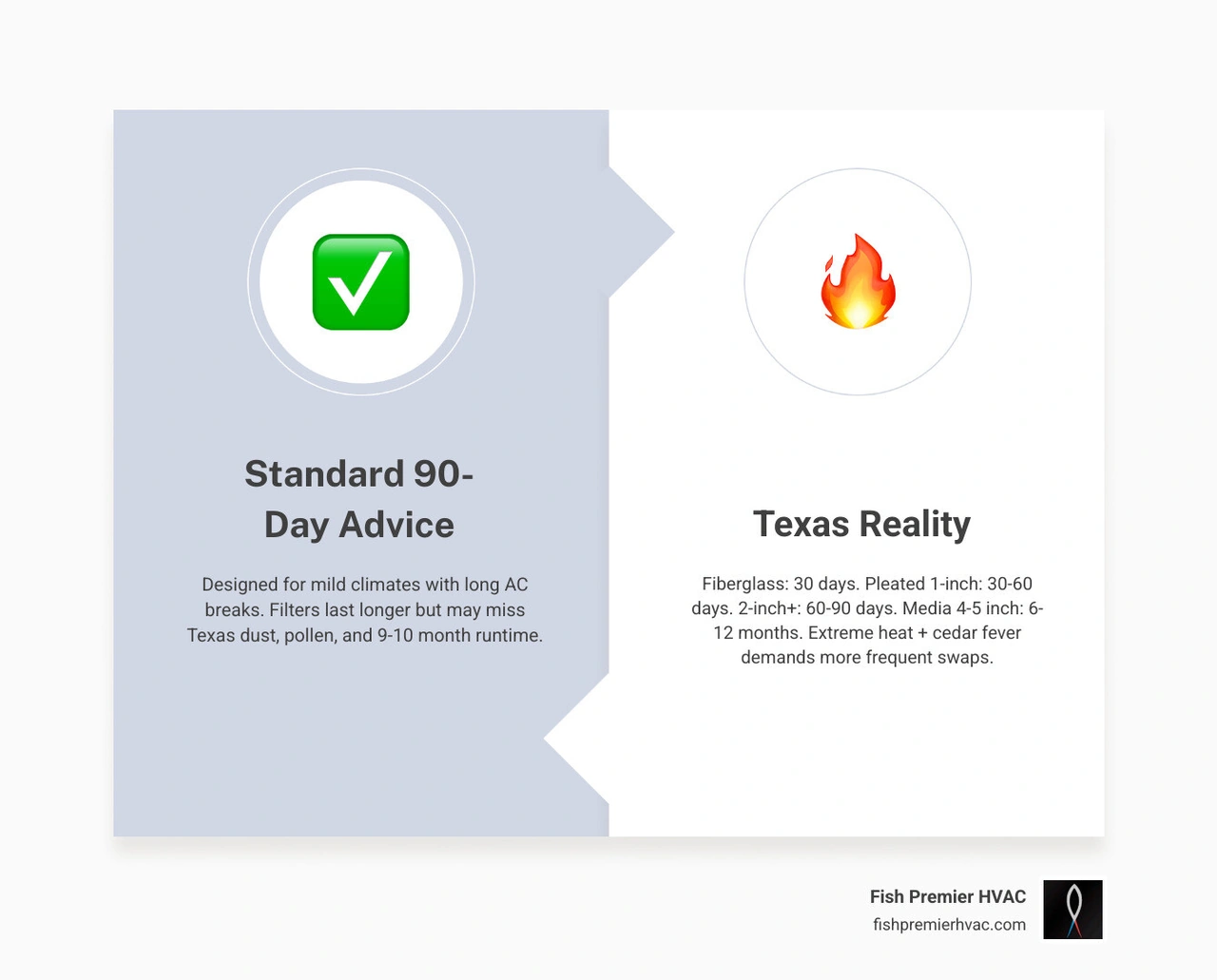
To truly master home comfort, you have to look beyond generic advice printed on the back of a filter box. The standard "90-day rule" is designed for mild climates where the air conditioner takes long, luxurious breaks. In North Texas, our systems face a grueling schedule. To keep your system running smoothly, we need to look closely at the actual hardware you are using.
The type of filter you slide into your return grille is the single biggest factor in determining its lifespan. Let's break down the three primary categories of filters and how they hold up under Texas conditions.
Fiberglass Filters (The 30-Day Budget Option)
Standard 1-inch fiberglass filters are the thin, green or blue spun-glass filters you can buy in bulk. While they are highly affordable, they are designed with a very loose weave. Their primary job is not to clean your breathing air, but to stop large debris, like stray pet hair or giant dust bunnies, from entering your air handler.
Because they have very little surface area, they clog quickly. In a typical Dallas-Fort Worth summer, a fiberglass filter should be changed every 30 days or less. If you leave one in for two or three months, it will quickly become a matted sheet of dust, restricting airflow and putting immense strain on your blower motor. Understanding When to Change Your HVAC Air Filter starts with recognizing that these basic filters require constant vigilance.
Pleated Filters (The 30 to 90-Day Standard)
Pleated filters are made from synthetic fibers or cotton folded into accordion-like pleats. This design dramatically increases the surface area of the filter. If you were to pull a pleated filter apart and stretch it out, it would cover a much larger footprint than a flat fiberglass filter. This "maze" design allows it to trap much smaller particles—such as pollen, mold spores, and fine pet dander—without immediately choking your system's airflow.
In Texas, a standard 1-inch pleated filter typically lasts 30 to 60 days during the peak cooling season. During milder times of the year, like late autumn or early spring, you can stretch this to 90 days. If you upgrade to a thicker 2-inch pleated filter, you gain even more surface area, allowing you to comfortably schedule changes every 60 to 90 days.
Media Filters (The 6 to 12-Month Luxury Standard)
If you want the ultimate in convenience and air filtration, a 4-inch to 5-inch deep media filter is the gold standard. These deep-pleated filters are housed in a dedicated media cabinet installed directly into your duct system. Because they are incredibly thick, they offer an expansive surface area that captures microscopic contaminants while keeping airflow restriction to an absolute minimum.
For busy homeowners in Keller, Southlake, and Colleyville, media filters are a game-changer. They generally only need to be replaced every 6 to 12 months. Even during a brutal North Texas summer, these filters keep working efficiently without requiring monthly maintenance. We highly recommend these premium systems for clients who want "set-it-and-forget-it" convenience combined with superior indoor air quality. Your AC System Needs Regular Filter Changes to maintain its baseline performance, and upgrading to a media filter is one of the best ways to simplify this chore.
Why Texas Climate Dictates How Often Should You Change Your AC Filter in Texas
The local climate is a relentless taskmaster for residential HVAC systems. In North Texas, we don't just experience warm summers; we experience sustained, triple-digit heat waves that force air conditioners to run almost continuously for weeks on end.
When your system is running 18 to 20 hours a day to keep your Westlake home cool, it is constantly pulling air through the return vents. This means your air filter is working overtime, filtering thousands of cubic feet of air daily. A filter that might last three months in Vermont will easily clog in four to six weeks in Texas simply because of the sheer volume of air passing through it.
Furthermore, our long shoulder seasons mean that even in May and October, we are often still running the cooling system. To protect your equipment from the thermal stress of our climate, you must align your filter schedule with local weather patterns. Learning How to Maintain Your AC in Extreme Heat is essential for preventing mid-summer breakdowns, and a fresh filter is your system's first line of defense.
Household Factors That Influence How Often Should You Change Your AC Filter in Texas
While the climate sets the baseline, your household's daily life determines the exact day your filter needs to be swapped out. No two homes load a filter at the exact same rate. Here are the primary internal factors that dictate your replacement schedule:
- Pets and Dander: If you share your home with dogs, cats, or other furry companions, your filter is fighting a constant battle against pet hair and microscopic dander. Dander is incredibly sticky and oily, meaning it clings to filter fibers and seals up the air gaps much faster than standard household dust. Homes with multiple pets should plan to change 1-inch filters every 30 days without fail.
- Allergies and Respiratory Sensitivities: If anyone in your family suffers from asthma, seasonal allergies, or respiratory conditions, your filter is serving as a health barrier. Leaving a loaded filter in place allows allergens to bypass the filter or blow back into your living spaces. For sensitive individuals, changing high-efficiency pleated filters every 30 days is highly recommended to keep indoor air clean.
- Home Size and Air Volume: Smaller homes have less overall air volume, which means the air circulates through the filter more frequently, trapping localized dust quickly. Conversely, very large homes with multiple systems may distribute the dust load, but they also feature multiple return grilles that all need to be checked. Keeping up with HVAC Maintenance Tips for Texas Homeowners means knowing how your specific home layout impacts airflow and filter loading.
Texas-Specific Environmental Challenges for Air Filters

Living in North Texas comes with unique environmental challenges that directly impact our indoor air quality. If you have ever walked outside in the spring or winter only to find your car coated in a thick layer of yellow dust, you know exactly what your air conditioner is up against.
The Cedar Fever Phenomenon
In North Texas, allergy season never truly ends. From December through February, when most of the country is experiencing a quiet winter, Texans battle "cedar fever." Strong winds carry pollen from mountain cedar trees hundreds of miles, creating incredibly high pollen counts. This fine, powdery pollen finds its way inside your home through open doors, windows, and clothing, quickly loading your air filter. During cedar season, you may need to shorten your filter replacement interval by 25% to keep your indoor air breathable and prevent your system from choking on pollen.
Spring Blooms and Ragweed
As soon as cedar season winds down, spring oak, elm, and pecan blooms take over, followed by ragweed in the late summer and fall. This continuous cycle of heavy pollen means your AC filter is constantly bombarded. If you don't change your filter regularly during these peak biological events, the accumulated organic material on the filter can even begin to harbor musty odors, especially when combined with our humid Texas air.
Rapid Suburban Construction Dust
The Dallas-Fort Worth metroplex is one of the fastest-growing regions in the country. If you live in expanding communities like Keller, Southlake, or Westlake, chances are there is home building, road work, or commercial construction happening nearby. Construction dust is composed of heavy, abrasive particles like silica, drywall dust, and concrete grit. These fine particles easily bypass basic filters and can cause significant wear on your system's internal components if your filter is not changed frequently. Keeping your filter fresh is a critical step when learning How to Extend the Life of Your AC in Texas.
The Consequences of Neglecting Your AC Filter
It is easy to adopt an "out of sight, out of mind" attitude toward your air filter. However, neglecting this simple component can trigger a cascading series of expensive mechanical failures and comfort issues.
Frozen Evaporator Coils
Your air conditioner cools your home by blowing warm indoor air over a freezing-cold evaporator coil. The refrigerant inside the coil absorbs the heat from the air. However, this process relies on a steady, robust stream of warm air.
If your air filter is clogged with dust and dander, the airflow slows to a crawl. Without enough warm air passing over the coil, the temperature of the coil drops below freezing. The moisture in the air quickly condenses and freezes on the coil, turning it into a solid block of ice. Once the coil freezes, your system will stop cooling entirely, and the ice can melt rapidly, causing water damage to your walls, ceilings, and floors.
Skyrocketing Utility Bills
When airflow is restricted, your system has to work twice as hard to push cool air through your home. The blower motor draws more electrical current, and your system has to run for much longer cycles to reach the temperature set on your thermostat. This extra runtime translates directly into higher monthly energy bills. Simply swapping out a dirty filter for a clean one is one of the most cost-effective ways to restore your system's efficiency.
Premature System Failure
An air conditioner that is constantly fighting against a clogged filter is under immense physical stress. The blower motor will run hotter and wear out prematurely, and the compressor—the expensive heart of your AC system—will experience increased wear and tear. Over time, this neglect can shave years off the lifespan of your unit. Investing in a professional maintenance agreement is a smart way to protect your investment; find out How a Maintenance Plan Extends AC Life in Texas to keep your home comfortable year-round.
MERV Ratings and Filter Selection for Texas Homes
When shopping for a new filter, you will see a MERV (Minimum Efficiency Reporting Value) rating on the packaging. MERV ratings range from 1 to 16 for residential systems, measuring how effectively the filter traps particles of various sizes.
- MERV 1 to 4: These are basic fiberglass filters. They capture large particles but let pollen, dust mites, and pet dander pass right through.
- MERV 8 to 11: This is the ideal range for most North Texas homes. These filters capture a high percentage of pollen, dust, and mold spores without restricting airflow to dangerous levels.
- MERV 12 to 13: These high-efficiency filters are excellent for severe allergy sufferers or homes with multiple pets. They capture exceptionally fine particles, including smoke and bacteria. However, because the weave is so tight, they can restrict airflow if your HVAC system is not designed to handle them.
Using a filter with a MERV rating that is too high for your system can act like a brick wall, suffocating your blower motor. It is always wise to consult with an expert to ensure your system can handle high-efficiency filtration. For homeowners in the Keller area, checking out our AC Maintenance Keller TX Guide or our Ultimate AC Maintenance Guide Keller TX can provide localized, expert insights into system compatibility and care.
Frequently Asked Questions About Texas AC Filters
How can I tell if my AC filter needs to be changed immediately?
The easiest way to check is the "light test." Take your filter out and hold it up to a bright light source or the sun. If you cannot see light passing through the fibers, the filter is fully loaded and needs to be replaced immediately. Other warning signs include a visible gray or brown layer of dust on the pleats, weak airflow coming from your supply registers, or an unusual amount of dust settling on your furniture shortly after cleaning.
Should I follow a strict calendar schedule or check my filter monthly?
We always recommend checking your filter monthly, even if you use a filter rated for 90 days. Our weather is unpredictable, and a sudden dry spell or a nearby construction project can clog your filter weeks ahead of schedule. Set a recurring reminder on your phone to inspect the filter on the first of every month. If it looks clean, slide it back in; if it has a gray hue, replace it.
Do thicker media filters last longer in Texas?
Yes, absolutely. A 4-inch or 5-inch media filter has significantly more surface area than a standard 1-inch filter. This allows it to hold a much larger volume of dust and debris before it begins to restrict airflow. While a 1-inch filter may need to be changed every month during the summer, a high-quality media filter can easily last 6 to 12 months, making it a highly convenient and efficient choice for busy homeowners.
Conclusion
At Fish Premier HVAC, we believe your home should be a sanctuary of comfort and luxury. Maintaining clean air filters is a simple yet vital part of protecting your home's HVAC system, keeping your energy bills low, and ensuring your family breathes clean, healthy air.
If you want to elevate your home comfort even further, we specialize in whole-home luxury comfort solutions across the Dallas-Fort Worth area, including Keller, Southlake, Westlake, and Colleyville. From high-efficiency system installations and advanced air scrubbers to custom home scenting and backup generators, our team provides concierge-level service tailored to your exact needs.
We operate Monday through Friday from 8:00 AM to 6:00 PM, with after-hours emergency services available to ensure you are never left in the heat. For top-rated service and expert system analysis in Fort Worth, TX, trust our licensed professionals (License #TACLB99535E).
Ready to experience true home comfort? Schedule premium air conditioning services with Fish Premier HVAC today.