%201.avif)
How to Reduce Cooling Costs During Heat Waves the Right Way
Reduce cooling costs during heat waves with smart thermostat settings, window shading, and HVAC maintenance for whole-home comfort in Texas.


.svg)
.svg)
.svg)
Why Reducing Cooling Costs During Heat Waves Is a Real Challenge for DFW Homeowners
Reducing cooling costs during heat waves is one of the biggest concerns for homeowners across the Dallas-Fort Worth area — and for good reason. When summer temperatures push past 100°F for days on end, your AC system works overtime, and your energy bill reflects every degree of that struggle. Cooling already accounts for about 12% of the average U.S. home's energy bill under normal conditions. During a DFW heat wave, that number climbs fast.
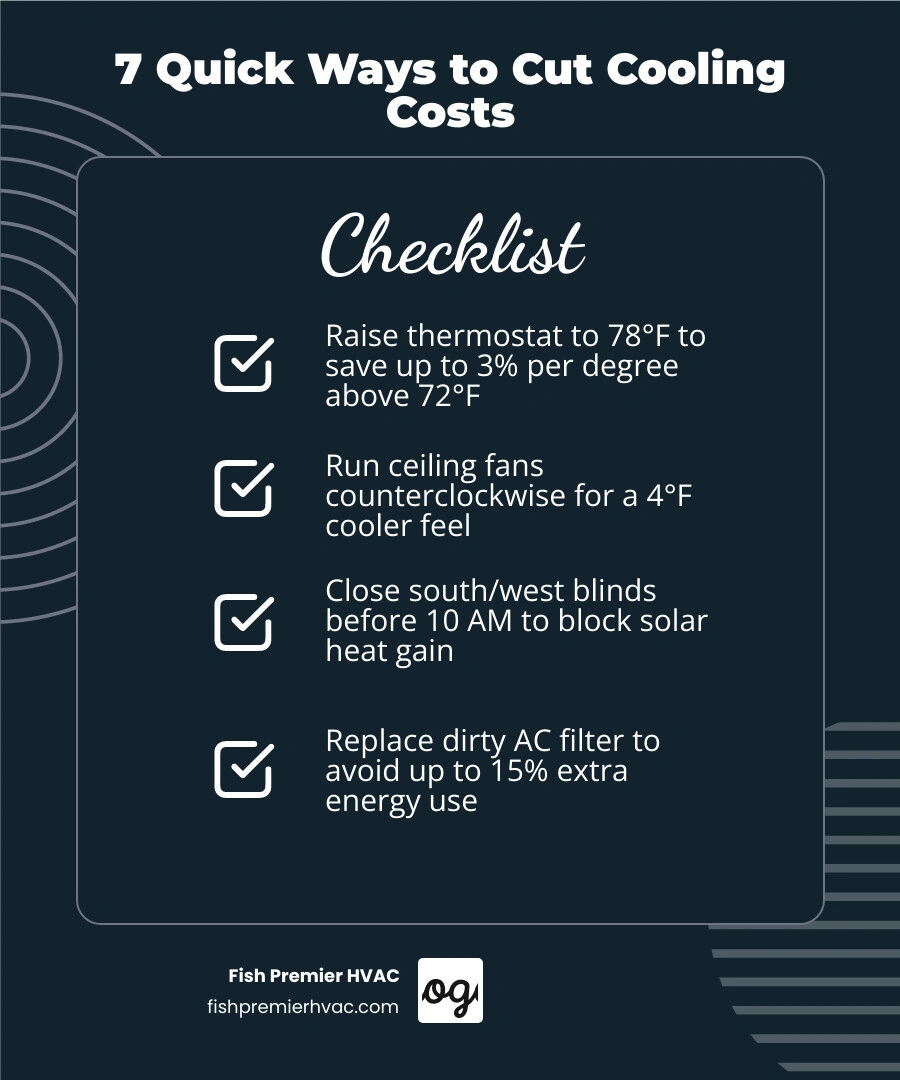
Here's a quick look at the most effective ways to lower your cooling costs right now:
- Raise your thermostat to 78°F when you're home — every degree above 72°F saves up to 3% on cooling costs
- Use ceiling fans counterclockwise to create a wind chill effect that makes a room feel up to 4°F cooler
- Close blinds and curtains on south- and west-facing windows before 10 AM to block solar heat gain
- Replace or clean your AC filter — a dirty filter can increase energy usage by up to 15%
- Unplug unused electronics and avoid oven use during peak heat hours
- Seal gaps around doors and windows with weatherstripping or caulk to stop cool air from escaping
- Pre-cool your home in the early morning when electricity rates are lower
These steps work together. No single fix is a silver bullet — but layering them can make a meaningful dent in your monthly bill without sacrificing the comfort your home deserves.
Immediate Actions for Reducing Cooling Costs During Heat Waves
When an intense heat wave settles over North Texas, you do not have to wait for major home renovations to start saving. Immediate, tactical changes in how you manage your home's thermal environment can yield instant relief for both your comfort levels and your monthly utility statement. Understanding How Heat Waves Affect AC Efficiency is the first step in realizing why these immediate actions are so crucial. When outdoor temperatures soar, your outdoor condenser struggles to shed heat, making every internal heat source in your home an additional, costly burden.
Managing Windows and Airflow to Lower Energy Use
Your windows are essentially giant solar collectors. During a summer heat wave, up to 40% of your home's unwanted heat gain comes directly through the glass via solar radiation. If you leave your drapes open on south- and west-facing windows during the middle of the day, you are practically inviting the Texas sun to run up your electric bill.
To combat this, master your window coverings. Close high-quality blinds, heavy drapes, or cellular shades before the sun hits that side of your home (usually by 10:00 AM). Cellular shades are particularly effective, capable of reducing solar heat gain by up to 62% when properly installed. For an even more robust shield, consider external shading options like awnings or solar screens, which block the sun’s energy before it ever touches your window glass.
Once you have blocked the external heat, you must optimize how you circulate the cool air already inside. Ceiling fans are your best ally here, but only if they are spinning the right way. Ensure your fan blades are set to rotate counterclockwise during the summer. This setting creates a direct, cooling downdraft.
It is important to remember the golden rule of fans: fans cool people, not rooms. They create a wind chill effect by accelerating the evaporation of moisture on your skin, making you feel up to 4°F cooler than the ambient air temperature. This psychological and physical trick allows you to raise your thermostat setting by those same four degrees without any perceived loss of comfort. Just remember to turn ceiling fans off when you leave a room; running them in an empty space is simply wasting electricity.
In homes with dedicated attic spaces, attic fans can also play a major role. Because heat naturally rises, your attic can easily reach temperatures exceeding 140°F on a 100°F day. This trapped heat acts like a hot blanket sitting on top of your living space, radiating warmth down through your ceilings. Attic ventilation fans push this superheated, stale air out while pulling in slightly cooler outdoor air, dramatically reducing the cooling load on your primary air conditioning system.
Behavioral Adjustments for Reducing Cooling Costs During Heat Waves
While mechanical systems do the heavy lifting, your daily habits have a massive impact on your home's internal cooling load. Every appliance you run, every light you turn on, and even the time of day you cook can either help or hinder your efforts toward reducing cooling costs during heat waves.
Start by eliminating internal heat sources. Traditional incandescent light bulbs are incredibly inefficient, converting roughly 90% of the electricity they use into radiant heat rather than light. Swapping these out for modern LED bulbs not only slashes your lighting energy consumption but also keeps your rooms noticeably cooler.
Next, wage war against "phantom loads"—also known as vampire power. Electronics like gaming consoles, desktop computers, television cable boxes, and chargers draw electricity and generate ambient heat even when they are turned off or in standby mode. Unplugging these devices or utilizing smart power strips can eliminate this unnecessary heat generation.
Your kitchen is another major battleground. Running a conventional oven can raise your kitchen's temperature by several degrees in a matter of minutes, forcing your AC to work twice as hard to restore balance. During a heat wave, shift your cooking habits:
- Cook outdoors on a grill.
- Utilize small, energy-efficient appliances like microwaves, toaster ovens, or slow cookers.
- Prepare cold meals that require no heat at all.
- If you must use the stove or dishwasher, delay these activities until after 8:00 PM when outdoor temperatures drop and utility demand peaks begin to subside.
Finally, consider a strategic practice known as pre-cooling. If your utility provider utilizes time-of-use rate structures, electricity is significantly cheaper during the early morning hours (typically before 6:00 AM or 7:00 AM). You can take advantage of this by lowering your thermostat to pre-cool your home during these off-peak hours. As the outdoor temperatures rise and peak pricing begins, you can raise your thermostat to 78°F or higher. Your home’s thermal mass will help maintain a comfortable indoor environment for hours, keeping your AC compressor quiet during the most expensive times of the day.
Optimizing Thermostat Settings and Smart Technology
When it comes to precision energy management, your thermostat is the command center. Far too many homeowners treat their thermostat like a gas pedal, cranking it down to 60°F in the belief that it will cool the house faster. In reality, traditional air conditioners run at the same speed regardless of the target temperature; setting it lower only ensures that the compressor runs longer, wasting energy and risking a system freeze-up. To understand how to leverage these controls properly, it is worth exploring Do Smart Thermostats Really Save Money to see how automation can transform your monthly bills.
Thermostat Settings for Reducing Cooling Costs During Heat Waves
The federal government and energy efficiency experts agree: setting your thermostat to 78°F when you are at home strikes the ideal balance between reasonable comfort and high-level efficiency. Every single degree you set your thermostat above 72°F can save you up to 3% on your cooling costs. If you are away from home for more than a few hours, raising the setting to 82°F or 85°F prevents your system from cooling an empty house, yielding massive savings.
For Texas residents navigating our unique climate, finding the sweet spot is essential. Reviewing the Best Thermostat Settings for Energy Savings in Texas can provide localized, practical schedules that work in harmony with our hot, humid summer afternoons.
A smart thermostat takes the guesswork out of this process. Rather than relying on you to manually adjust settings throughout the day, a smart thermostat learns your family’s routine and automatically adjusts temperatures based on occupancy. Many models can sync with your utility provider’s peak-hour pricing schedules, automatically shifting your cooling cycles to avoid high-rate periods. They also allow you to monitor and control your home's climate remotely, ensuring you never waste money cooling a home when your plans change and you stay out late.
Maximizing HVAC Efficiency and Low-Cost Home Improvements
An air conditioning system is only as efficient as the home envelope it serves and the maintenance it receives. If your home has poor insulation, leaky ductwork, or a neglected HVAC unit, you are essentially throwing money out the window. Fortunately, a few low-cost home improvements and consistent maintenance habits can dramatically ease the strain on your system.
To keep your system running optimally, regular attention is required. Understanding the Benefits of Regular AC Maintenance in Texas is critical to preventing sudden system failures when outdoor temperatures peak. Furthermore, knowing How to Extend the Life of Your AC in Texas can save you from premature system replacements.
Here are the most cost-effective maintenance tasks and minor upgrades you can perform to boost efficiency:
- Change Your Air Filter Monthly: A clean air filter is the single simplest way to maintain proper airflow. When a filter becomes clogged with dust and pet dander, your system has to work significantly harder to pull air through it, restricting circulation and forcing the blower motor to draw more electricity. Replacing or cleaning your filter every 30 to 60 days during peak summer can lower your AC’s energy consumption by 5% to 15%.
- Clean the Outdoor Condenser Coils: Your outdoor unit is responsible for releasing the heat extracted from your home. If the coils are blanketed in dirt, grass clippings, or fallen leaves, they cannot shed heat effectively. Keep a clear two-foot perimeter around your outdoor unit, and gently spray the coils with a garden hose annually to wash away accumulated debris.
- Seal Air Leaks (Weatherstripping and Caulk): Infiltration is the silent enemy of home comfort. Hot, humid air from the outside constantly tries to find its way into your cool home through tiny gaps around doors, windows, and utility penetrations. Walk through your home and check for visible light around closed doors and windows. Sealing these gaps with fresh caulk and weatherstripping can cut your annual energy bill by up to 10%.
- Inspect and Upgrade Attic Insulation: Even the best AC unit will struggle if your attic lacks proper insulation. Heat from your attic will continuously migrate down into your living spaces. Ensuring your attic has adequate insulation (typically measured at R-38 to R-60 for our region) keeps the heat where it belongs—outside.
- Seal Leaky Ductwork: Central air conditioning systems can lose 20% to 30% of their conditioned air through minor leaks, loose joints, and tears in the ductwork located in unconditioned spaces like attics or crawlspaces. Sealing these ducts ensures that every cubic foot of cool air you pay for actually reaches your living areas.
Upgrading to High-Efficiency Systems and Smart Climate Solutions
When older, standard air conditioning units begin to struggle consistently during severe heat waves, it may be time to look beyond quick fixes and consider upgrading to modern, high-efficiency technology. The HVAC industry has made massive leaps in efficiency over the last decade, meaning a new installation can fundamentally change your home's energy dynamics.
To evaluate whether your current system is draining your wallet, read about how an outdated AC SEER Rating Costing You Money could be impacting your monthly expenses. If you decide to transition to a modern system, exploring the Heat Pump Benefits for Texas Homeowners is an excellent place to start. For local homeowners ready to make a change, securing a professional Energy Efficient AC Installation Fort Worth ensures your new system is sized perfectly and installed to the highest standards.
To help you understand the landscape of modern cooling options, we have compiled a comparison of the three primary systems used today:
| Feature / Metric | High-Efficiency Heat Pump | High-Efficiency Traditional AC | Evaporative Cooler (Swamp Cooler) |
|---|---|---|---|
| Primary Cooling Mechanism | Refrigerant cycle with variable-speed compressor | Refrigerant cycle with single or multi-stage compressor | Water evaporation across wet media pads |
| Average SEER2 Range | 18 to 30+ | 16 to 24+ | N/A (Measured by EER) |
| Climate Suitability | Excellent for all climates, including hot & humid | Excellent for all climates, including hot & humid | Strictly dry, low-humidity desert climates |
| Humidity Control | Superb (Continuous low-speed operation removes moisture) | Good (Standard dehumidification during cooling cycles) | None (Adds moisture to the indoor air) |
| Energy Efficiency | Extremely High (Saves an average of $228/yr vs dual-fuel) | High (Significant improvement over older units) | Extremely High (Uses up to 75% less electricity) |
| Environmental Impact | Low (Can reduce whole-home CO2 by over 10,000 lbs/yr) | Moderate | Low |
For homeowners in the DFW metroplex, the choice between these systems comes down to our specific climate. Because our summers are characterized by high humidity alongside extreme heat, evaporative coolers (swamp coolers) are entirely unsuitable for our region. They rely on dry air to evaporate water and lower temperatures; in humid environments, the air is already saturated, rendering these units ineffective and leaving your home feeling sticky and warm.
Instead, high-efficiency traditional ACs and variable-speed heat pumps are the gold standards. Modern heat pumps are particularly impressive. A variable-speed heat pump can adjust its cooling output precisely to match the real-time heat load of your home, running continuously at lower, whisper-quiet speeds. This continuous operation allows the system to extract immense amounts of humidity from the air, making a 75°F indoor setting feel incredibly cool and crisp.
Furthermore, because heat pumps provide both heating and cooling in a single footprint, they eliminate the need for a separate gas furnace. By removing a fossil-fuel furnace and installing an electric heat pump, you can reduce your home's carbon footprint by over 10,000 lbs of CO2 annually while saving an average of $228 per year compared to a dual-fuel system.
Safety, Backup Power, and Financial Incentives
While managing your monthly energy bill is important, safety must always come first during extreme weather events. Heat waves put immense pressure on the electrical grid, occasionally resulting in rolling blackouts or unexpected power outages. Being prepared for these scenarios is a vital aspect of home ownership.
If a power outage occurs when outdoor temperatures are in the triple digits, your home can heat up dangerously fast. To protect your family, keep a well-stocked emergency kit on hand. This kit should include at least a 72-hour supply of water (the Red Cross recommends a minimum of 3/4 gallon of water per person daily), non-perishable food, battery-operated or rechargeable personal fans, and flashlights.
Identify local cooling centers, such as public libraries or community centers, where you can seek air-conditioned shelter if your home becomes unsafe. If you have vulnerable neighbors, such as the elderly or families with young children, check on them regularly.
For ultimate peace of mind and uninterrupted comfort, a standby whole-house generator is an invaluable investment. Unlike portable generators, which require manual setup, extension cords, and constant refueling with gasoline, a standby generator is permanently installed outside your home. It connects directly to your home’s natural gas or propane line and monitors incoming utility power. Within seconds of a grid failure, the standby generator automatically starts up and transfers your home’s electrical load to its generator power, keeping your central air conditioning, refrigeration, and medical devices running seamlessly.
To help offset the cost of upgrading to safer, high-efficiency climate solutions, various financial incentives are available. Homeowners can take advantage of federal tax credits, local utility rebates, and state-level programs. To maximize your savings, review Texas Energy Rebates for HVAC Upgrades to see what incentives are active. When you are ready to move forward, our guide on How to Apply for Energy Rebates in Texas will walk you through the application process step-by-step.
Frequently Asked Questions About Summer Energy Savings
What is the most effective immediate action to lower my AC bill during a heat wave?
The single most effective immediate action you can take is raising your thermostat to 78°F (or higher) and pairing it with a counterclockwise-spinning ceiling fan in whatever room you are currently occupying. This combination instantly reduces the workload on your AC compressor while the fan's wind-chill effect keeps you feeling cool. Additionally, keeping your window blinds closed to block direct sunlight prevents solar heat from entering your living space in the first place, stopping the heat before your AC has to fight it.
How do humidity levels affect my choice of cooling system in Texas?
In Texas, high humidity levels make traditional air conditioners or variable-speed heat pumps the only viable choices. These systems use refrigerant to cool indoor air and naturally condense moisture out of the air in the process, lowering the relative humidity of your home. Evaporative coolers, which add moisture to the air to achieve cooling, do not work in our humid climate because the air cannot absorb additional water vapor, leaving your home warm, humid, and uncomfortable.
Can a backup generator keep my home cool during a power grid failure?
Yes, a properly sized standby generator can easily run your entire home's air conditioning system during a power grid failure. Whole-house standby generators are engineered to handle the high electrical starting currents required by large AC compressors. They activate automatically within seconds of a power loss, ensuring your home remains a safe, cool sanctuary even during prolonged grid outages.
Conclusion
Managing comfort and reducing cooling costs during heat waves does not have to be a stressful balancing act. By combining smart behavioral habits, simple maintenance, and high-efficiency technology, you can protect your wallet while maintaining a cool, inviting indoor environment.
At Fish Premier HVAC, we specialize in delivering whole-home luxury and concierge-level service to homeowners who demand the absolute best in residential comfort. Serving Fort Worth, Keller, Westlake, Colleyville, and Southlake, we bring premium installations, innovative air quality solutions, and reliable backup power options directly to your doorstep. Whether you are looking to upgrade to a whisper-quiet variable-speed heat pump, improve your indoor air quality with premium air scrubbers, or protect your family with a standby generator, our team is dedicated to providing an unparalleled customer experience.
Ready to transform your indoor comfort? Contact us today for Expert AC Services tailored to your luxury home.
Fish Premier HVAC — Fort Worth, TX | Texas License #TACLB99535E