%201.avif)
How to Set the Best Thermostat Settings for Energy Savings in Texas
Discover the best thermostat settings for energy savings in Texas and cut summer cooling costs with smart HVAC tips for Dallas-Fort Worth homes.


.svg)
.svg)
.svg)
Why Your Thermostat Is the Most Powerful Tool for Cutting Energy Bills in Texas
The best thermostat settings for energy savings in Texas come down to a simple framework most homeowners overlook: 78°F when you're home, 85°F when you're away, and 68°F in winter while awake. Here's a quick-reference breakdown:
| Situation | Recommended Setting |
|---|---|
| Summer - Home & Awake | 78°F |
| Summer - Away from Home | 85°F |
| Summer - Sleeping | 72-75°F |
| Winter - Home & Awake | 68°F |
| Winter - Away from Home | 60°F |
| Winter - Sleeping | 65°F |
Texas summers are no ordinary challenge. Temperatures across the Dallas-Fort Worth area routinely climb past 100°F, and that extreme heat puts a relentless strain on your HVAC system. In fact, heating and cooling account for roughly 50% of a typical Texas home's electric bill — meaning your thermostat settings have a bigger impact on your monthly costs than almost anything else in your house.
The stakes are high here in ways they simply aren't in milder climates. A thermostat set just 6°F too low can meaningfully drive up your cooling bill — not for a few days, but across a five-month Texas summer that stretches from late May through mid-October. Small, smart adjustments add up fast, and the U.S. Department of Energy estimates you can save up to 10% annually on heating and cooling just by adjusting your thermostat 7-10°F for 8 hours a day.
Whether you're managing a luxury home in Southlake, a newer build in Frisco, or a classic estate in Fort Worth, the principles are the same — and the savings are real.
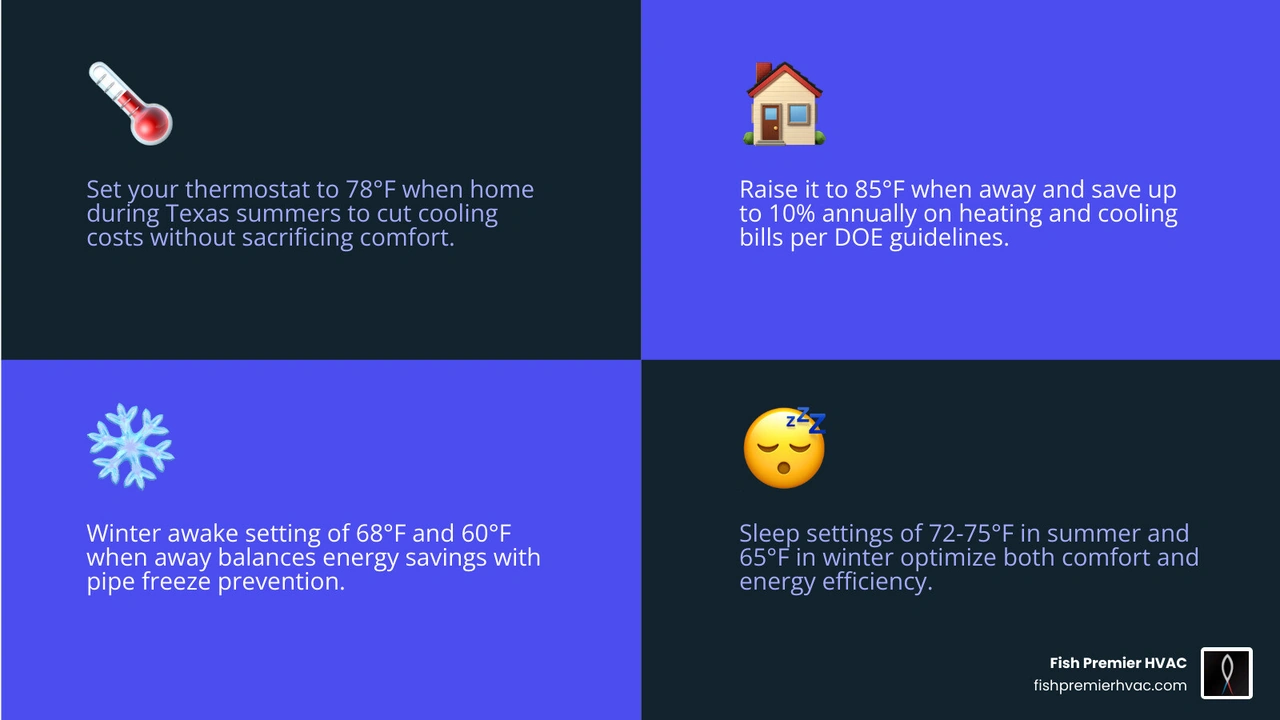
The Best Thermostat Settings for Energy Savings in Texas During Summer

When summer arrives in North Texas, the temperature differential between the scorching outdoors and your indoor sanctuary can easily exceed 25°F to 30°F. If it is 103°F in Keller or Westlake, setting your thermostat to 68°F forces your air conditioner to work continuously against a massive thermal gradient.
The U.S. Department of Energy and local HVAC experts recommend setting your thermostat to 78°F when you are at home and awake. While 78°F might sound warm at first, it represents the optimal intersection of system performance, indoor comfort, and financial efficiency.
To understand why this works, we must look at the physics of heat transfer. The rate at which heat enters your home is directly proportional to the difference between the indoor and outdoor temperatures. A cooler indoor setting (like 70°F) accelerates the rate of heat penetration through your walls, windows, and attic. By maintaining a higher indoor setpoint of 78°F, you slow down this heat infiltration, which drastically decreases your cooling runtime. For a deeper dive into managing comfort during our regional weather shifts, check out our North Texas Climate HVAC Guide 2026.
Daytime and Away Settings: Maximizing Your Savings
The single biggest mistake Texas homeowners make is leaving their air conditioner set to a cool "occupied" temperature when everyone is out of the house. If you are leaving your home for four hours or more, you should raise your thermostat to 85°F.
Some homeowners worry that letting the house warm up to 85°F will make the system work "harder" and consume more energy to cool it back down later. This is a common thermodynamic myth. According to Newton’s Law of Cooling, a warmer house actually absorbs heat from the outdoors much slower than a cold house. Your AC does not run at a "faster" speed to cool a warm room; it cools at the exact same steady rate regardless of the starting temperature.
By keeping the thermostat at 85°F while you are at work or away, you minimize the total heat gained by your home during the hottest peak hours of the day. When you return, lowering the system back to 78°F will require a single, continuous run cycle, which is far more energy-efficient than letting the system cycle on and off all day long. This strategy alone can yield up to 10% in annual cooling savings. If your system is older, these long runtimes can be even more taxing, which is why understanding if your AC SEER Rating Costing You Money is crucial for managing your monthly investments.
Nighttime and Sleep Settings for Texas Summers
While the Department of Energy technically suggests keeping the thermostat at 82°F at night, most Texans find this unrealistic for a good night's sleep. Sleep science indicates that human bodies require a cooler environment to initiate deep, restorative sleep cycles.
A highly efficient and comfortable compromise is to set your thermostat between 72°F and 75°F during sleeping hours. Because outdoor temperatures drop overnight, the temperature differential between the inside and outside of your home is much narrower. This means your air conditioner can maintain a cooler nighttime setting with far less energy and strain than would be required during the heat of the afternoon.
To maximize comfort at 75°F, always use your ceiling fans. Moving air creates a "wind-chill" effect on your skin, facilitating evaporative cooling. Running a ceiling fan counterclockwise at medium to high speed can make the room feel up to 4°F cooler than the actual thermostat reading, allowing you to sleep soundly without forcing your AC to run all night.
Winter Thermostat Settings for Texas Homes
Texas winters may be relatively brief, but cold snaps can bring freezing temperatures that catch DFW homeowners off guard. Suddenly, the focus shifts from fighting triple-digit heat to keeping your home warm without letting your electric or gas bills skyrocket.
For the winter months, the U.S. Department of Energy recommends setting your thermostat to 68°F when you are home and awake. This temperature balances personal warmth with energy conservation. Just like in the summer, keeping the indoor temperature moderate slows down the rate of heat loss from your home to the cold outdoors. If you are looking to make your home more energy-efficient before the next cold front hits, you might want to learn How to Apply for Energy Rebates in Texas to offset the cost of any efficiency improvements.
Finding the Best Thermostat Settings for Energy Savings in Texas Winters
To achieve the best results, implement a strategic setback schedule during the winter:
- While Awake and Home: 68°F
- While Away (for 8+ hours): 60°F
- While Sleeping: 62°F to 65°F (under warm bedding)
Lowering your thermostat by 7°F to 10°F for eight hours a day can save you roughly 10% on your annual heating costs. However, if your home relies on an electric heat pump, you must be careful with manual adjustments.
Traditional heat pumps can operate less efficiently if you raise the temperature setting too quickly. If you demand a temperature increase of more than two degrees at once, many heat pumps will automatically engage their auxiliary electric resistance heat strips (often labeled "Aux Heat"). These heating coils consume a massive amount of electricity.
To avoid this, either adjust your thermostat upward in gradual increments of 1°F to 2°F, or use a smart thermostat specifically designed to manage heat pump recovery cycles efficiently. Upgrading to a modern, high-efficiency system can prevent these issues altogether, and you can explore Texas Energy Rebates for HVAC Upgrades to help fund a high-performance system replacement.
How Smart Thermostats and Home Automation Maximize Efficiency
While programmable thermostats have been around for decades, they rely on human programming that often gets ignored or bypassed. Smart thermostats solve this problem by taking human error out of the equation, making it incredibly simple to maintain the best thermostat settings for energy savings in Texas.
Smart thermostats leverage advanced machine learning algorithms to study your daily routine. Within a week or two of installation, these systems learn when you wake up, when you leave for work, and when you return. They use this data to build a custom, highly optimized temperature schedule that prioritizes savings when you are away and comfort when you are home.
Furthermore, many local utilities offer incentives for installing these systems. You can read more about how to secure these savings in our guide on Oncor and Texas Energy Rebates for Homeowners.
Integrating Smart Thermostats for the Best Thermostat Settings for Energy Savings in Texas
When integrated into a broader home automation system, smart thermostats unlock advanced features that manual systems simply cannot match:
- Geofencing: By tracking your smartphone’s location, your thermostat knows when you leave your neighborhood in Colleyville or Southlake. It will automatically shift into "Away Mode" (raising the temperature to 85°F in the summer) and begin cooling the home back down to 78°F the moment you cross a pre-set boundary on your drive home.
- Smart Humidity Control: In Texas, high humidity can make 78°F feel sticky and uncomfortable. Many high-end smart thermostats can communicate with variable-speed HVAC systems to run longer, slower cycles that remove excess moisture from the air without over-cooling the home.
- Energy Reporting: These systems provide monthly breakdowns of your heating and cooling runtimes, helping you pinpoint exactly where you are wasting energy.
- Weather Tracking: Smart systems monitor local DFW weather forecasts in real-time, proactively adjusting your home’s cooling or heating cycles before an extreme temperature swing hits.
If you are ready to bring this level of automated comfort and efficiency into your home, our team can assist with a professional, Energy Efficient AC Installation Fort Worth tailored to your property's specific layout.
Complementary Strategies to Boost Your HVAC Efficiency
Even the most calculated thermostat settings will underperform if your home is actively fighting against your HVAC system. To truly minimize your energy footprint, combine your thermostat habits with these low-cost, high-impact strategies:
| Strategy | Energy/Comfort Impact | How It Helps Your HVAC |
|---|---|---|
| Ceiling Fans | Makes room feel up to 4°F cooler | Allows higher summer thermostat settings without sacrificing comfort. |
| Window Treatments | Reduces solar heat gain by up to 77% | Blocks radiant heat from entering through east and west-facing windows. |
| Regular Filter Changes | Improves airflow by 5% to 15% | Prevents dust buildup from choking your system's blower motor. |
| Professional Maintenance | Restores lost system efficiency | Cleans coils and optimizes refrigerant levels for lower operational stress. |
By taking a holistic approach to your home’s thermal envelope, you take the pressure off your air conditioner. For example, keeping your blinds and thermal curtains closed on your south- and west-facing windows during a hot July afternoon prevents solar radiation from turning your living room into a greenhouse.
Additionally, never underestimate the power of clean air filters. A clogged filter restricts airflow, forcing your system to run longer and consume more power to achieve your thermostat's setpoint. Replacing filters every 30 to 60 days is one of the simplest things you can do to protect your equipment.
Regular professional care is equally vital. Routine tune-ups ensure your system operates at peak capacity, which is why understanding the Benefits of Regular AC Maintenance in Texas is so important. For actionable steps you can take yourself, review our HVAC Maintenance Tips for Texas Homeowners.
Taking these steps is the single best way How to Extend the Life of Your AC in Texas. After all, knowing How Long Does an AC System Last in Texas helps you plan for the future, and proper maintenance can easily add years of reliable service to your investment.
Frequently Asked Questions About Texas Thermostat Settings
Does setting the thermostat lower cool the house faster?
No. This is one of the most common misconceptions in residential heating and cooling. Standard air conditioning systems operate at a single, steady speed. They are designed to deliver cold air at a consistent rate until the indoor temperature reaches the setpoint on your thermostat.
If your home is currently 80°F and you want it to be 74°F, setting the thermostat to 60°F will not make the system cool the space any faster. It simply means the system will keep running past your desired comfort level, wasting a significant amount of electricity and placing unnecessary wear and tear on your compressor.
Is it better to keep the thermostat at a constant temperature all day?
No, especially not during the extreme summer and winter seasons in Texas. Leaving your system at a constant cool setting (like 74°F) while you are away at work for nine hours means your system will cycle on and off all day to maintain a temperature for an empty house.
Allowing the temperature to rise to 85°F when you are away reduces the rate of heat entering your home, meaning your system will run far less overall. The energy required to cool the home back down when you return is substantially less than the energy wasted maintaining a cool temperature all day.
What is the minimum safe temperature to set in winter?
During a winter cold snap, you should never set your thermostat lower than 55°F, even if you plan to be away from home for an extended period. If the indoor temperature drops below 55°F, you run a severe risk of your water pipes freezing inside your walls, which can lead to catastrophic water damage.
Additionally, the World Health Organization recommends maintaining an indoor temperature of at least 64°F to 68°F for homes with children, elderly residents, or individuals with underlying health conditions.
Conclusion
Finding the best thermostat settings for energy savings in Texas is a powerful balance of smart temperature choices, automated technology, and proactive home maintenance. By adopting a standard of 78°F in the summer and 68°F in the winter, and utilizing smart setbacks when you're away, you can enjoy a comfortable home while keeping your energy bills in check.
At Fish Premier HVAC, we provide concierge-level service, offering luxury, comfort, and premium installations for homeowners who demand the very best. From high-efficiency HVAC systems and air scrubbers to backup generators and custom home scenting solutions, we deliver comprehensive whole-home luxury comfort to families across Keller, Westlake, Colleyville, Southlake, and the wider Dallas-Fort Worth area.
We operate Monday through Friday from 8:00 AM to 6:00 PM, and we are always available for after-hours emergency services when you need us most. Our experienced team is top-rated in the DFW metroplex, bringing prompt service, deep technical analysis, and premium care to every home we touch (Texas License #TACLB99535E).
Ready to elevate your home comfort and maximize your efficiency? Upgrade to Smart Home Automation with Fish Premier HVAC today and experience the difference of true concierge-level comfort.