%201.avif)
The Ultimate Guide to How Smart Home Technology Improves HVAC Performance
Discover how smart home technology improves HVAC performance with automation, sensors, and energy-saving controls for luxury comfort.

.svg)
.svg)
.svg)
How Smart Home Technology Improves HVAC Performance in Your Home
How smart home technology improves HVAC performance is one of the most important questions Dallas-Fort Worth homeowners are asking right now — and for good reason. Your HVAC system accounts for nearly 40% of your home's energy use. Getting it to work smarter, not harder, can mean real comfort gains and meaningful savings on energy bills.
Here's a quick snapshot of the core ways smart home technology elevates HVAC performance:
• Smart thermostats — How It Improves HVAC Performance: Learn your schedule and adjust temperatures automatically to avoid waste
• Geofencing — How It Improves HVAC Performance: Detects when you leave or return home and adjusts conditions accordingly
• Zoned climate control — How It Improves HVAC Performance: Delivers personalized comfort to specific rooms rather than the whole house
• Occupancy sensors — How It Improves HVAC Performance: Reduces heating and cooling in empty rooms in real time
• Predictive algorithms — How It Improves HVAC Performance: Anticipates weather and usage patterns to optimize system operation ahead of time
• Maintenance alerts — How It Improves HVAC Performance: Notifies you of filter changes or system issues before they become costly problems
• Remote access — How It Improves HVAC Performance: Lets you control your system from anywhere via smartphone or voice assistant
• Indoor air quality monitoring — How It Improves HVAC Performance: Automatically adjusts ventilation, humidity, and filtration for healthier air
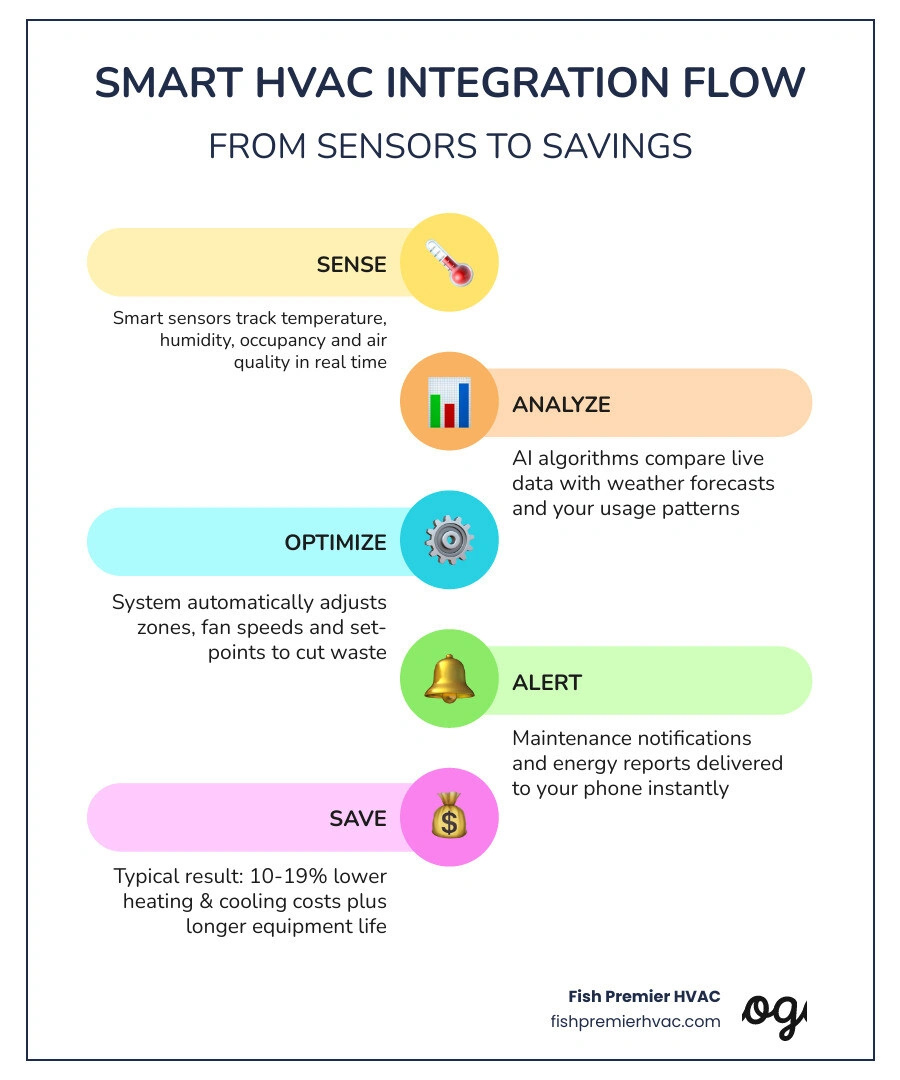
The results are backed by real data. According to the U.S. Environmental Protection Agency, smart thermostats can save homeowners up to 10–12% on heating and 15% on cooling costs. Field research published in Applied Energy found that predictive heating control reduced daily heating energy use by 19% and cut backup heat energy consumption by 38% — in a real home, through a real winter, not just a simulation.
For homeowners in the Dallas-Fort Worth area who expect more from their home environment — reliability, precision, and a seamless experience — smart HVAC integration isn't a luxury upgrade. It's the new standard of whole-home comfort.
How Smart Home Technology Improves HVAC Performance: An Overview
At its core, smart home integration for heating and cooling systems is about bridging the gap between static mechanical equipment and the dynamic realities of modern living. Traditional HVAC systems operate on a simple, reactive loop: the temperature drops or rises past a set point, and the system runs at full blast until the thermostat is satisfied. This binary approach ignores weather shifts, occupancy changes, and utility grid stress.
By introducing Internet of Things (IoT) devices, we can establish a fully connected ecosystem. This infrastructure allows your heating, cooling, and indoor air quality equipment to communicate with each other, with external data sources (like local weather feeds), and with you. Through centralized Home Automation, your home transitions from a collection of isolated appliances into a unified, responsive sanctuary.
Remote management via secure mobile applications or intuitive voice assistants ensures you are always in control, whether you are relaxing in your living room in Southlake or traveling abroad. The real magic, however, happens when the system operates autonomously, making micro-adjustments behind the scenes to maximize both your comfort and your system's operational efficiency.
How Smart Home Technology Improves HVAC Performance Through Automation
Automation is the engine that drives modern HVAC efficiency. Rather than relying on you to manually adjust the thermostat before you leave for work or head to bed, automated systems handle the heavy lifting using sophisticated logic.
• Adaptive Learning: Devices like Nest or Ecobee analyze your daily habits. Within a few weeks, they learn when you wake up, when you leave the house, and what temperatures you prefer during different times of the day. They construct a highly customized schedule that matches your lifestyle perfectly.
• Geofencing: By establishing a virtual boundary around your property using your smartphone's GPS, your HVAC system knows exactly when you are away. It can automatically enter an energy-saving "away" mode when you cross the boundary, and then begin restoring your preferred comfort settings the moment you head back. This ensures you never waste energy conditioning an empty house, yet you always return to a perfectly comfortable environment.
• Occupancy Sensing: Built-in motion and ambient sensors detect real-time activity. If a guest room or home office remains empty for several hours, the system can dial back the climate control in that specific area.
This level of localized, automated control is particularly beneficial in our North Texas climate, where spring and autumn days can swing from chilly mornings to hot, humid afternoons. Implementing a Connected Home HVAC Colleyville setup allows your home to effortlessly adapt to these rapid outdoor changes without requiring constant manual intervention.
The Role of Intelligent Sensors and Zoned Climate Control
Traditional HVAC systems suffer from a major design limitation: they rely on a single thermostat, usually located in a central hallway, to make decisions for the entire house. This inevitably leads to hot and cold spots, especially in larger multi-story homes.
Smart home technology solves this through intelligent sensors and zoned climate control. Wireless remote sensors can be placed in key living areas, such as the master bedroom, the kitchen, or a home theater. These sensors measure both temperature and relative humidity, transmitting the data back to the primary controller.
When paired with automated smart vents or a dedicated motorized zoning damper system, the climate control can be directed precisely where it is needed. For example, during a warm summer evening, the system can prioritize cooling the upstairs bedrooms while reducing airflow to the unoccupied downstairs living areas. This targeted approach is a cornerstone of our Integrated Smart HVAC Keller installations, ensuring that every room maintains its ideal climate without overworking your primary compressor.
Key Benefits of Upgrading to a Connected HVAC System
Upgrading your home with smart HVAC technology delivers a wide range of practical benefits that enhance your daily life, protect your property, and reduce your environmental footprint.

When we look at the big picture of how smart home technology improves HVAC performance, the advantages fall into several key categories:
• Substantial Energy Savings: By eliminating unnecessary runtimes during unoccupied hours, smart systems directly lower your utility bills.
• Unrivaled Indoor Comfort: Consistent temperatures, targeted zoning, and proactive humidity management create a superior living environment.
• Extended Equipment Lifespan: Because the system operates with greater precision and undergoes fewer rapid on-off cycles, mechanical wear and tear is significantly reduced.
• Proactive System Protection: Real-time performance monitoring alerts you to minor anomalies before they escalate into major mechanical failures.
• Valuable Data Insights: Homeowners gain access to detailed energy reports, helping them understand exactly how their habits impact their home’s energy consumption.
For a deeper dive into the financial return on these upgrades, explore our detailed guide: Do Smart Thermostats Really Save Money.
Maximizing Efficiency and Reducing Peak Energy Demand
One of the most exciting developments in smart HVAC technology is its ability to interact with the broader electrical grid. During hot Texas summers, peak electricity demand puts immense strain on the local grid, often driving up energy costs. Smart home systems can help mitigate this through intelligent load balancing.
By analyzing your home's unique "energy signature" — how quickly it loses or retains heat relative to the outdoor temperature and humidity (often calculated using the difference, or "delta T") — a smart system can pre-cool your home during off-peak hours when electricity rates are lower. It then scales back operation during peak hours, keeping you comfortable while lowering your overall energy impact. Utilizing integrated Home Energy Management Westlake solutions empowers homeowners to take full advantage of these advanced load-shifting strategies, contributing to a more resilient local grid while keeping operational costs to an absolute minimum.
Enhancing Indoor Air Quality and Humidity Management
True comfort goes far beyond simple temperature control. High humidity can make a room feel sticky and warm, while dry air can irritate your respiratory system and damage delicate wood furnishings.
Smart HVAC systems excel at managing the latent load (humidity) of your home. They can orchestrate the operation of variable-speed compressors, whole-home dehumidifiers, and dedicated ventilation systems to maintain relative humidity within the ideal 40% to 60% comfort zone.
Furthermore, smart controls can be integrated with premium air purification systems, such as whole-home air scrubbers. When outdoor air quality drops — whether due to seasonal pollen or regional dust — or when indoor sensors detect elevated particulate levels, the system can automatically increase filtration cycles. This ensures that the air you and your family breathe is consistently clean, fresh, and healthy.
Overcoming Challenges and FAQs in Smart HVAC Integration
While the benefits of smart HVAC technology are clear, navigating the integration process can raise practical questions for homeowners. Ensuring a seamless transition requires addressing compatibility, network security, and installation requirements up front.
To help you evaluate the best path forward for your home, it is helpful to look at how a professional integration compares to a standard do-it-yourself approach:
• System Compatibility — DIY Smart Thermostat Setup: Limited to basic low-voltage wiring checks. — Professional Smart HVAC Integration: Comprehensive assessment of multi-stage systems, variable-speed blowers, and zone dampers.
• Wiring & Safety — DIY Smart Thermostat Setup: Risk of improper "C-wire" connections or damage to control boards. — Professional Smart HVAC Integration: Safe, certified low-voltage wiring and system configuration.
• Sensor Placement — DIY Smart Thermostat Setup: Often placed based on convenience rather than thermal dynamics. — Professional Smart HVAC Integration: Strategic placement of remote sensors for balanced, accurate readings.
• Ecosystem Integration — DIY Smart Thermostat Setup: Basic pairing with a single smartphone app. — Professional Smart HVAC Integration: Full integration with home automation hubs, air scrubbers, and backup generators.
• Network Security — DIY Smart Thermostat Setup: Standard home Wi-Fi setup with default device settings. — Professional Smart HVAC Integration: Secure configuration, firmware updates, and local network optimization.
• Long-Term Support — DIY Smart Thermostat Setup: Self-troubleshooting via online forums. — Professional Smart HVAC Integration: Ongoing maintenance, remote diagnostics, and priority service.
If you are planning an upgrade in the Fort Worth area, consulting with a specialist in Home Automation HVAC Fort Worth can help you avoid common pitfalls and ensure your entire system is configured for maximum performance and security from day one.
Can I integrate my existing HVAC system with smart home technology?
Yes, in the vast majority of cases, existing systems can be upgraded with smart capabilities. Most modern heating and cooling systems utilize standard low-voltage control wiring, making them compatible with smart thermostats and remote sensors.
However, the age and design of your system do play a role. Older, single-stage systems can easily adopt smart scheduling and remote access, but they won't support advanced features like variable-speed airflow modulation. If your home utilizes specialized equipment, such as ductless mini-splits or advanced zoning dampers, specialized smart adapters or professional interface modules may be required to ensure all components communicate correctly without sacrificing manufacturer warranties.
How much energy can a smart thermostat actually save?
While individual results vary based on your home's insulation, your local climate, and your personal habits, the savings are highly consistent across large-scale studies. The U.S. Department of Energy estimates that homeowners can save up to 10% a year on heating and cooling by simply turning their thermostat back 7 to 10 degrees Fahrenheit for eight hours a day from its normal setting.
Smart thermostats automate this process, ensuring you achieve these savings without ever having to think about it. By optimizing runtimes, coordinating with weather forecasts, and utilizing geofencing, most homeowners see a complete return on their smart thermostat investment within the first two to three years of installation.
Is professional installation necessary for smart HVAC systems?
While basic smart thermostats are often marketed as DIY-friendly, professional installation is highly recommended for premium residential systems. Modern high-efficiency HVAC units — especially those featuring variable-capacity compressors, integrated humidifiers, or multi-zone damper systems — rely on complex communication protocols.
Improper wiring (such as a missing or poorly connected common wire, or "C-wire") can lead to intermittent power loss, system short-cycling, or even permanent damage to your equipment's main control board. A professional technician ensures that all parameters, from fan delay profiles to staging thresholds, are calibrated precisely to match your home’s unique airflow requirements.
Future Innovations: AI and Predictive Climate Control
The world of home automation is evolving rapidly, and the future of climate control lies in artificial intelligence (AI) and predictive machine learning. We are moving away from simple schedule-based programming and entering an era of truly cognitive homes.
Future smart HVAC systems will not just react to what is happening in the moment; they will anticipate what is coming. By utilizing advanced machine learning algorithms, these systems can analyze real-time local weather forecasts, solar radiation patterns, and even your historical household behavior. If the system knows a hot, sunny afternoon is heading toward Keller, it can proactively adjust the cooling cycles ahead of time, preventing your home from overheating and avoiding the need for the system to run at maximum capacity during the hottest part of the day.
Furthermore, as utility companies transition toward real-time, dynamic pricing structures, AI-driven systems can communicate directly with the smart grid. They can automatically shift heavy energy usage to times when electricity is cheapest and most abundant, all while maintaining your preferred indoor comfort. Combined with secure data handling protocols like decentralized blockchain technology to protect your household's usage data, the next generation of smart HVAC systems will offer unprecedented levels of security, efficiency, and customized luxury.
How Smart Home Technology Improves HVAC Performance with Predictive Analytics
Predictive analytics represent the pinnacle of how smart home technology improves HVAC performance. Rather than waiting for your home to become too warm or too cold, predictive controllers continuously run thermal simulations of your home in real time.
These advanced systems calculate how your home's structure responds to external factors like wind speed, humidity levels, and direct sunlight. They combine this physical profile with occupancy predictions to determine the absolute most efficient way to maintain thermal comfort.
For example, instead of running a high-stage backup heating element during a sudden winter cold snap, a predictive controller can gently ramp up your highly efficient heat pump hours in advance. This avoids the use of energy-intensive auxiliary heat, keeps your indoor climate perfectly stable, and significantly reduces the mechanical stress on your system's compressor.
Conclusion
Embracing smart home technology is no longer just about convenience — it is the single most effective way to unlock the true potential of your heating and cooling system. From reducing energy waste and lowering utility bills to delivering precise, zoned comfort and safeguarding your indoor air quality, the benefits of a connected system are undeniable.
At Fish Premier HVAC, we specialize in bringing this level of "Whole Home Luxury" and "Expert HVAC Service For Whole Home Comfort" to discerning homeowners across the Dallas-Fort Worth area. Serving Keller, Westlake, Colleyville, and Southlake, we combine premium, high-efficiency heating and cooling installations with advanced air scrubbers, backup generators, and custom home scenting solutions.
Our concierge-level service model ensures that every aspect of your home's climate and air quality is designed, installed, and calibrated to meet the absolute highest standards of luxury and reliability. Licensed under Texas License #TACLB99535E, our highly trained team is available Monday through Friday from 8:00 AM to 6:00 PM for standard services, with prompt after-hours emergency support ready whenever you need us.
Ready to elevate your home's comfort and performance? Explore our premium Home Automation integration services and experience the difference that true concierge-level HVAC expertise can make.