%201.avif)
The Ultimate Guide to Nest Thermostat Benefits for HVAC Systems
Discover how Nest thermostat benefits for your HVAC system deliver smart energy savings, comfort, and seamless home automation in Texas.


.svg)
.svg)
.svg)
Why Nest Thermostat Benefits for Your HVAC System Matter in Dallas-Fort Worth
Understanding the nest thermostat benefits for your HVAC system can help you make a smarter decision about one of the most impactful upgrades available for your home's comfort and efficiency. Here's a quick look at what a Nest thermostat actually does for your heating and cooling system:
• Reduces energy waste by learning your schedule and adjusting temperatures automatically
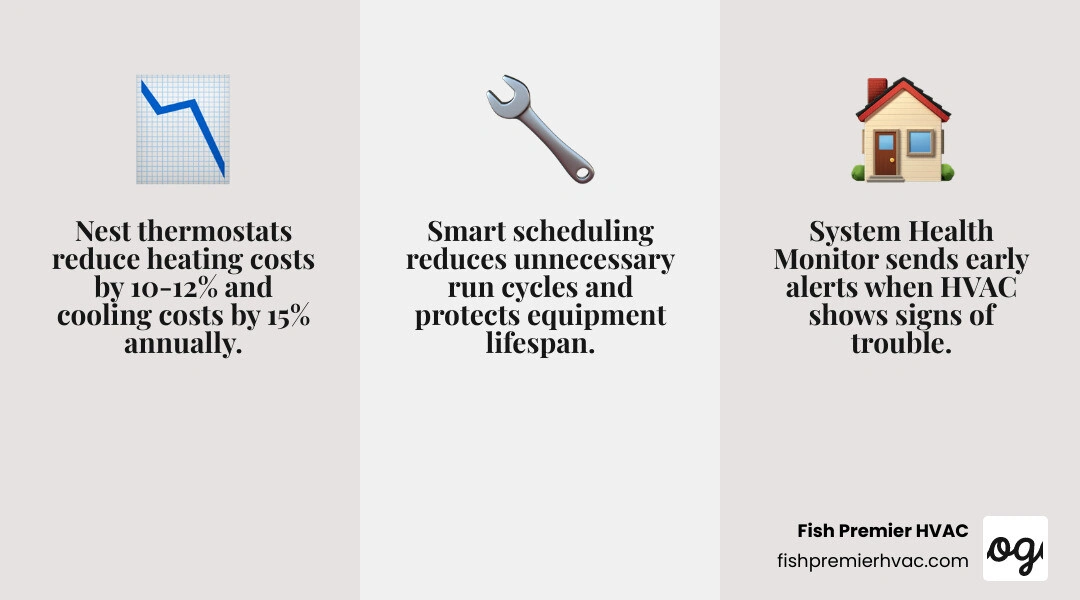
• Cuts heating costs by an average of 10-12% and cooling costs by around 15% annually
• Protects your HVAC equipment by reducing unnecessary run cycles when your home is unoccupied
• Sends early alerts when your system shows signs of trouble through the System Health Monitor
• Integrates with smart home platforms including Google Home, Amazon Alexa, and Apple HomeKit
• Pays for itself in under two years based on typical energy savings
• Works with most standard HVAC systems, including gas furnaces, central AC, and heat pumps
Heating and cooling account for roughly half of all energy use in the average home. That makes your thermostat one of the most powerful levers you have for controlling comfort, costs, and equipment health. A smart thermostat like Google Nest doesn't just replace the dial on your wall — it actively works with your HVAC system to optimize every cycle, every day.
For discerning homeowners in the Dallas-Fort Worth area, where summers push AC systems to their limits and efficiency demands are high, the right thermostat can make a meaningful difference in both your monthly bills and the long-term health of your system.
Know your nest thermostat benefits for your hvac system terms:
• best thermostat settings for energy savings in texas
• do smart thermostats really save money
What is a Nest Thermostat and How Does It Work?
At its core, a Google Nest thermostat is an internet-connected, smart climate controller designed to replace your traditional, manually operated wall thermostat. Unlike older programmable models that require tedious manual scheduling, the Nest uses built-in sensors, local weather data, and machine learning algorithms to manage your home's climate.
The device connects directly to your home's Wi-Fi network, allowing it to communicate with the Google Home app on your smartphone, tablet, or smart display. By continuously analyzing data, the thermostat bridges the gap between your daily routine and your heating and cooling system. It operates on standard low-voltage (24V) HVAC control systems, sending precise signals to your furnace, air conditioner, or heat pump to maintain your desired indoor climate with minimal energy waste.
In modern homes across Keller, Southlake, and Westlake, the integration of smart climate technology is a key component of a sophisticated living space. Upgrading to a smart thermostat is a central pillar of Home Automation HVAC Fort Worth and a highly sought-after feature for creating a fully Connected Home HVAC Colleyville.
Smart Scheduling and Machine Learning
The true magic of the Nest Learning Thermostat lies in its auto-learning capabilities. During the first week of installation, the device acts like an apprentice. Every time you turn the temperature up when you wake up, or lower it before heading to bed, the Nest notes the time and your preference.
Equipped with a array of advanced temperature and activity sensors, the Nest observes when people are moving through the home and when the house falls silent. Over the course of four to seven days, its machine learning algorithm processes these habits to draft a personalized, highly efficient schedule. If you consistently lower the AC to 72°F at 10 PM on weekdays, Nest learns this pattern and automates it for you. This hands-off scheduling ensures your home remains perfectly comfortable without requiring you to constantly fiddle with the wall unit. To understand how these automated adjustments align with local climate challenges, you can read about the Best Thermostat Settings for Energy Savings in Texas.
Seamless Integration with DFW Smart Homes
A luxury home in the Dallas-Fort Worth metroplex relies on seamless technology integration. The newest fourth-generation Nest Learning Thermostat features native Matter-over-Wi-Fi support. This is a massive leap forward for smart home enthusiasts because Matter allows the Nest to integrate directly with Apple HomeKit, Amazon Alexa, and Samsung SmartThings without the need for complex, third-party bridges.
Whether you prefer using voice commands with Siri while relaxing in your living room, or setting automated routines through Google Home, the Nest fits effortlessly into your existing ecosystem. This cross-platform compatibility ensures that your climate control works in perfect harmony with your lighting, security, and entertainment systems, delivering the ultimate experience in Integrated Smart HVAC Keller.
Key Nest Thermostat Benefits for Your HVAC System

When evaluating the nest thermostat benefits for your HVAC system, it is easy to focus solely on convenience. However, the advantages go far deeper than simply being able to adjust your AC from the comfort of your bed. The Nest acts as an intelligent coordinator that optimizes how your heating and cooling systems run, ensuring they operate at peak performance. For a broader look at the financial returns of these smart upgrades, explore our guide on Do Smart Thermostats Really Save Money.
Maximizing Nest Thermostat Benefits for Your HVAC System Performance
One of the most impressive features of the Nest ecosystem is the System Health Monitor. Your heating and cooling systems are complex, and subtle performance declines often go unnoticed until a total breakdown occurs. The Nest thermostat continuously monitors your system's behavior and compares it to historical data.
If your air conditioner is taking significantly longer than usual to cool your home on a typical 95°F afternoon, the Nest can detect this anomaly and send an early alert to your smartphone. This early warning system allows you to address minor issues—like a failing capacitor or a slow refrigerant leak—before they turn into costly emergency repairs.
Furthermore, advanced models support smart ventilation systems and premium indoor air quality accessories. By communicating with whole-home air scrubbers and fresh air dampers, the Nest can bring in fresh outdoor air only when the local outdoor air quality is high, keeping your home both comfortable and healthy. If you ever encounter communication issues between your device and your heating or cooling system, our tips on Troubleshooting AC Thermostat Problems can guide you through the initial steps.
Long-Term Nest Thermostat Benefits for Your HVAC System Lifespan
An HVAC system is a major investment. Extending its operational lifespan is a priority for any homeowner. The primary cause of premature compressor or furnace failure is mechanical wear and tear caused by excessive or inefficient run cycles.
Traditional thermostats operate on rigid, basic temperature differentials. They turn the system on the second the temperature drifts a single degree, often leading to short, frequent cycles. Nest’s advanced algorithms, combined with features like Adaptive Eco and Natural Heating & Cooling, help smooth out these cycles. By understanding how long your home takes to heat up or cool down, Nest prevents unnecessary "short-cycling" and minimizes the high-stress startup sequences that wear down your compressor.
When your HVAC system runs in longer, more efficient cycles, it experiences significantly less wear, extending the lifespan of your expensive equipment. Of course, even the smartest thermostat cannot replace physical upkeep; pairing your smart device with the Benefits of Regular AC Maintenance in Texas ensures your luxury system runs flawlessly for decades.
Energy Savings and Efficiency Features
The Google Nest Learning Thermostat holds the distinction of being the first programmable thermostat to receive an ENERGY STAR certification. Because heating and cooling make up the largest portion of a home's utility expenses, the efficiency features built into the Nest are designed to deliver tangible, measurable financial returns.
To help you choose the right fit for your home's setup, let's look at how the flagship fourth-generation model compares to the standard Nest Thermostat:
• MSRP / Positioning — Nest Learning Thermostat (4th Gen): Premium / High-End Luxury — Nest Thermostat (Standard): Budget-Friendly / Essential
• Material & Design — Nest Learning Thermostat (4th Gen): Stainless Steel, Borderless Glass — Nest Thermostat (Standard): Polished Plastic, Mirrored Lens
• Scheduling Method — Nest Learning Thermostat (4th Gen): AI Auto-Learning & Manual — Nest Thermostat (Standard): Manual App Programming
• Smart Home Protocol — Nest Learning Thermostat (4th Gen): Matter-certified, Google, Alexa, Apple — Nest Thermostat (Standard): Matter-certified, Google, Alexa, Apple
• C-Wire Requirement — Nest Learning Thermostat (4th Gen): No (Power Sharing Tech in most homes) — Nest Thermostat (Standard): Often required (or uses Power Connector)
• HVAC Compatibility — Nest Learning Thermostat (4th Gen): Works with 95% of 24V systems (inc. 3-stage) — Nest Thermostat (Standard): Works with 85% of 24V systems (1-2 stage)
• Sensor Support — Nest Learning Thermostat (4th Gen): Includes 2nd Gen Sensor (Supports up to 6) — Nest Thermostat (Standard): Supports Nest Sensors (sold separately)
• Advanced HVAC Control — Nest Learning Thermostat (4th Gen): Humidifiers, Dehumidifiers, Ventilation — Nest Thermostat (Standard): Basic Heating and Cooling
Eco Mode and Seasonal Savings
The Nest utilizes two primary features to eliminate energy waste when you aren't home: Eco Temperatures and Seasonal Savings.
Using built-in motion sensors and your smartphone’s GPS location (via the Google Home app), the thermostat detects when the house is empty. It then automatically switches to your pre-configured Eco Temperatures. This prevents your AC from cooling an empty house while you are at work or traveling, but ensures the system recovers to a comfortable temperature by the time you walk through the door.
Additionally, Nest offers Seasonal Savings. This opt-in program makes tiny, imperceptible adjustments to your schedule over the course of several weeks as the seasons transition. For instance, in early summer, it might adjust your temperature schedule by just 0.5°F or 1°F at strategic times. These minor tweaks add up, helping Nest users save an additional 3% to 7% on cooling and 3% to 8% on heating costs without sacrificing comfort.
Real-World Energy Bill Reductions
The financial impact of installing a Nest thermostat is backed by extensive real-world data. Multi-state utility bill analyses show that Nest users save an average of 10% to 12% on heating bills and 15% on cooling bills annually.
In terms of actual dollars, the average customer saves between $131 and $145 per year. Depending on your home's size, local weather patterns, and your baseline energy habits, some households report savings of up to 31% on their heating and cooling costs. With these consistent savings, a Nest thermostat typically pays for itself in under two years, making it an incredibly smart, high-return investment for your home.
Compatibility, Installation, and Potential Drawbacks
While the benefits are clear, ensuring a flawless integration with your specific heating and cooling system requires a bit of planning. Understanding compatibility and potential technical hurdles beforehand will help you avoid system errors and protect your equipment. For general system care tips, you can review our HVAC Maintenance Tips for Texas Homeowners.
HVAC System Compatibility and C-Wire Requirements
Nest thermostats are compatible with up to 95% of standard 24V heating and cooling systems. This includes conventional gas, electric, and oil forced-air furnaces, heat pumps, and radiant heating systems.
However, a common point of confusion surrounds the common wire, or C-wire. The C-wire provides a continuous loop of 24V power from your HVAC system's transformer to keep the thermostat's internal battery charged. While Nest thermostats feature patented Power Sharing technology that allows them to run without a C-wire in many homes by "stealing" small amounts of power when the system is running, some older or highly sensitive HVAC control boards do not tolerate this.
Without a dedicated C-wire, you may experience issues like:
• Thermostat screen flickering
• Wi-Fi dropping offline frequently
• Strange clicking noises from your furnace or AC unit
• System short-cycling
To resolve this, we highly recommend utilizing the Nest Power Connector or having a professional HVAC technician run a dedicated C-wire during installation to guarantee system stability.
Potential Drawbacks and Short-Cycling Concerns
While Nest is a stellar piece of technology, it is not without potential drawbacks. Some homeowners with oversized HVAC systems have reported issues with short-cycling. If an AC system is too large for the square footage of a home, it cools the space incredibly fast. If the thermostat's internal temperature differential (often called the "deadband") is set too tight, the system will turn on and off rapidly to chase a single degree. This can lead to increased energy use and excessive wear on the compressor.
Additionally, Nest thermostats are highly dependent on a stable Wi-Fi connection to access their smartest features, such as remote app control, weather tracking, and energy history reports. If your home has Wi-Fi dead zones near the thermostat location, you may lose access to these premium features.
Finally, technology moves quickly. It is worth noting that older smart devices eventually lose support; for example, first- and second-generation Nest Learning Thermostats (released in 2011-2012) officially lost cloud and app support in late 2025. Choosing a modern, Matter-certified model ensures your home automation system remains future-proofed for years to come.
Frequently Asked Questions About Nest Thermostats
Does a Nest thermostat work without Wi-Fi?
Yes, a Nest thermostat will continue to function as a traditional, reliable wall thermostat even if your home Wi-Fi goes down or if you experience an internet outage. It will still run your current temperature schedule, utilize its local sensors to detect occupancy, and allow you to manually adjust the temperature using the physical dial or touch slider. However, you will temporarily lose remote control via the Google Home app, real-time weather tracking, and energy history reports until the connection is restored.
How long does it take for Nest to learn your schedule?
The Nest Learning Thermostat typically takes about four to seven days of consistent use to build an accurate, personalized schedule. During this initial learning period, it is best to adjust the thermostat manually whenever you want a temperature change, rather than programming a static schedule. This active feedback allows the machine learning algorithm to understand your true daily preferences and routines.
Is a Nest thermostat compatible with all HVAC systems?
While Nest works with the vast majority of 24V heating and cooling systems, it is not compatible with high-voltage (110V or 240V) baseboard heaters, proprietary communicating HVAC systems, or most ductless mini-split systems. Before purchasing, it is always best to use the official online Google Nest Compatibility Checker or consult with a licensed HVAC professional to verify your home's wiring.
Conclusion
Upgrading to a smart thermostat is one of the most practical and rewarding ways to maximize your home's comfort, protect your heating and cooling equipment, and enjoy substantial energy savings. By automating your daily climate schedules and providing remote access, the Nest thermostat delivers modern convenience while actively reducing wear and tear on your HVAC system.
At Fish Premier HVAC, we believe in providing Expert HVAC Service For Whole Home Comfort and Whole Home Luxury to homeowners throughout the Dallas-Fort Worth area. Serving Keller, Westlake, Colleyville, and Southlake, our team specializes in premium, high-efficiency HVAC installations, advanced air scrubbers, backup generators, and custom home scenting solutions.
As a top-rated provider with Texas License #TACLB99535E, we are dedicated to delivering concierge-level service. Whether you need a prompt diagnostic analysis during our regular business hours (Monday-Friday, 8am-6pm) or require our after-hours emergency services, we are here to ensure your home remains a perfect sanctuary.
Ready to elevate your home's climate control? Upgrade your home comfort with luxury home automation solutions today and experience the ultimate in residential comfort and efficiency.