%201.avif)
Deep in the Heart of Savings: The Ultimate Texas Heat Pump Guide
Discover heat pump benefits for Texas homeowners: slash energy bills 50%, ace 2026 standards, unlock incentives & conquer DFW climate!


.svg)
.svg)
.svg)
Why Heat Pump Benefits for Texas Homeowners Are Impossible to Ignore in 2026
Heat pump benefits for Texas homeowners include dramatically lower energy bills, year-round heating and cooling from a single system, superior humidity control, and access to significant federal and state financial incentives — all uniquely well-suited to the DFW climate.
At a glance, here's what Texas homeowners gain by switching to a heat pump:
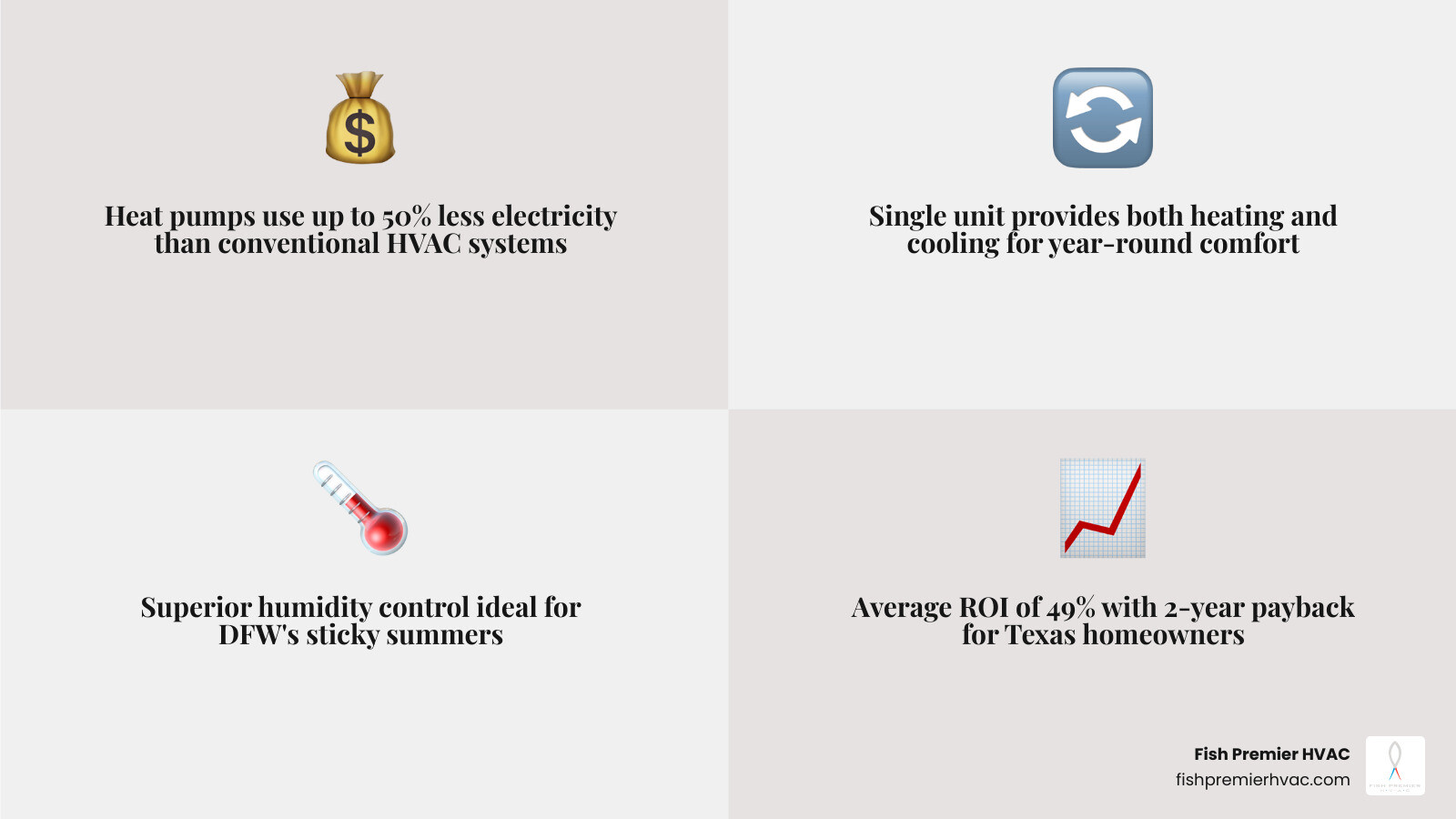
• Lower energy costs — Heat pumps use up to 50% less electricity than conventional HVAC systems and can cut heating costs by as much as 75% compared to electric resistance heating
• One system, two jobs — A single unit replaces both your air conditioner and furnace, simplifying your home's comfort setup
• Better humidity control — Modern inverter-driven heat pumps actively manage indoor humidity, which matters enormously in DFW's sticky summers
• Stronger financial returns — Texas homeowners replacing aging AC and electric resistance systems see an average ROI of 49%, with a payback period of roughly two years
• Federal tax credits — The Inflation Reduction Act offers a 30% tax credit (up to $2,000 annually) for qualifying heat pump installations in 2026
• Environmental impact — Switching reduces your home's carbon footprint significantly, with Texas standing to save over 3.2 million metric tons of CO₂ per year if widespread adoption occurs
• Grid reliability — Heat pumps reduce strain on the ERCOT grid, especially during the kind of winter demand spikes Texas experienced during Winter Storm Uri in 2021
Texas already has more heat pumps installed in homes than any other state — 1.95 million and counting. That's not a coincidence. The combination of long, hot summers, relatively mild winters, and Texas's lower-than-average electricity costs makes heat pumps one of the smartest home comfort investments a DFW homeowner can make right now.
For discerning homeowners in communities like Southlake, Keller, Westlake, and Fort Worth, the question in 2026 isn't really whether a heat pump makes sense. It's whether your current system is holding you back from the comfort, efficiency, and reliability your home deserves.
What are Heat Pumps and How Do They Handle the Texas Climate?
To understand why a Heat Pump is so effective in North Texas, we first have to debunk a common myth: heat pumps do not "create" heat or cold. Instead, they are master movers. Think of a heat pump as a high-efficiency transport system for thermal energy.
Using a sophisticated refrigerant cycle, these systems pull heat from where it isn't wanted and move it to where it is. In the summer, a heat pump works exactly like a traditional air conditioner—it absorbs the heat inside your Southlake home and expels it outdoors. However, thanks to a specialized component called a reversing valve, the process can flip. In the winter, the system extracts ambient heat from the outdoor air—even when it feels chilly to us—and pumps it into your living room.
Modern units utilize variable-speed technology (often called inverter technology). Unlike older systems that are either "all on" or "all off," variable-speed compressors adjust their output in tiny increments. This is a game-changer for the Dallas-Fort Worth climate. During our long, "sticky" summers, these systems run at lower speeds for longer periods, which allows them to pull significantly more moisture out of the air. This superior humidity control means you can feel comfortable at a higher thermostat setting, further driving down your energy usage.
I'm looking to upgrade my home's comfort. What are the primary heat pump benefits for Texas homeowners?
When we discuss the heat pump benefits for Texas homeowners, we are looking at a triple-win: financial savings, enhanced comfort, and community responsibility. Because Texas has lower-than-average electricity costs but relatively higher natural gas prices compared to the national average, the math heavily favors all-electric heat pump systems.
The efficiency numbers are staggering. On average, air-source heat pumps use 50% less electricity than conventional HVAC systems for heating and cooling. During the winter, the savings are even more pronounced; a heat pump can reduce electricity use for heating by as much as 75% compared to electric resistance furnaces. For a typical household in Keller or Colleyville, this can translate to an average of $670 in annual savings on electric bills.
Beyond your wallet, there is the benefit of grid stability. Texas residents remember the strain on the ERCOT grid during recent winter events. Research shows that if Texas homeowners widely adopted heat pumps, the state could reduce residential winter peak demand by 7.5 GW. That is equivalent to avoiding the need for twenty-five 300-MW gas-fired power plants. By choosing a Heat Pump Service Fort Worth Tx, you aren't just upgrading your home; you're helping protect the entire Texas power grid.
How do the heat pump benefits for Texas homeowners compare to traditional gas furnaces?
While gas furnaces provide a "blast" of hot air, they often lead to significant temperature swings and "hot spots" throughout the house. Heat pumps, particularly those with inverter technology, provide a steady, consistent flow of air. This results in a much more stable indoor environment without the noisy "on-off" cycling associated with traditional furnaces.
Safety is another luxury. Because heat pumps are all-electric, they eliminate the risk of carbon monoxide leaks or gas line issues within the home. Furthermore, modern systems offer advanced air filtration, working seamlessly with air scrubbers to ensure the air in your Westlake estate is as clean as it is comfortable. If your current system is making strange noises or failing to keep things even, it might be time for a Heat Pump Repair Keller Tx or a full system evaluation.
Why are the heat pump benefits for Texas homeowners so significant in 2026?
In 2026, the financial argument for heat pumps has reached a tipping point. The Return on Investment (ROI) for these systems is now among the highest of any home improvement. For homeowners replacing an existing central AC and electric resistance heat setup, the ROI is approximately 49% with a simple payback period of just two years. In new construction, that ROI jumps to a massive 103%.
With the continued volatility of fossil fuel prices, reducing gas reliance is a strategic move. By opting for a high-efficiency electric system, you insulate your household budget from the fluctuations of the gas market. For those looking for a clear path forward, our Affordable Heat Pump Install Keller Guide provides a roadmap for navigating these upgrades.
Comparing Heat Pumps to Traditional AC and Furnace Systems
Choosing between a dual-function heat pump and the traditional "AC + Furnace" combo often comes down to your home's existing infrastructure and your long-term goals.
• Functionality — Heat Pump: Heating & Cooling in one unit — Traditional AC + Gas Furnace: Cooling only (AC); Heating only (Furnace)
• Efficiency (Cooling) — Heat Pump: High (Up to 20% better than old ACs) — Traditional AC + Gas Furnace: Standard to High (SEER2)
• Efficiency (Heating) — Heat Pump: 300-400% (Moves heat) — Traditional AC + Gas Furnace: 80-98% (Creates heat by burning fuel)
• Lifespan — Heat Pump: 15–20 Years (with maintenance) — Traditional AC + Gas Furnace: AC: 10-15 Years; Furnace: 15-20 Years
• Energy Source — Heat Pump: Electricity — Traditional AC + Gas Furnace: Electricity (AC) + Gas/Propane (Furnace)
• Humidity Control — Heat Pump: Excellent (Variable-speed models) — Traditional AC + Gas Furnace: Standard
While a central AC unit might have a slightly lower upfront cost if you already have a working furnace, the Heat Pump Vs Traditional Hvac debate usually ends in favor of the heat pump for North Texas. The heat pump's ability to handle both seasons with one high-efficiency compressor simplifies maintenance and reduces the "mechanical footprint" in your home.
When is the Best Time for a Heat Pump Installation in Southlake or Keller?
Timing is everything when it comes to HVAC. We often see homeowners waiting until a system catastrophic failure occurs in the middle of a July heatwave. However, the best time to consider a Heat Pump Installation Southlake Tx is before the emergency strikes.
Signs your existing system is ready for retirement include:
1. Age: If your current AC or furnace is between 10–12 years old, it is likely operating at a fraction of the efficiency of modern 2026 models.
2. Rising Bills: If your utility costs are climbing despite similar usage patterns, your system is working harder to achieve less.
3. Frequent Repairs: If you have our team on speed dial for monthly "fixes," those costs are better spent on a down payment for a new, warrantied system.
4. Uneven Comfort: If the master suite is a sauna while the kitchen is an icebox, your system's airflow and ducting integration are likely failing.
For those in our service area, we recommend reviewing our Heat Pump Installation Keller Tx Guide to understand the process and how we ensure a "concierge-level" experience from the first load calculation to the final thermostat calibration.
Navigating Federal and State Incentives for Your 2026 Upgrade
One of the most compelling heat pump benefits for Texas homeowners in 2026 is the sheer volume of financial assistance available. The federal government, through the Inflation Reduction Act (IRA), offers a 30% Tax Credit on the total cost of a qualified heat pump installation, capped at $2,000 per year.
But the savings don't stop there. Texas has received significant federal funding for state-administered rebate programs. Depending on your household income, you could be eligible for:
• HEAR/HOMES Rebates: Up to $8,000 for a heat pump for space heating and cooling.
• Heat Pump Water Heaters: An additional rebate of up to $1,750.
• Income-Based Support: If your household income is less than 80% of the area's median income, you may qualify for 100% of the available rebates, potentially totaling $9,750 back in your pocket.
Because these credits refresh annually, some of our clients choose to space out their upgrades—installing a new HVAC heat pump one year and a heat pump water heater the next—to maximize the $2,000 annual tax credit limit. When you schedule a Heat Pump Installation Fort Worth Tx, we can help you navigate the documentation required to claim these incentives.
Frequently Asked Questions about Texas Heat Pumps
Do heat pumps work in extreme Texas freezes?
Yes. There is a common misconception that heat pumps fail when the temperature drops. While older models struggled, new "cold-climate" heat pumps are designed to operate effectively down to -10°F. For the rare occasions when DFW experiences a deep, prolonged freeze, these systems are equipped with auxiliary electric heat strips. These act as a safety net, ensuring your home stays warm even when the outdoor temperatures are record-breaking. If your system ever switches over unexpectedly, you can learn more about how this works in our guide on Heat Pump Emergency Mode.
What are the electrical requirements for a new system?
Because heat pumps are powerful electric appliances, they do require a robust electrical setup. Most modern homes in Westlake and Southlake already have the standard 200-amp electrical panel required. However, if you live in an older home with a 100-amp or 125-amp panel, an upgrade may be necessary. The good news? The IRA also provides tax credits of up to $600 (or more depending on income) for electrical panel upgrades when performed in conjunction with a heat pump installation. We specialize in Heat Pump Installation Westlake Tx, which includes a full assessment of your home's electrical capacity.
How long do these systems typically last in DFW?
With proper care and professional maintenance, a high-quality heat pump can last 15-20 years. Because these systems run year-round (providing both heating and cooling), they do require consistent attention. We recommend twice-yearly "tune-ups"—once before the summer heat hits and once before the winter chill arrives. This preventive care ensures that your Heat Pump Replacement Fort Worth Tx is an investment that lasts for decades, not just a few seasons.
Conclusion
The transition to heat pump technology represents the future of Texas home comfort. By moving heat instead of creating it, these systems offer a level of efficiency and precision that traditional furnaces simply cannot match. For the homeowners of Keller, Southlake, Westlake, and Colleyville, the benefits are clear: lower utility bills, a smaller environmental footprint, and a more resilient home.
At Fish Premier HVAC, we don't just "install boxes." We provide a concierge-level service that treats your home with the respect it deserves. From premium, whisper-quiet installations to advanced air quality integration, we are here to ensure your transition to a heat pump is seamless and luxurious.
Ready to experience the best in residential climate control? Explore our full range of Heat Pump services and discover how we can elevate your home's comfort today.