%201.avif)
The Texan Guide to Surviving Storm Damage to Your Air Conditioner
Discover how Texas storms affect your HVAC system. Protect your AC from hail, wind, surges & outages with expert tips for DFW homeowners.

.svg)
.svg)
.svg)
How Texas Storms Affect Your HVAC System — and What Every DFW Homeowner Needs to Know
How texas storms affect your hvac system is something every homeowner in the Dallas-Fort Worth area eventually learns the hard way — often right when summer heat becomes unbearable. Texas doesn't do anything small, and that includes its storms. From spring hailstorms pounding North Texas suburbs to flash floods swamping outdoor units overnight, the damage can be swift, costly, and easy to miss until your system stops working entirely.
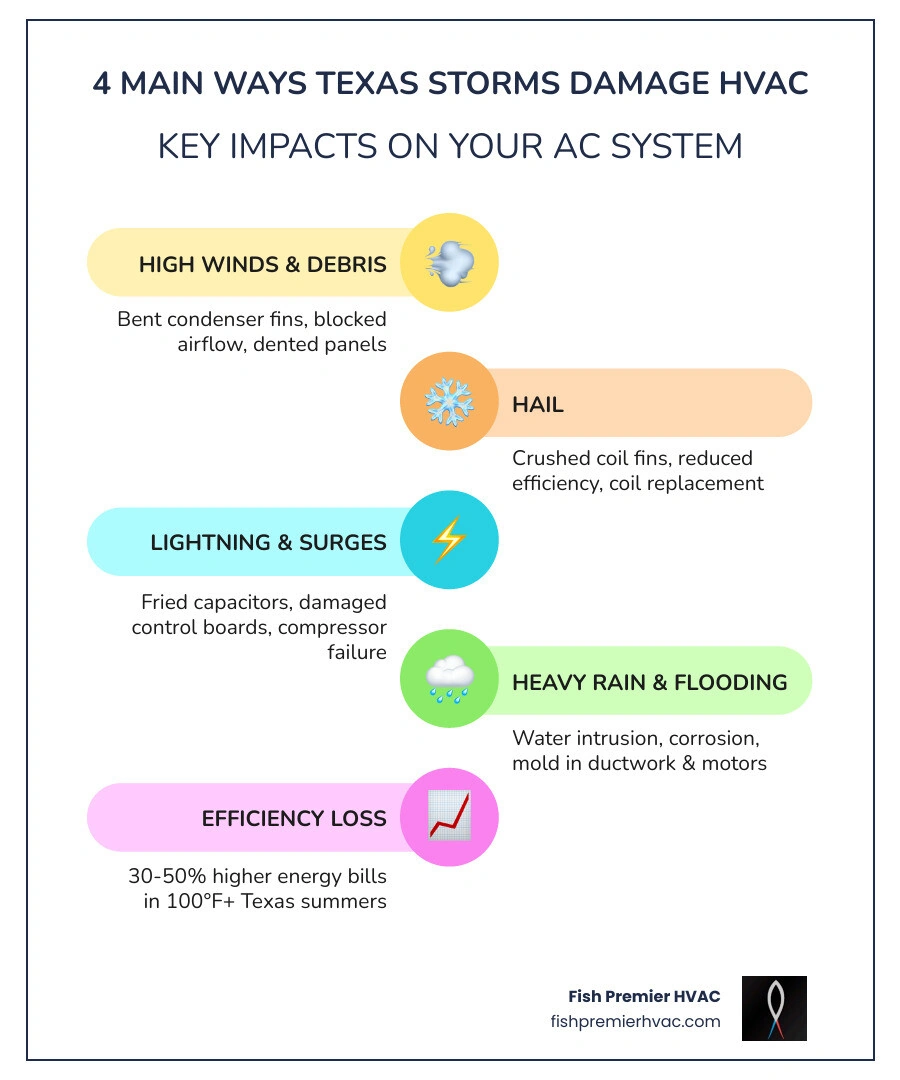
Here's a quick summary of the four main ways Texas storms damage HVAC systems:
| Storm Threat | Primary HVAC Impact |
|---|---|
| High winds and flying debris | Bent condenser fins, blocked airflow, dented panels |
| Hail | Crushed coil fins, reduced efficiency, potential coil replacement |
| Lightning and power surges | Fried capacitors, damaged control boards, compressor failure |
| Heavy rain and flooding | Water intrusion, corrosion, mold growth in ductwork and motors |
The stakes are high in the DFW area. Summers regularly push past 100°F, and when your AC goes down after a storm, your home can become genuinely unsafe — not just uncomfortable. Research shows that energy consumption spikes by 30 to 50% when outdoor temperatures climb above 95°F, meaning a damaged or struggling system drives up your bills fast while still failing to keep up.
What makes Texas storms uniquely brutal for HVAC equipment is the combination of factors that rarely hit other regions all at once: hail that shreds condenser fins, lightning that fries sensitive electronics, high humidity that follows every storm and pushes mold risk indoors, and flooding that can submerge ground-level units in minutes. In North Texas, a 75-degree morning can give way to a severe thunderstorm by afternoon — and your HVAC system absorbs every bit of that stress.
This guide walks you through exactly what happens to your system during and after a storm, what warning signs to watch for, and how to protect your investment before the next one hits.
Common Texas Storms and Their Impact on HVAC Systems
Living in North Texas, specifically in communities like Southlake or Westlake, we are well-acquainted with the sheer intensity of the weather. Our HVAC systems are the frontline soldiers in this environment. Thunderstorms, tornadoes, and high winds aren't just spectacles; they are mechanical threats.
When a thunderstorm rolls through, it brings a cocktail of high wind and heavy rain. High winds can turn patio furniture or loose tree limbs into projectiles. Meanwhile, flash flooding—common in our flat terrain—can submerge the base of your outdoor unit. If water reaches the electrical components or the fan motor, you're looking at immediate corrosion or short-circuiting. Even if the unit isn't submerged, how to maintain your ac in extreme heat becomes significantly harder when the system is recovering from water intrusion.
Spring Storm Patterns in North Texas
Spring in the DFW area is often a "stress test" rather than a break season. It’s characterized by rapid temperature swings and intense atmospheric pressure changes. One of the most significant issues we face is the humidity spike that follows a heavy spring rain.
Texas humidity adds a "second job" to your AC. Beyond cooling the air, it must remove moisture. This dehumidification process can consume up to 40% of your system's total cooling capacity. When storms saturate the air, your system works overtime. If the drainage system isn't perfectly clear, you'll encounter ac drainage problems during high humidity, leading to water backing up into your home or causing the system to shut down to prevent a flood.
How Texas Storms Affect Your HVAC System: Wind, Debris, and Hail
Wind and debris are the "physical attackers" of your HVAC system. During a typical North Texas storm, wind speeds can easily exceed 60 mph. At these speeds, even small items like mulch, gravel, or twigs can be forced into the outdoor cabinet.
Flying debris can dent the protective panels or, worse, strike the condenser coils. These coils are the heart of the heat-exchange process. When they are blocked by mud, leaves, or trash, the system can't "breathe." This lack of airflow forces the compressor to work harder, leading to a massive drop in efficiency. You might notice your home feels warmer even though the AC is running constantly. This is exactly how heat waves affect ac efficiency, but the damage is physical rather than just environmental.
The 30% Rule for Condenser Fin Damage
The soft aluminum "fins" on your outdoor unit are incredibly delicate. Hail is their worst enemy. When hail strikes these fins, it flattens them, sealing off the gaps that allow air to pass through the coils.
In the HVAC industry, we use the "30% Rule." If more than 30% of your condenser fins are severely bent or crushed, the airflow is restricted to a point where the system can no longer operate safely or efficiently. At this stage, a professional needs to assess whether the fins can be "combed" back into place or if the entire coil needs replacement. Ignoring this leads to mechanical failure of the compressor, which is the most expensive part of your system.
Common Debris Hazards in DFW Yards:
- Tree Limbs: Falling branches can crush fan motors.
- Loose Mulch: Can be sucked into the unit, clogging the bottom of the coils.
- Patio Decor: Statues or lightweight furniture can be blown into the unit.
- Hail: Anything larger than a marble can cause permanent fin deformation.
Electrical Hazards and Power Outage Protection
Texas is a leader in lightning strikes, and our electrical grid often fluctuates during severe weather. For your HVAC system, this is a silent killer. A single lightning strike nearby can send a massive voltage spike through your home's wiring.
While a direct hit is rare, power surges are constant. These surges target the "brains" of your system: the control boards and capacitors. Capacitors are particularly vulnerable to heat and electrical stress. We frequently find that systems failing to start after a storm have a "fried" capacitor or a blown fuse on the control board. This is why power outage protection is not a luxury in Keller or Colleyville—it's a necessity.
Electrical Hazards: How Texas Storms Affect Your HVAC System Components
When a power surge hits, it doesn't always kill the system instantly. Sometimes, it weakens the insulation on the motor windings or damages the compressor's internal circuitry. You might find your AC works for a few days after a storm and then suddenly dies during the next 100-degree afternoon.
To prevent this, we recommend installing an HVAC-specific surge protector. These devices ($75–$200 installed) act as a gatekeeper, sacrificing themselves to save your multi-thousand-dollar compressor. For those seeking the ultimate peace of mind, finding the best home standby generator fort worth tx ensures that your cooling stays on even when the local grid fails.
Backup Power Solutions for DFW Homeowners
A power outage in July isn't just an inconvenience; it's a home comfort emergency. Indoor air can feel 5 to 10 degrees warmer than your thermostat reads when humidity climbs above 60%, which happens almost immediately after the power cuts out.
We specialize in high-capacity backup solutions. Whether you need a generator installation dallas fort worth guide to understand your options or you are ready for a whole home generator southlake tx, having a standby system ensures your high-efficiency AC continues to dehumidify and cool your home. We provide tailored solutions for whole home generator westlake tx residents who want concierge-level reliability.
Post-Storm Inspection: Immediate Steps for Homeowners
Once the skies clear, your first priority is safety. Never approach your outdoor unit if there is standing water around it. Electricity and water are a lethal combination. If the yard is dry, perform a visual sweep.
Look for any obvious signs of impact: dented cabinets, loose wires, or the unit shifting off its level pad. High winds can actually move a condenser, which can crack the copper refrigerant lines. If you see ice on the lines or oily residue (which indicates a refrigerant leak), turn the system off at the thermostat immediately.
Warning Signs: How Texas Storms Affect Your HVAC System Performance
Sometimes the damage isn't visible from the outside. You need to listen and smell for issues.
- Tripped Breakers: If your AC breaker trips during a storm, reset it once. If it trips again immediately, do not try a third time. There is a short circuit.
- Burning Smells: An electrical "ozone" smell or the scent of burning plastic indicates a fried component.
- Unusual Noises: Grinding, screeching, or loud banging suggests debris is stuck in the fan blade or the compressor is struggling.
- Weak Airflow: If the vents are barely blowing, your outdoor coils might be completely clogged with mud or debris.
If you have a whole home generator keller tx, ensure it has cycled back to standby mode properly after the utility power returns.
Checking Your Attic and Ductwork
Don't forget to look up. Texas storms often involve driving rain that can find its way into attic vents. If your ductwork is located in the attic (as is common in Colleyville), water intrusion can lead to soggy insulation or, worse, mold growth.
Mold and air quality risks increase significantly when indoor humidity exceeds 60%. If your roof was damaged, water could be dripping directly onto your indoor evaporator coil or into the return air plenum. We often assist with whole home generators colleyville tx installations that include air scrubbers to manage the indoor air quality issues that follow these wet weather events.
Long-Term Protection and Maintenance Strategies
The best way to handle how texas storms affect your hvac system is to prepare before the clouds gather. We recommend a multi-layered approach to protection.
First, ensure your outdoor unit is on an elevated slab. In the flat terrain of North Texas, even a few inches of elevation can save your system from a flash flood. Second, maintain a 3-foot "clear zone" around your unit. Remove heavy statues, loose gravel, or low-hanging branches that could become storm hazards.
Preventing Storm Damage Through Proactive Care
Regular maintenance is your best defense. A technician can identify "weak" capacitors that might fail during the next power flicker or clear out the dust and North Texas pollen that clogs filters faster than in other regions. In fact, dust accumulates so quickly here that we often recommend changing filters monthly.
| Feature | Surge Protector | Standby Generator |
|---|---|---|
| Primary Purpose | Blocks voltage spikes | Provides continuous power |
| Protects Against | Lightning, grid surges | Blackouts, brownouts |
| HVAC Benefit | Saves control boards | Keeps home cool/dehumidified |
| Maintenance | Replace after major hit | Annual engine service |
Frequently Asked Questions about Texas Storm Damage
Are storm-damaged HVAC repairs covered by homeowners insurance?
In many cases, yes. Damage from "perils" like lightning, wind-blown debris, and hail is typically covered. However, "flood" damage (water rising from the ground) often requires a separate flood policy. Pro Tip: Take photos of your unit before storm season and immediately after damage occurs. Save your maintenance records to prove the system was in good working order prior to the storm.
When is it time to call a professional HVAC technician?
You should call us if you experience any of the following:
- The system won't turn on after a power reset.
- You hear mechanical grinding or screeching.
- The breaker trips repeatedly.
- You see visible "crushing" of the condenser fins from hail.
- There is standing water inside the electrical compartment of the unit.
Should I cover my AC unit during a Texas storm?
This is a common question. While a cover can protect against hail, you must turn the power off to the unit before covering it. If the AC tries to turn on while covered, it will burn out the motor in minutes due to lack of ventilation. Most modern units are designed to be outdoors; usually, clearing the area of debris is more effective than a cover that might trap moisture and cause rust.
Conclusion
At Fish Premier HVAC, we understand that your home is your sanctuary. In the Dallas-Fort Worth area, that sanctuary depends entirely on a functional, high-efficiency cooling system. Whether you are in Keller, Westlake, Colleyville, or Southlake, the reality of how texas storms affect your hvac system is a constant factor in homeownership.
From premium installations of high-efficiency units to providing power outage protection through whole-home generators, we offer concierge-level service to ensure you never have to sweat out a Texas storm. Don't wait for the next thunderclap to wonder if your AC is protected. Reach out to us for a comprehensive storm-readiness inspection and keep your family in total comfort, no matter what the North Texas sky throws your way.