%201.avif)
Keep Your AC From Melting During a Texas Heat Wave
Learn how to maintain your AC in extreme heat: DIY tips, thermostat hacks, pro maintenance & upgrades for Texas heatwaves. Stay cool!


.svg)
.svg)
.svg)
Your AC Is Working Harder Than Ever — Here's What to Do
How to maintain your ac in extreme heat is one of the most important things a Texas homeowner can know before summer arrives. When outdoor temperatures push past 100°F across the Dallas-Fort Worth area, your air conditioner isn't just keeping you comfortable — it's working at the edge of its limits, every single hour of the day.
Here's the core problem: your AC works by moving heat from inside your home to the outside air. When that outside air is already scorching hot, the system has to work much harder to dump that heat. That extra strain hits the compressor and fan motors hardest — the most expensive components in your system. And according to ENERGY STAR, dirt and neglect are the leading causes of HVAC inefficiency and early failure, not age or bad luck.
The quick answer — how to maintain your AC in extreme heat:
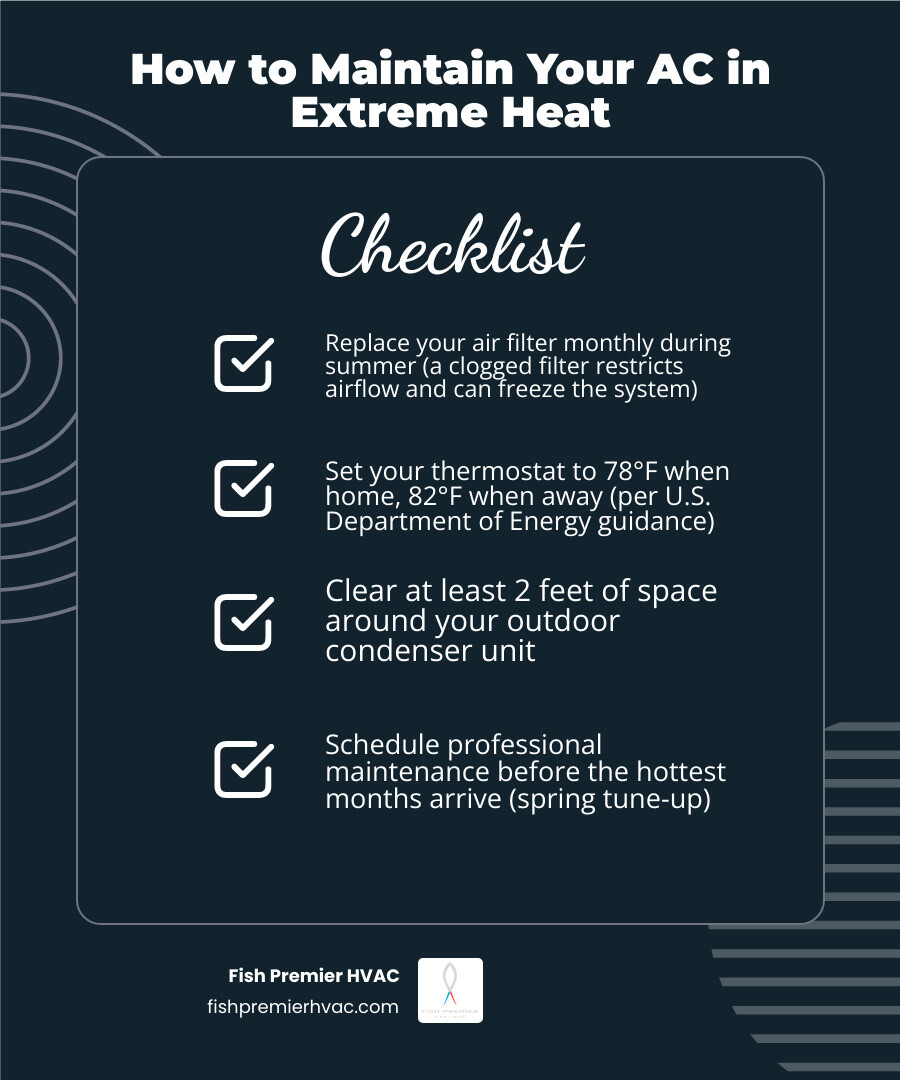
- Replace your air filter monthly during summer (a clogged filter restricts airflow and can freeze the system)
- Set your thermostat to 78°F when home, 82°F when away (per U.S. Department of Energy guidance)
- Clear at least 2 feet of space around your outdoor condenser unit
- Close blinds and curtains on sun-facing windows during peak heat hours
- Schedule professional maintenance before the hottest months arrive (spring tune-up)
- Seal duct leaks — ducts can lose up to 30% of cooled airflow through gaps and cracks
- Check attic insulation — proper insulation can cut cooling costs by up to 40% (EPA)
- Avoid running heat-generating appliances (ovens, dryers) during the 2–7 p.m. peak heat window
- Keep the outdoor unit shaded if possible — direct sunlight reduces condenser efficiency by up to 10%
- Call a professional immediately if you notice ice on the unit, unusual sounds, or warm air blowing
The sections below walk through each of these steps in detail — from simple DIY tasks you can do today to the professional services that protect your system when Texas turns up the heat.
How Extreme Heat Impacts AC Performance and Efficiency
It is April 2026, and as we look toward another intense Texas summer, understanding How Heat Waves Affect AC Efficiency is vital for every resident in Keller, Southlake, and beyond. Your air conditioner doesn’t actually "create" cold; it performs a delicate act of heat transfer. It pulls heat from your indoor air and releases it outside.
When ambient temperatures soar above 100°F, this process hits a wall. The outdoor air is already so saturated with heat that your system struggles to find "room" to dump the heat it collected from your living room. This creates significant compressor strain and puts immense stress on fan motors. Instead of reaching a state of thermal equilibrium quickly, the unit may run nonstop just to maintain a safe temperature.
| Outdoor Temperature | System Efficiency Impact | Energy Consumption |
|---|---|---|
| 85°F | Peak Operating Efficiency | Standard Baseline |
| 95°F | Moderate Efficiency Loss | +15-20% Increase |
| 105°F+ | Significant Efficiency Drop | +40% or more Increase |
When we combine this environmental stress with dirt and neglect, we see the leading causes of early system failure. A layer of dust on a coil acts like a thermal blanket, trapping heat inside the machine and forcing it to work twice as hard. In the Dallas-Fort Worth climate, a "tired" system during a heatwave isn't just an inconvenience; it's a breakdown waiting to happen.
How to Maintain Your AC in Extreme Heat: Essential DIY Steps
You don't need a tool belt to perform some of the most impactful maintenance tasks. The first and most critical step is monthly filter replacement. We cannot stress enough that your AC System Needs Regular Filter Changes, especially during high-demand periods. A dirty filter causes airflow restriction, which can lead to the evaporator coils getting too cold and literally turning into a block of ice—even when it's 105°F outside.
Next, take a walk outside to inspect your condenser unit. We recommend maintaining a strict 2-foot perimeter of clear space around the unit. Clear away grass clippings, weeds, or fallen leaves that might be choking the airflow. If the metal fins on the outside of the unit look dusty or caked with pollen, you can gently hose down the condenser coils with a standard garden hose (avoid using high-pressure power washers, as these can bend the delicate fins). Following these Best AC Maintenance Tips Colleyville TX homeowners swear by can keep your head pressures low and your efficiency high.
Optimizing Your Thermostat and Indoor Environment
Recommended Thermostat Settings for Extreme Heat
The temptation to "crank it down" to 65°F when you get home is strong, but it's a myth that your AC cools faster at lower settings. It cools at a steady rate regardless of the setpoint. The Department of Energy recommends a 78°F baseline when you are home. For every degree you set the thermostat below 78°F, your energy use can increase by about 8%.
We suggest using smart thermostats with geofencing capabilities. This allows the system to raise the temperature to 82°F while you are away at work in Keller or Westlake, and then start cooling the home back down 30–60 minutes before you arrive. This consistent cooling strategy prevents the house from becoming "heat-soaked," which happens when walls and furniture absorb so much heat that the AC has to run for hours just to catch up. If you need help setting up these advanced controls, our team provides expert AC Maintenance Keller TX to ensure your tech and your hardware are in perfect sync.
Reducing Indoor Heat Sources to Help Your AC
Your AC is fighting a war on two fronts: the heat coming through the walls and the heat generated inside. You can give your system a massive break by:
- Closing Blackout Curtains: Solar gain through windows is a huge heat contributor. Closing shades on the east side in the morning and the west side in the afternoon is essential.
- Switching to LED Lighting: Older incandescent bulbs are essentially tiny heaters. LEDs run much cooler.
- Timing Your Appliances: Avoid using the oven, dishwasher, or clothes dryer during peak heat hours (typically 2 p.m. to 7 p.m.).
- Using Ceiling Fans: Ensure fans are rotating counterclockwise to push air straight down. This creates a wind-chill effect that makes 78°F feel like 74°F. Just remember: fans cool people, not rooms, so turn them off when you leave.
Our neighbors utilizing AC Maintenance Southlake TX services often find that these small habit changes result in much lower utility bills and a significantly quieter HVAC system.
Professional Maintenance and Long-Term Efficiency
Crucial Professional Tasks for How to Maintain Your AC in Extreme Heat
While DIY steps are great, there are technical elements that require a professional touch. During a high-end AC Tune-Up Fort Worth TX, we look at things the average homeowner can't see. This includes checking the refrigerant charge; if your system is even slightly low on coolant, it will run indefinitely without ever reaching your target temperature.
We also inspect all electrical connections for signs of "pitting" or heat damage, which often happens during Texas heatwaves. Our Ultimate AC Maintenance Guide Keller TX highlights the importance of component lubrication and testing safety controls. A well-lubricated motor runs cooler and uses less electricity, extending the life of your premium investment.
Boosting Efficiency with Insulation and Shading
If your AC is the "engine," your home’s insulation is the "cooler." According to the EPA, homeowners can save up to 40% on cooling costs with proper attic insulation. In Westlake and Southlake, where homes often have large attics, ensuring your insulation meets current standards is the best way to keep the heat out.
Furthermore, we often find that ducts can lose up to 30% of airflow through leaks in the attic. Sealing these gaps ensures the air you paid to cool actually reaches your bedrooms. For those looking for AC Maintenance Westlake TX, we also recommend looking at condenser shading. If your outdoor unit is in direct afternoon sun, its efficiency can drop by 10%. Planting tall shrubs (keeping that 2-foot clearance!) or installing a lattice screen can provide much-needed relief to the machine.
When to Consider an Upgrade or Emergency Repair
Signs You Need Professional Help for How to Maintain Your AC in Extreme Heat
How do you know when how to maintain your ac in extreme heat has moved from "prevention" to "emergency"? Watch for these red flags:
- Ice Formation: If you see ice on the copper lines or the indoor coil, turn the system off immediately and switch to "fan only" mode to thaw it. This is often caused by a clogged filter or a refrigerant leak.
- Unusual Noises: Grinding, hissing, or clanking sounds usually indicate a mechanical failure in the compressor or fan motor.
- The 20-Degree Rule: Generally, an AC can only cool the air about 20 degrees lower than the outside temperature. If it's 100°F and your home is 80°F, it might be doing its best. But if it's 85°F inside, something is wrong.
If your system is 10-15 years old and consistently fails during heat spikes, it may be time to consider an upgrade to a modern, high-efficiency system with a higher SEER rating. We provide 24-Hour AC Maintenance in Colleyville TX for those moments when the heat becomes a safety risk.
Frequently Asked Questions about AC Maintenance
Why does my AC struggle when it’s over 100 degrees?
Most residential systems are designed to maintain a 20-degree difference between the indoors and outdoors. When Dallas-Fort Worth temperatures hit 105°F, your system reaches "heat saturation." The outdoor air is so hot that the chemical process of heat exchange slows down, making the compressor work at maximum capacity just to keep the house at 78°F.
Should I turn my AC off when I leave the house?
No! This is a common mistake. Turning the unit off allows your home to "heat-soak." Your walls, flooring, and furniture absorb the 100-degree heat. When you turn the AC back on, it has to work for hours just to remove the heat from your sofa and walls before it can even start cooling the air. Instead, use a 7-degree offset (setting it to 82°F or 85°F) to maintain humidity control and a manageable baseline.
How often should I change my filter during a heatwave?
During a Texas heatwave, we recommend a monthly inspection. If you have pets or live near construction in a growing area like North Fort Worth, you might even need to change it every 3 weeks. High-demand periods mean more air is being pulled through that filter, and a clean filter is the easiest way to ensure airflow optimization.
Conclusion
Maintaining your home’s comfort during a brutal Texas summer requires a mix of smart DIY habits and professional expertise. At Fish Premier HVAC, we specialize in more than just "fixing" air conditioners; we provide concierge-level service designed for the discerning homeowner. From premium installations of high-efficiency systems to advanced air scrubbers and home scenting, we ensure your indoor environment is a true sanctuary from the heat.
Whether you are in Keller, Westlake, Colleyville, or Southlake, don't wait for the next 100-degree day to find out if your system can handle the strain. Protect your investment and your family's comfort by choosing the experts who understand the unique demands of the Dallas-Fort Worth climate.
Schedule your premium AC maintenance today with Fish Premier HVAC and experience the difference that luxury service and expert care can make for your home.