%201.avif)
Federal Tax Credits for AC and Heat Pump Upgrades: In Depth Guide
Maximize federal tax credits for AC and heat pump upgrades with our in-depth guide to eligibility, documentation, and savings.

.svg)
.svg)
.svg)
How Federal Tax Credits for AC and Heat Pump Upgrades Can Save You Thousands
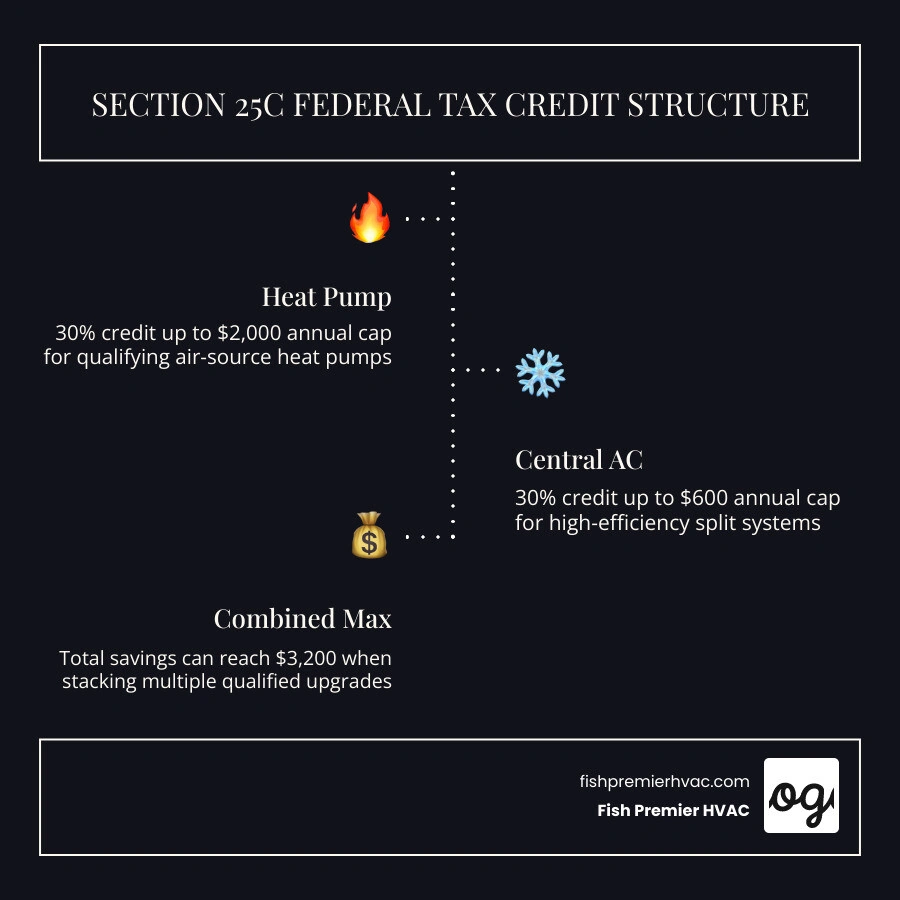
If you installed a qualifying system before December 31, 2025, federal tax credits for ac and heat pump upgrades are still available to claim when you file your 2025 taxes in 2026. Here is a quick breakdown of what you can claim:
| Upgrade Type | Credit Rate | Annual Cap |
|---|---|---|
| Heat pump (air-source) | 30% of cost | $2,000 |
| Central air conditioner | 30% of cost | $600 |
| Insulation / air sealing | 30% of cost | $1,200 (shared cap) |
| Home energy audit | 30% of cost | $150 (shared cap) |
| Combined maximum | $3,200 |
These credits come from Section 25C of the tax code, which was expanded by the Inflation Reduction Act of 2022. The credit is nonrefundable, meaning it reduces the taxes you owe — but it does not generate a refund if the credit exceeds your tax liability.
The important thing to understand right now: if your qualifying equipment was installed and placed in service by December 31, 2025, you can still claim the credit on your 2025 federal tax return. The program ended at the close of 2025, but your right to claim it for work completed before that deadline remains very much alive.
For Dallas-Fort Worth homeowners who invested in a high-efficiency heat pump or central AC system, this means real, meaningful savings are sitting on the table — you just need to know how to claim them properly.
Quick federal tax credits for ac and heat pump upgrades definitions:
- how to apply for energy rebates in texas
- oncor and texas energy rebates for homeowners
- texas energy rebates for hvac upgrades
Understanding Federal Tax Credits for AC and Heat Pump Upgrades
When navigating home comfort investments, understanding the tax code is just as important as choosing the right system. The Energy Efficient Home Improvement Credit, governed by Internal Revenue Code Section 25C, has been the primary vehicle for federal tax relief on residential HVAC upgrades. Under this provision, homeowners can claim a tax credit equal to 30% of the qualified installation expenses.
While Section 25C handles standard air-source heat pumps and central air conditioners, Section 25D (the Residential Clean Energy Credit) covers geothermal heat pump systems. Geothermal systems enjoy a 30% tax credit with no annual dollar limits, but they require specialized underground loops and a larger initial footprint. For the vast majority of premium homes in communities like Southlake and Westlake, high-efficiency air-source heat pumps offer the ideal balance of sophisticated design, whisper-quiet performance, and outstanding energy yield.
As we navigate the 2026 tax filing landscape, we are helping clients finalize their documentation for systems placed in service during the 2025 tax year. To understand how these modern comfort systems compare to older combustion or single-stage cooling technology, explore our Heat Pump Advantages Complete Guide and check out our head-to-head comparison in Heat Pump vs Traditional HVAC.
Section 25C Limits for Central Air Conditioners
If you upgraded to a premium, high-efficiency central air conditioner, Section 25C provides a tax credit of 30% of the purchase and installation costs, capped at a maximum of $600. This $600 limit is a sub-cap within a larger $1,200 annual limit that applies to general energy-efficiency upgrades like windows, doors, and insulation.
To qualify for this credit, the air conditioning system must meet stringent efficiency criteria. Standard builder-grade AC units do not qualify. Upgrading to a qualifying split system not only secures this tax credit but also dramatically lowers your monthly cooling bills. To see how lower-tier cooling systems might be silently draining your household budget, read about how an AC SEER Rating Costing You Money can impact your long-term savings. For homeowners in the Fort Worth area, choosing a premium, certified system is key; discover your options with our guide on Energy Efficient AC Installation Fort Worth.
Section 25C Limits for Heat Pumps
Heat pumps represent the pinnacle of modern, electrified home climate control. Because they transfer heat rather than generate it through combustion, they operate with incredible efficiency. Recognizing this, the federal government carved out a much larger incentive for heat pump technology under Section 25C.
Instead of being bound by the standard $1,200 general cap, heat pumps and heat pump water heaters qualify for an independent annual limit of up to $2,000. This means you can claim a 30% credit up to $2,000 for a qualifying air-source heat pump installation. When combined with other envelope upgrades—such as high-performance attic insulation or a home energy audit—your total tax credit in a single year can reach up to $3,200.
This is particularly advantageous for luxury homes in North Texas. The mild winters and hot summers of our climate make heat pumps an incredibly elegant, single-system solution for year-round comfort. Learn more about how these systems perform locally in our article on Heat Pump Benefits for Texas Homeowners and dive into the mechanics with Heat Pump Efficiency in Warm Climates Explained.
Stacking Federal Tax Credits for AC and Heat Pump Upgrades with Texas Rebates
One of the most effective strategies for maximizing your return on investment is "stacking" your federal tax incentives with local state and utility programs. In Texas, several avenues exist to help offset the cost of premium HVAC equipment:
- HEEHRA (High-Efficiency Electric Home Rebate Act): Part of the Inflation Reduction Act, this program is administered at the state level and provides up to $8,000 in point-of-sale rebates for qualifying heat pump installations for income-eligible households.
- HOMES (Home Energy Performance-Based, Whole-House Rebates): This program offers rebates based on the actual, measured energy savings achieved through comprehensive home retrofits.
- Utility Incentives: Local utility providers, such as Oncor, offer substantial rebate programs for homeowners who upgrade to high-efficiency cooling and heating systems.
By combining a $2,000 federal tax credit with state-level rebates and local utility incentives, you can dramatically lower the net cost of upgrading to a world-class home comfort system. To navigate these programs successfully, read our detailed guide on Texas Energy Rebates for HVAC Upgrades and find out how to leverage local utility programs in Oncor and Texas Energy Rebates for Homeowners.
Technical Requirements and Efficiency Ratings for HVAC Upgrades
Not every air conditioner or heat pump sitting in a distributor's warehouse qualifies for federal tax credits. To protect consumers and ensure actual energy reduction, the IRS mandates that qualifying residential energy property must meet or exceed the highest non-advanced efficiency tier established by the Consortium for Energy Efficiency (CEE).
These standards are measured using modern, real-world testing metrics:
- SEER2 (Seasonal Energy Efficiency Ratio 2): Measures cooling efficiency over a typical cooling season.
- EER2 (Energy Efficiency Ratio 2): Measures cooling efficiency at a constant, high outdoor temperature (95°F).
- HSPF2 (Heating Seasonal Performance Factor 2): Measures heating efficiency of a heat pump over a typical heating season.
The table below outlines the precise technical requirements that your HVAC equipment must have met to qualify for the 25C tax credit:
| Equipment Type | Configuration | Minimum SEER2 | Minimum EER2 | Minimum HSPF2 |
|---|---|---|---|---|
| Central AC | Split System | 16.0 | 12.0 | N/A |
| Central AC | Packaged System | 15.2 | 11.5 | N/A |
| Heat Pump | Split System | 16.0 | 12.0 | 9.0 |
| Heat Pump | Packaged System | 15.2 | 11.5 | 7.2 |
Qualifying Criteria for Central Air Conditioning
For a split-system central air conditioner to qualify for the $600 tax credit, it must achieve a SEER2 rating of 16.0 or higher and an EER2 rating of 12.0 or higher. For packaged systems, the bar is set at 15.2 SEER2 and 11.5 EER2.
In our hot Texas summers, meeting these standards is not just a matter of qualifying for a tax write-off; it is a shield against soaring electric bills. If your current system is showing its age, it might be time to evaluate whether a replacement is the most financially sound path. Learn how to spot the warning signs in When Should You Replace Your AC in a Hot Climate and weigh your options with our guide on Replace vs Repair Aging AC System.
Qualifying Criteria for Heat Pumps
Air-source heat pumps must meet the CEE highest tier standards (excluding the advanced tier) in effect at the start of the calendar year the system was placed in service. For split-system heat pumps, this generally translates to a minimum of 16.0 SEER2, 12.0 EER2, and 9.0 HSPF2.
Because heat pumps serve as both your air conditioner and your heater, they run year-round, making their build quality and efficiency ratings incredibly critical to their lifespan. If you are wondering how long a premium system can be expected to keep your home perfectly conditioned, explore our analysis on How Long Does an AC System Last in Texas.
Eligible Labor and Installation Expenses
A common point of confusion for homeowners is what actually constitutes a "qualified expense." Under Section 25C, the tax credit is calculated based on the total cost of the project. This includes:
- The cost of the physical equipment (condenser, evaporator coil, air handler, or furnace).
- Auxiliary components necessary for the proper operation of the system (such as advanced thermostats or smart zoning controls).
- All installation labor costs, including custom ductwork modifications, electrical wiring upgrades, and professional commissioning.
Because labor is fully eligible, partnering with a premier, licensed professional ensures that your system is installed to absolute perfection while maximizing your tax credit basis. For residents in premium DFW enclaves, see what a flawless, high-efficiency installation looks like by reading about our High Efficiency HVAC Install Colleyville services.
How to Claim and Document Your Energy-Efficient Upgrades
To successfully claim your federal tax credits, you must file IRS Form 5695 alongside your annual federal income tax return. Because these credits are nonrefundable, they can reduce your tax liability down to zero, but any excess credit cannot be refunded directly to you or carried forward to future tax years. Proper planning and impeccable documentation are your best tools for securing these savings.
Filing IRS Form 5695 for Federal Tax Credits for AC and Heat Pump Upgrades
IRS Form 5695 (Residential Energy Credits) is divided into two primary sections. Part I deals with the Residential Clean Energy Credit (Section 25D), while Part II is where you will calculate and report your Energy Efficient Home Improvement Credit (Section 25C) for central air conditioners, heat pumps, and home energy audits.
To claim the credit:
- Enter the total qualified contract cost (including labor) for your heat pump or AC system on the designated lines of Part II.
- Calculate 30% of that cost.
- Apply the specific caps ($600 for AC, $2,000 for heat pumps).
- Carry the final credit amount over to your Schedule 3 (Form 1040) to directly offset your tax liability.
For a step-by-step overview of how to align these federal filings with state-level program applications, consult our guide on How to Apply for Energy Rebates in Texas.
Required Documentation and Manufacturer Certification
If you are ever audited by the IRS, simply showing a credit card charge or a generic invoice from an installer will not suffice. You must maintain a comprehensive tax file containing:
- A detailed, itemized invoice from your contractor showing the exact make, model, and serial numbers of both the indoor and outdoor units.
- Proof of payment and the exact date the system was completed and "placed in service."
- The Manufacturer Certification Statement. This is a formal document issued by the HVAC manufacturer certifying that the specific model combination meets or exceeds the CEE efficiency requirements for the tax credit.
We recommend keeping these digital and physical records in your home archives for at least three to five years.
The 2025 and 2026 Qualified Manufacturer PIN Requirements
A significant procedural change took effect for systems placed in service. To curb fraudulent claims, the IRS introduced a mandatory Qualified Manufacturer (QM) program.
Under this rule, manufacturers must register their qualifying products with the IRS and assign a unique Qualified Manufacturer Identification Number (QMID) or a product-specific PIN. When you or your CPA files Form 5695, you must enter this manufacturer PIN directly onto the form for the credit to be accepted. If your equipment was installed in 2025, ensure your installer has provided this specific PIN alongside your standard manufacturer certification statement.
Frequently Asked Questions about HVAC Tax Credits
Do renters or second-home owners qualify for these tax credits?
The eligibility rules vary depending on the type of upgrade:
- Primary Residences: Homeowners upgrading their main, primary residence (where they live the majority of the year) can claim all Section 25C credits, including heat pumps, central ACs, insulation, and energy audits.
- Renters: Tenants can claim credits for certain qualifying upgrades they pay for out-of-pocket, such as a heat pump or an energy-efficient window, provided the property is their primary residence.
- Second Homes / Vacation Homes: You cannot claim Section 25C credits for central air conditioners, heat pumps, or energy audits installed in a home that you do not use as your primary residence. However, Section 25D (geothermal, solar, wind) does allow claims on second homes, provided you reside there part-time and do not rent it out as a commercial property.
What happens if my tax credit exceeds my total tax liability?
Because the Section 25C credit is nonrefundable, it can only reduce your tax liability (the total amount of tax you owe the government) to zero. For example, if you qualify for a $2,000 heat pump credit but your total tax liability for the year is only $1,500, your tax liability will be wiped out, but you will forfeit the remaining $500. It cannot be refunded to you as a check, nor can it be carried forward to offset your taxes in the next tax year.
Tip: If you plan to make multiple home improvements, consider spreading them across multiple tax years to maximize the annual caps.
What are the most common mistakes when claiming HVAC tax credits?
- Assuming All Energy Star Equipment Qualifies: The federal tax credit requires systems to meet the highest non-advanced CEE tiers, which are often more stringent than basic Energy Star certification.
- Missing the Manufacturer PIN: Failing to include the required QM PIN on your Form 5695 will result in the automated rejection of your credit claim.
- Mismatched Split Systems: If you replace the outdoor condenser but keep an older, inefficient indoor coil, the combined system will not meet the certified SEER2 ratings, invalidating the credit. Both components must be certified together.
Elevate Your Home Comfort with Fish Premier HVAC
Investing in a high-efficiency HVAC system is about more than just tax credits; it is about bringing a sense of complete luxury, whisper-quiet operation, and unmatched reliability to your home. At Fish Premier HVAC, we specialize in "Whole Home Luxury" and "Expert HVAC Service For Whole Home Comfort."
Serving sophisticated homeowners across the Dallas-Fort Worth area, including Keller, Westlake, Colleyville, and Southlake, we deliver a concierge-level experience from the initial analysis to the final, premium installation. Whether you are looking for ultra-high-efficiency heat pumps, advanced air scrubbers for pristine indoor air quality, backup generators for peace of mind, or bespoke home scenting solutions, we curate comfort to your exact standards.
Our highly trained team operates Monday-Friday from 8am to 6pm, and we remain at your service with prompt, after-hours emergency support when you need us most. Under Texas License #TACLB99535E and operating from our Fort Worth, TX location, we ensure every installation is a masterpiece of engineering and aesthetics.
Ready to experience the ultimate in residential comfort while securing your financial incentives? Explore our flexible Financing options to design your ideal system, and Explore our premium home comfort solutions to schedule your personal consultation today.