%201.avif)
Diagnosing a Tripped AC Breaker After a DFW Summer Thunderstorm
A severe July lightning storm can cause power surges that shut down your cooling system. We explain the safe way to check your breaker and when an immediate second trip requires emergency HVAC service.


.svg)
.svg)
.svg)
Losing AC Power During a Peak July Thunderstorm
July in the Dallas-Fort Worth metroplex brings extreme peak summer heat, but it also introduces a severe threat to your home's cooling system: intense electrical storms. If you are currently sweating in your home and diagnosing a tripped AC breaker after a DFW summer thunderstorm, you are facing a critical decision point. In our years of serving local homeowners, we know the house warms up fast, and the temptation to simply march out to the garage and force the electrical panel back on is incredibly high. However, doing so without understanding what caused the interruption can turn a minor electrical hiccup into a catastrophic equipment failure.
During these peak summer months, regional weather patterns produce lightning storms of extreme intensity. When these storms roll through, our team at Fish Premier HVAC routinely sees how lightning strikes frequently cause massive power surges across the local grid right when residential air conditioners are operating under maximum thermal load. This sudden spike in voltage is the primary reason your system suddenly shuts down and the breaker flips to the neutral or "off" position. When this happens, homeowners must decide whether it is safe to attempt a basic reset or if they need to call for professional HVAC services immediately. Navigating this safely requires understanding the difference between a simple grid fluctuation and severe electrical damage to your condenser.
How Severe Weather and Power Surges Affect Your AC Condenser
To understand why your system shut down, it helps to know how severe weather impacts residential cooling equipment in Fort Worth TX neighborhoods. Your outdoor AC condenser sits exposed to the elements, connected directly to your home's main electrical supply via a high-voltage whip. When lightning strikes nearby, it introduces massive voltage spikes into the grid. These surges travel at incredible speeds and easily exceed the tolerance of the sensitive electrical components inside your air conditioner.
There is a distinct difference between a temporary grid fluctuation (a brownout) and a hard electrical short caused by a direct surge. A temporary fluctuation might cause the breaker to trip harmlessly as a protective measure because the voltage dropped too low, causing the system to pull too many amps. A lightning surge, however, physically damages the components.
When investigating the need for air conditioning repair after a storm, our Fish Premier HVAC technicians typically look at three specific vulnerable areas we see fail most often:
• The Dual-Run Capacitor: This component stores energy to give the compressor and fan motors the initial jolt they need to start. Power surges frequently overheat and rupture capacitors.
• The Contactor: This is the mechanical switch that allows high-voltage electricity to flow into the compressor. A surge can weld the contacts closed or burn them out entirely.
• The Compressor Windings: The most expensive component in the system. Massive surges can melt the internal insulation on the copper windings, causing a direct short to the metal casing.
Grid Fluctuation vs. Lightning Surge
• Grid Fluctuation (Brownout) — Impact on Electrical Grid: Temporary drop in voltage across the local utility lines. — Typical Effect on AC Unit: AC pulls higher amperage to compensate, safely tripping the breaker. — Expected Outcome: Usually resolves with a safe, single reset once power stabilizes.
• Lightning Surge — Impact on Electrical Grid: Massive, instantaneous spike in high-voltage electricity. — Typical Effect on AC Unit: Overloads capacitors, contactors, and internal wiring instantly. — Expected Outcome: Requires professional diagnostic testing and part replacement.
The Safety-First Checklist: Applying the 'One-Reset Rule'
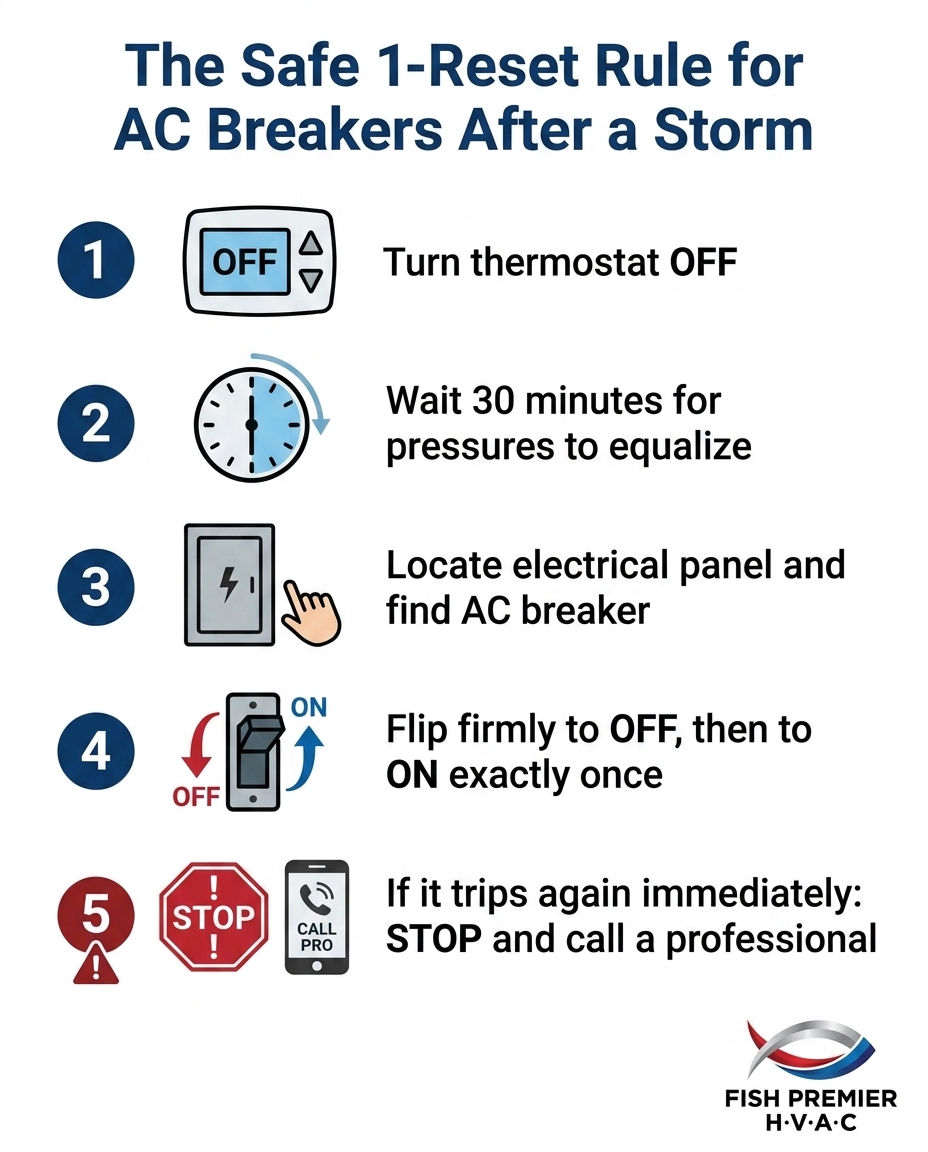
Because the stakes are so high during a July peak summer heatwave, our team strictly enforces a safety-first boundary known as the "one-reset rule." As protectors of your home's safety and your expensive cooling equipment, our guidance is designed to prevent electrical hazards. If your AC circuit breaker keeps tripping, or if it just tripped for the first time following a loud thunderclap, we highly recommend following this definitive go/no-go checklist before attempting to restore power.
1. Turn the thermostat to the "OFF" position: Do not skip this step. If the thermostat is still calling for cooling when you flip the breaker, the system will immediately try to draw a massive electrical load. Turning it off ensures the system resets in a neutral state.
2. Wait a full 30 minutes: This is the most critical and frequently ignored step. When an AC unit shuts down abruptly, the internal refrigerant pressures are highly unequal. The high side is extremely pressurized, and the low side is not. If you try to force the compressor to start against that high pressure immediately, it will draw excessive amperage and trip the breaker again—even if the system is perfectly healthy. Waiting 30 minutes allows the pressures to equalize.
3. Apply the One-Reset Rule: After 30 minutes, go to your electrical panel. Locate the AC breaker. It may be resting in the middle (neutral) position. Push it firmly all the way to the "OFF" position until it clicks, then push it firmly to the "ON" position. You may only do this exactly one time.
4. Turn the thermostat back to "COOL": Go back inside and lower the temperature setting. Listen carefully to the outdoor unit. If it starts normally and runs, the trip was likely a harmless grid fluctuation.
5. Stop and step away if it fails: If the breaker trips again immediately, or if the outdoor unit makes a loud buzzing sound without the fan spinning, you must stop. Explicitly, do not open the condenser cabinet, and do not attempt any DIY electrical disassembly. The system has suffered a hard short.
What It Means When the AC Breaker Trips Immediately Again
If you followed the one-reset rule and the breaker slammed back to the "off" position the second you turned the thermostat on, you are no longer dealing with a fluke. An immediate second trip is a hard stop indicating a severe electrical fault. The breaker is doing exactly what it was engineered to do: stopping the flow of high-voltage electricity into a circuit that is broken, shorted, or severely compromised.
One Fort Worth TX homeowner recently called our team after experiencing this exact scenario when their lower-level AC unit quit cooling during a very hot weekend with out-of-town guests arriving. After a storm rolled through, the system lost power. Instead of forcing the system to run, they left the breaker off and requested a diagnostic visit from Fish Premier HVAC. One of our technicians responded without delay, tested the electrical components, and found that the storm had caused a failed capacitor. Because the homeowner did not repeatedly force the breaker, the compressor was unharmed, and the unit was blowing cold air again shortly after the capacitor was replaced.
Common Storm-Induced Electrical Failures
When our professionals arrive to diagnose a system that immediately trips the breaker, we use specialized multimeters to check for specific storm-related damages we frequently encounter in the DFW area:
• The Blown Dual-Run Capacitor: When a capacitor absorbs a massive surge, the internal dielectric fluid boils, causing the top of the cylinder to bulge or burst. Without a working capacitor, the compressor cannot start. It will sit there pulling locked-rotor amps (a massive electrical draw) until the breaker trips to prevent a fire.
• The Grounded Compressor: This is the worst-case scenario following a lightning strike. The surge melts the thin enamel coating on the copper wire coils inside the compressor shell. The bare copper then touches the steel casing, creating a direct path to ground. The moment electricity hits the system, it shorts out and trips the breaker instantly.
• Shorted Contactor Coils: The low-voltage coil that pulls the high-voltage contacts closed can burn out during a surge, creating a short circuit that trips either the main breaker or the low-voltage fuse on the indoor control board.
None of these issues can be resolved without replacing parts, which is why attempting to bypass the electrical panel is entirely futile and highly dangerous.
The Hidden Dangers of Repeatedly Forcing a Breaker Reset
The most expensive mistakes we see happen when homeowners let the frustration of July peak summer heat override electrical safety. Circuit breakers are not suggestions; they are critical life-safety devices designed to prevent electrical fires. When a breaker trips, it means the wires inside your walls and outside your home are carrying more electrical current than they can safely handle without melting their insulation.
By repeatedly forcing a breaker to reset, you are intentionally forcing high-voltage power into a shorted circuit. As local HVAC professionals, we provide this honest guidance because we've seen the aftermath firsthand: bypassing safety controls can permanently destroy your AC compressor.
Consider the scenario of a blown capacitor. If the capacitor is dead, the compressor cannot start, but it will still try. Every time you flip the breaker, you send a massive surge of electricity into the stationary compressor motor. The motor rapidly overheats. If you do this three or four times, the heat will melt the internal windings, turning a relatively straightforward capacitor replacement into a catastrophic failure that requires full HVAC equipment replacement.
Warning signs that you must leave the breaker off:
• The breaker feels hot to the touch or smells like burning plastic.
• The outdoor unit makes a loud, aggressive humming or buzzing sound for 3 to 5 seconds before the power cuts out.
• You see visible scorch marks on the outdoor electrical disconnect box.
• The breaker is "spongy" and will not physically stay in the ON position.
Frequently Asked Questions About Post-Storm AC Troubleshooting
Dealing with severe weather can leave homeowners with a lot of questions about how to protect their cooling systems and heat pump systems. Below are the most common questions our dispatchers and technicians hear from Fort Worth TX residents after a major electrical storm rolls through the area.
What should I do if my AC breaker trips after a thunderstorm?
Turn off the thermostat, wait 30 minutes, and apply the one-reset rule at the electrical panel. Waiting allows the internal refrigerant pressures to equalize so the compressor doesn't struggle to start. If the breaker stays on and the unit cools, it was likely a temporary grid issue; if it trips again, leave it off and call a professional.
Why does my AC breaker trip immediately after I reset it?
An immediate trip indicates a hard electrical short, such as a failed capacitor or grounded compressor, requiring professional repair. The breaker is detecting that electricity is flowing outside of its intended path, and it shuts down the circuit instantly to prevent the wiring from overheating and causing a fire.
Can a lightning storm damage my AC compressor?
Yes, power surges from lightning can melt internal wiring, causing the compressor to short to ground. Because the outdoor condenser is directly wired to your home's main electrical panel, a severe voltage spike can bypass basic surge protectors and severely damage the heavy-duty motors inside the unit.
How long should I wait to reset my AC breaker after a power outage?
Wait at least 30 minutes to allow internal refrigerant pressures to equalize, preventing the compressor from starting under extreme load. If you attempt to restore power immediately after an outage, the compressor will draw excessive amperage trying to push against high-pressure refrigerant, which will only trip the breaker again.
Are heat pump systems also vulnerable to lightning strikes?
Yes, the outdoor components of both traditional ACs and heat pumps face similar risks from voltage spikes. They share the same basic electrical architecture—including contactors, capacitors, and compressors—meaning a severe electrical storm poses an equal threat to a heat pump's operational safety.
Is a blown AC fuse the same as a tripped breaker?
While both interrupt power during an electrical fault, a blown fuse must be physically replaced by a professional, whereas a breaker can be reset. Fuses contain a metal filament that intentionally melts to break the circuit during a surge, providing excellent protection but requiring manual replacement once destroyed.
Get Safe, Professional Diagnosis for Your Storm-Damaged AC
When the skies clear over Fort Worth TX, the priority is getting your home back to a safe, comfortable temperature. However, safety must always come first when dealing with post-storm electrical issues. If you have applied the one-reset rule and your system refuses to power on, you have done everything you safely can as a homeowner. Continuing to force the system will only risk further damage to your property and your expensive cooling equipment.
Just last week, our Fish Premier HVAC team helped another local homeowner who faced a similar post-storm issue and reached out for help rather than forcing the breaker. The responding technician thoroughly explained the electrical issue, completed the necessary repair quickly and efficiently, and restored the home's cooling with complete transparency. If your breaker will not stay on, do not take chances with high-voltage electricity. Reach out to our local experts for a thorough diagnostic inspection, ensuring your system is repaired safely and efficiently so you can enjoy a cool, comfortable home for the rest of the summer.