%201.avif)
The Hidden Cost of Closing Vents in Unused Rooms to Save Energy
Trying to lower your July cooling bills by shutting off airflow to unoccupied rooms? This common practice actually spikes static pressure and strains your blower motor.


.svg)
.svg)
.svg)
The Persistent Myth of Shutting Vents for Energy Savings
Many homeowners are unaware of the hidden cost of closing vents in unused rooms to save energy, a practice that doesn't actually lower utility bills but instead forces your system to work harder and risks severe mechanical damage. It is entirely logical to assume that cooling fewer rooms should require less energy. If you are not using a guest bedroom or a home office, why pay to pump conditioned air into it? Unfortunately, this common assumption ignores how modern cooling equipment is engineered to function as a unified whole.
If you are concerned about the health of your air conditioning systems or suspect you might be dealing with a failing AC fan motor due to airflow restrictions, we can help restore proper balance to your home.
Modern cooling systems are not designed to operate on a room-by-room basis. Instead, they breathe as a complete, whole-house ecosystem. When the original installers sized the equipment and the ductwork, they calculated the total volume of air required to keep the entire home comfortable. Every vent, return grille, and duct branch plays a specific role in maintaining that delicate balance.
In our years of serving the community, our team at Fish Premier HVAC frequently sees Fort Worth area homeowners face a critical decision point: keeping vents closed to supposedly save energy versus opening them to prevent catastrophic equipment strain. When you close a supply register, the blower motor does not slow down or push less air. It continues to force the exact same volume of air through a suddenly restricted pathway. Over time, this habit leads directly to a failing blower motor, frozen coils, and compromised comfort, rather than the lower utility bills you were hoping to achieve.
Understanding Static Pressure: How Your HVAC System Breathes
To understand why closing vents is so damaging, you have to understand a concept called static pressure. Static pressure is the resistance to airflow within the ductwork. Think of it as the blood pressure of your home's respiratory system. The blower motor must push air with enough force to overcome the friction of the duct walls, the resistance of the air filter, and the twists and turns of the layout.
Residential systems are typically calibrated to operate at a maximum static pressure of 0.5 inches of water column. This is a very precise measurement, and the equipment relies on all vents remaining open to maintain it. When you close even a few vents, you dramatically increase the internal pressure inside the ducts. The air backs up, creating a bottleneck that forces the blower motor to work against a wall of resistance.
One local customer reached out recently during a brutal Fort Worth heatwave when their AC system needed repair due to poor airflow. Our technician arrived quickly, diagnosed the issue efficiently, and completed the repair with transparent communication about how closed vents and high static pressure had contributed to the breakdown. This kind of restriction is a leading cause of AC duct problems that reduce cooling across the rest of the house, as the pressurized air escapes through tiny leaks in the duct seams instead of reaching your living spaces.
The 'Garden Hose' Effect in Your Ductwork
The bottleneck principle: The easiest way to visualize static pressure is to think about a garden hose. If you turn on the spigot, water flows freely out of the end. But if you place your thumb over half of the opening, the water doesn't stop flowing from the source. Instead, the pressure builds up behind your thumb, and the water sprays out forcefully and erratically.
When you close supply vents, you are putting your thumb over the end of the HVAC system's "hose." The blower is still pushing the exact same volume of forced air, but that air now has nowhere to go. The resulting pressure spike puts immense mechanical stress on the entire system.
The Danger of Continuous Operation in Extreme Heat
The mechanical strain of high static pressure is bad enough under normal conditions, but it becomes exponentially worse when the system has no downtime to recover. In the extreme climate of Fort Worth summers, where relentless temperatures require nearly continuous cooling, any airflow restriction becomes highly dangerous to the equipment.
During the July peak summer heat, it is not uncommon for a cooling system to experience an 18 hours a day system runtime just to keep up with the intense thermal load. When a system is running for 18 hours straight, there is absolutely no margin for error when it comes to airflow. The equipment needs a constant, unobstructed volume of air moving over the coils and through the blower compartment to keep the internal components from overheating.
What happens during long runtimes with closed vents:
• Heat buildup: The blower motor generates its own heat as it runs. The air returning from your home helps cool the motor. Restricted airflow means less cooling for the motor itself.
• Component fatigue: Running against high pressure for 18 hours accelerates wear and tear on bearings, belts, and electrical capacitors.
• Efficiency loss: The system struggles to satisfy the thermostat, leading to even longer runtimes and higher energy consumption.
• Thermal overload: Eventually, the overheated motor may trip its internal safety switches, shutting down the system completely on the hottest day of the year.
When you combine closed vents with peak summer runtimes, you are essentially forcing your equipment to run a marathon while breathing through a straw.
Why Variable-Speed Blower Motors Suffer the Most
The myth of closing vents is particularly destructive to modern, high-efficiency equipment. If you have upgraded your system in recent years, you likely have a variable-speed blower motor rather than an older, single-stage motor. Understanding the difference is crucial to protecting your investment.
An older single-stage motor operates at one speed: on or off. If you close a vent and increase the static pressure, a single-stage motor will simply push less air, resulting in sluggish airflow and poor cooling. However, a modern variable-speed motor (often called an ECM, or electronically commutated motor) is programmed with a computer chip to maintain a specific volume of airflow regardless of the resistance it encounters.
When a variable-speed motor senses the increased static pressure from closed vents, it automatically ramps up its RPMs to overcome the bottleneck. It will spin faster and harder, fighting against the closed vents to deliver the programmed amount of air. This means the motor will consume significantly more electricity trying to compensate for the restriction—completely defeating the purpose of closing the vents to save energy in the first place.
• Single-Stage Motor — Reaction to Closed Vents: Pushes less air against the resistance — Resulting Damage: Sluggish cooling, frozen coils, poor comfort
• Variable-Speed Motor — Reaction to Closed Vents: Ramps up RPMs to fight the resistance — Resulting Damage: High electricity use, premature motor burnout
At Fish Premier HVAC, we provide concierge-level expertise in protecting high-end, sophisticated systems from unnecessary wear and tear. In our daily fieldwork across Fort Worth, our technicians frequently see expensive variable-speed motors suffer premature mechanical failure simply because a homeowner unknowingly induced a static pressure imbalance by shutting vents in unused rooms.
The Domino Effect: From Frozen Coils to Complete Shutdowns
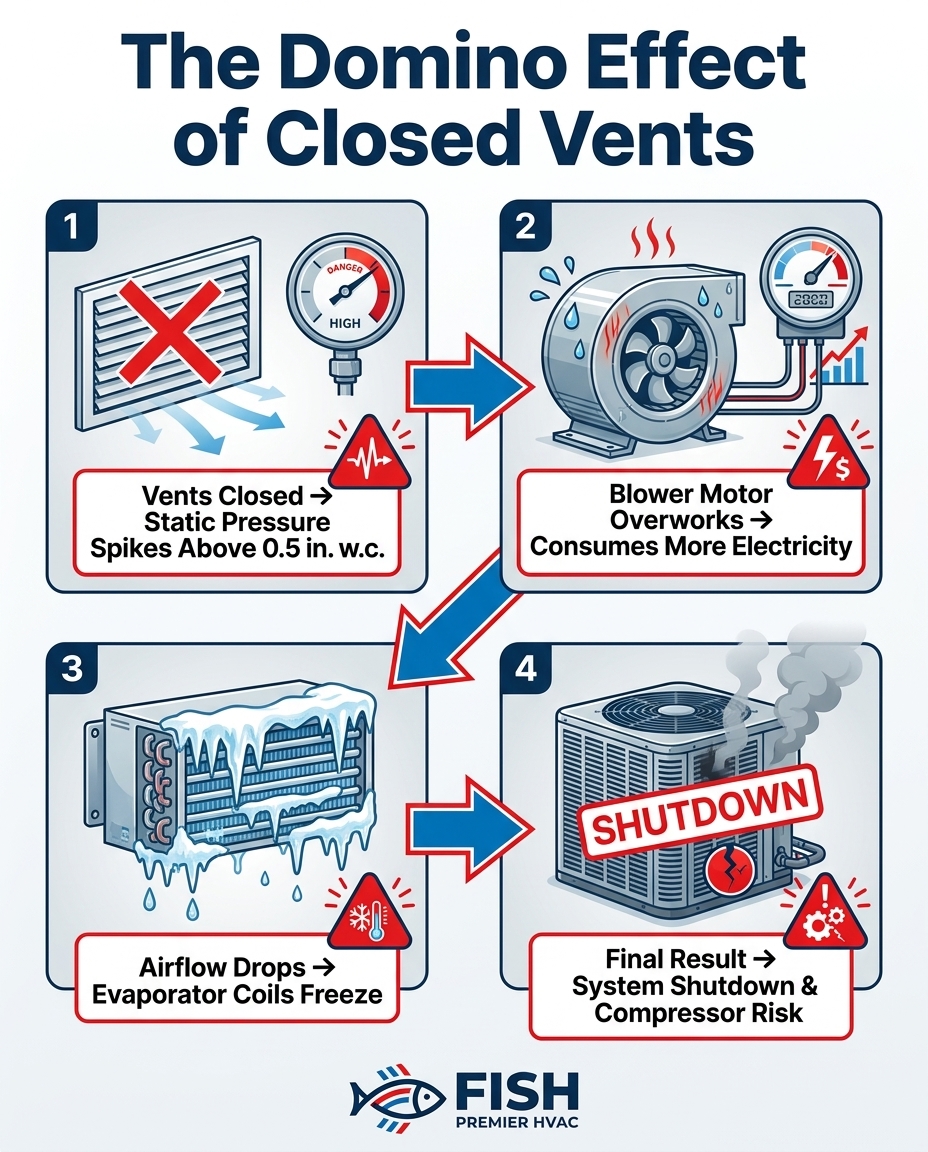
The damage caused by restricted airflow rarely stops at the blower motor. High static pressure triggers a cascading chain of failures that can ultimately destroy the most expensive component in your entire system: the compressor. This domino effect is a harsh mechanical reality that catches many homeowners off guard.
One homeowner reached out during a peak July weekend when out-of-town guests were visiting and their upstairs system suddenly quit cooling. A technician showed up right away, found the coils frozen solid due to restricted airflow, and helped get the system back online so it was functional for the remainder of the summer. This is a textbook example of what happens when airflow drops below the critical threshold.
By scheduling a regular AC maintenance visit, you can ensure your technician catches the early signs of static pressure damage before this total failure sequence occurs.
Step 1: Reduced Air Exchange
The cooling process relies on a continuous supply of warm air from your home blowing over the indoor evaporator coil. The refrigerant inside the coil absorbs the heat from the air. When vents are closed and airflow is restricted, not enough warm air reaches the indoor coil fast enough to transfer the cooling energy. The refrigerant remains dangerously cold.
Step 2: Coil Freezing
Because the refrigerant is not absorbing enough heat, the temperature of the evaporator coil drops below freezing. As warm, humid summer air hits this freezing metal, the condensation instantly turns to solid ice. This ice buildup quickly spreads across the entire coil, suffocating the system and entirely blocking any remaining airflow from passing through.
Step 3: Compressor Strain
Once the coil is encased in ice, the cooling process completely stops, but the outdoor unit continues to pump refrigerant. This is the most dangerous stage. The iced-over coil prevents the refrigerant from turning from a liquid into a gas. As a result, liquid refrigerant flows backward down the suction line into the outdoor compressor. Compressors are designed to pump gas, not liquid. This "liquid slugging" can cause catastrophic and permanent damage to the compressor valves, requiring a massive repair or a full system replacement.
Safe Alternatives for Managing Temperatures in Empty Rooms
If closing vents is off the table, how can you manage the temperature in unused rooms without destroying your equipment? There are several safe, highly effective strategies that allow you to control your home's thermal load without altering the vital static pressure of your ductwork.
The fundamental rule of thumb is to leave all supply vents and return grilles fully open, unblocked by furniture, and free of dust. This maintains the system's designed static pressure balance.
Safe temperature management checklist:
• Leave all vents open: Ensure that every vent in the home is at least 90% open. Never close more than one small register in an entire house.
• Install thermal window treatments: Utilize blackout curtains, thermal blinds, or solar window film in unused rooms. Blocking the radiant heat from the sun reduces the heat gain in that specific room without choking the HVAC airflow.
• Upgrade to a zoning system: If you truly want room-by-room control, invest in a professionally installed zoning system. This uses automated dampers inside the ductwork, paired with bypass ducts, to safely redirect air while maintaining perfect static pressure at the blower motor.
• Keep doors open: Keep interior doors open to allow air to flow freely back to the central return grilles.
For more comprehensive strategies that don't involve restricting the blower motor, explore our broader summer energy saving tips to keep your home comfortable and efficient.
Frequently Asked Questions About AC Airflow and Vents
Why does closing vents damage the AC?
Closing vents damages the AC by drastically increasing the static pressure inside the ductwork. The blower motor is forced to work against a wall of trapped air, which causes the motor to overheat and wear out prematurely. Additionally, the restricted airflow can cause the indoor evaporator coils to freeze over, which can lead to permanent damage to the outdoor compressor.
What is HVAC static pressure?
HVAC static pressure is the measurement of resistance to airflow within your duct system. It is similar to blood pressure in the human body. Residential systems are designed to operate at a specific pressure (usually around 0.5 inches of water column), and closing vents creates a bottleneck that spikes this pressure beyond safe operating limits.
Does closing vents lower my electric bill?
No, closing vents does not lower your electric bill. In fact, if you have a modern variable-speed blower motor, closing vents will actually increase your electricity consumption. The motor will detect the airflow restriction and ramp up its speed, using more power to try and force air through the blocked ductwork.
How many vents can I safely close?
As a general rule, you should never close more than 10% of the vents in your home, which typically equates to just one small vent. Closing any more than that will disrupt the static pressure balance, strain the blower motor, and increase the likelihood of frozen coils and system breakdowns.
Why is my closed room still hot?
Your closed room is still hot because heat transfers naturally through walls, ceilings, and interior doors. Even if you cut off the conditioned air supply, the ambient heat from the rest of the house and the radiant heat from the windows will quickly warm the room. The lack of air circulation makes the space feel stuffy and stagnant.
Will restricted airflow cause my AC to freeze?
Yes, restricted airflow is one of the most common causes of a frozen AC system. When vents are closed, there is not enough warm indoor air blowing over the cold evaporator coils. The refrigerant inside drops below freezing, turning the natural condensation on the coils into a solid block of ice that suffocates the system.
Protect Your Equipment While Staying Cool
The hidden cost of closing vents in unused rooms to save energy is simply too high. While it may seem like a logical way to cut back on utility usage, the mechanical reality is that it suffocates your system, spikes static pressure, and severely strains your blower motor. Keeping your vents open is the easiest, most effective way to protect your equipment and ensure consistent, reliable cooling throughout the intense summer heat.
Proper airflow management provides the clear, mechanical satisfaction of a healthy, balanced system that operates exactly as it was designed. When your equipment breathes easily, it lasts longer and cools better. If you suspect your system is already struggling with airflow issues, or if some rooms remain uncomfortable despite your best efforts, do not wait for a breakdown. Schedule a professional inspection with our Fort Worth team today to restore perfect balance to your home's ductwork.