%201.avif)
Why 'Topping Off' Freon is a Band-Aid for Your Struggling AC
Facing a sweltering house with an AC blowing warm air? A quick refrigerant top-off is tempting, but since systems never naturally consume Freon, a low charge always points to a leak.


.svg)
.svg)
.svg)
The Costly Myth of the Routine AC Freon Recharge
If you are searching for answers about exactly why 'topping off' freon is a band-aid for your struggling AC, the explanation begins with a fundamental truth our technicians at Fish Premier HVAC share with customers every day: air conditioners never naturally consume refrigerant. A widespread myth persists among homeowners that an air conditioning unit simply "uses up" its freon over time, much like a car burns through a tank of gasoline or an engine consumes oil. This misconception leads countless people to request a quick recharge when their vents start blowing warm air, assuming it is just a routine maintenance requirement.
The reality of a failing air conditioner is incredibly frustrating, especially when it happens right when you need cooling the most. We see this scenario constantly during peak summer. You might walk into your living room on a sweltering July afternoon in the Fort Worth area, only to realize the thermostat is set to 72 degrees but the indoor temperature is climbing past 80. The air coming from your ceiling registers feels lukewarm and stagnant. In that stressful moment, you face a critical decision point: do you pay for a temporary refrigerant recharge to get through the weekend, or do you invest in finding the actual source of the problem?
Choosing the quick top-off is a tempting shortcut. It seems faster, and on the surface, it feels like an immediate fix. However, adding refrigerant to a system that is running low is treating a symptom while ignoring a progressive disease. Because your air conditioner is a sealed mechanical environment, a low charge is absolute proof that a physical breach exists somewhere in the equipment. By understanding the science behind your cooling equipment, you can make informed decisions when hiring professional HVAC services to restore your home's comfort permanently.
The Difference Between Maintenance and Masking a Problem
To fully grasp why a recharge is merely a delay tactic, it helps to look at what actual routine maintenance involves. True maintenance includes cleaning coils, clearing condensate drains, testing electrical components, and tightening connections. It never includes adding refrigerant. When our technicians hook up their gauges and find a system is low, our very next sentence is always a conversation about locating the leak. Accepting a "gas and go" service without a diagnostic plan means you are knowingly leaving a broken pipe or a corroded coil in your home, waiting for the newly added refrigerant to inevitably escape into the atmosphere.
Understanding Your AC's Closed-Loop Refrigerant System
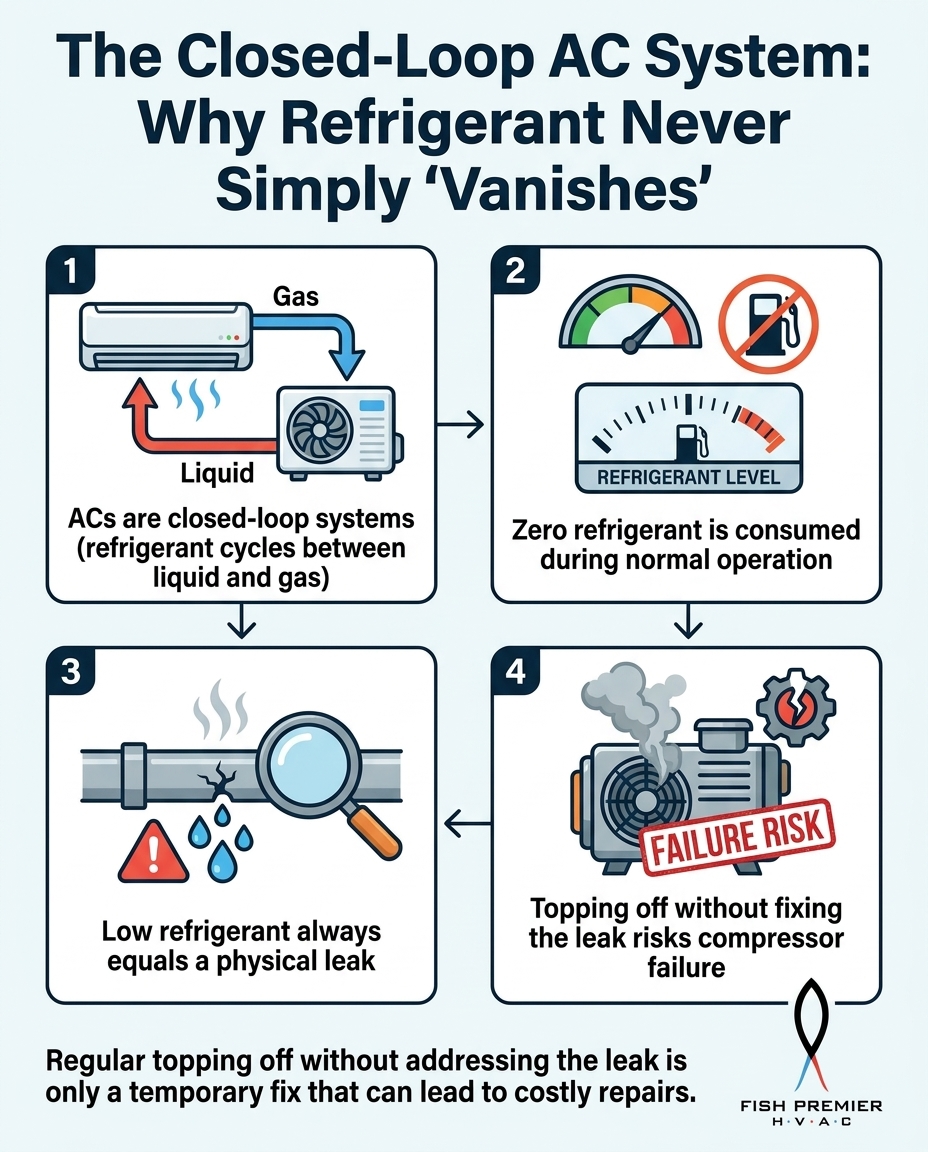
To debunk the top-off myth completely, we have to look closely at the physics of a closed-loop system. Your air conditioner does not create cold air out of nothing; it transfers heat from the inside of your home to the outside. The vehicle for this heat transfer is the refrigerant (commonly referred to by the legacy brand name Freon, or modern equivalents like R-410A). This chemical compound continuously cycles between a liquid and a gas state, traveling back and forth between your indoor evaporator coil and your outdoor condenser unit.
Because this system is entirely sealed—literally welded and brazed shut at the factory and during installation—the amount of refrigerant inside it should remain exactly the same for the entire lifespan of the unit. This specific amount is known as the system's "charge." You can compare the refrigerant in an air conditioning system to the blood in a healthy human body. It circulates endlessly, carrying heat instead of oxygen, but it is never burned off, exhausted, or "used up" during normal operation.
When a system is functioning correctly, it uses precise pressure changes to manipulate the refrigerant's temperature. Inside, it expands into a cold gas to absorb heat from your indoor air. Outside, the compressor squeezes it into a hot, high-pressure liquid to release that heat into the outdoor air. If the system is low on refrigerant, this delicate balance of pressures collapses. The only way a system becomes low is if a physical breach—a crack, a rusted spot, or a failing valve—has allowed the pressurized gas to escape.
This reality is why honest diagnostics are so vital. Consider a recent situation our team handled where a local homeowner realized their HVAC service was needed immediately. Because we pride ourselves on honest, professional, and friendly service, our responding technician took the time to verify the system's charge scientifically rather than just guessing or offering a blind top-off. The result was an efficient HVAC service that worked perfectly, proving that a properly sealed system operates flawlessly without arbitrary recharges. When you invest in proper air conditioning repair and solutions, you ensure the integrity of this closed loop is maintained.
How Extreme Heat Exposes Hidden Refrigerant Leaks
A slow refrigerant leak might go unnoticed during the mild days of spring, but extreme weather forces hidden vulnerabilities into the light. The compressor is the heart of your air conditioning system, and it is an incredibly hard-working motor. Just like a car engine, it generates a massive amount of heat while it runs. However, unlike a car engine that uses a radiator and coolant to keep itself from melting down, your AC compressor relies entirely on the returning cool refrigerant gas to keep its own internal motor from overheating.
During periods of July peak summer heat, a slow leak becomes a critical, system-threatening vulnerability. In our years of servicing Fort Worth ACs, we've found that the combination of our extreme summer temperatures and moderate humidity creates a brutal operating environment for an undercharged system. When the refrigerant level drops, the compressor has to run longer and harder to achieve the same amount of cooling inside the house. Simultaneously, because there is less refrigerant returning to the outdoor unit, the compressor is starved of the cooling effect it desperately needs to survive.
This extreme strain leads to a cascade of physical symptoms that homeowners often misinterpret. One of the most paradoxical signs is ice buildup. When the system lacks enough refrigerant, the pressure inside the indoor evaporator coil drops drastically. This causes the coil's temperature to plunge below freezing. The moderate humidity in the indoor air condenses on this freezing coil and rapidly turns to solid ice. Soon, the entire indoor unit is encased in a block of ice, which blocks airflow completely and halts all cooling. If you notice a frozen coil, hissing sounds, or suddenly warm air, you are witnessing the signs your AC is low on refrigerant.
The Stress Factors: Normal vs. Low Refrigerant
• Compressor Motor — Under Normal Charge: Cooled adequately by returning gas; cycles on and off normally. — Running Low on Refrigerant: Starved of cooling; overheats, runs continuously, risks total failure.
• Evaporator Coil — Under Normal Charge: Maintains temperature above freezing; removes humidity effectively. — Running Low on Refrigerant: Pressure drops too low; condensation freezes into a solid block of ice.
• Energy Consumption — Under Normal Charge: Operates within factory specifications for monthly electrical pull. — Running Low on Refrigerant: Skyrockets as the system runs 24/7 trying to reach the thermostat setting.
Ignoring these signs during peak heat, or trying to solve them with a simple top-off, almost always leads to catastrophic, irreversible compressor failure. When the compressor dies, the repair costs jump from a manageable leak fix to a major component replacement.
The Mechanical and Environmental Risks of the 'Band-Aid' Approach
Repeatedly adding freon without fixing the underlying leak is harmful on multiple fronts. It is a deeply flawed strategy that drains your wallet, destroys your equipment, and damages the environment. We frequently meet homeowners who have fallen into the "gas and go" trap, finding themselves paying for multiple service calls in a single season, mistakenly believing they are saving money by avoiding a larger repair bill.
Here is a breakdown of why this band-aid approach is so dangerous:
1. The Financial Trap: Refrigerant is a highly specialized, expensive chemical. When you pay for a top-off, you are literally buying a product that is guaranteed to leak back out of your system. Whether it takes a month, a week, or a single afternoon, that investment will evaporate into the air. Over a few seasons, the cumulative cost of repeated recharges easily eclipses the cost of simply fixing the leak in the first place.
2. Severe Mechanical Degradation: Continuously running a compromised system drastically shortens the overall lifespan of your HVAC unit. Every time the system runs low, the compressor suffers microscopic wear and tear from overheating and poor lubrication (as refrigerant oil often leaks out alongside the gas). A unit designed to last 15 years might fail in half that time if subjected to chronic low-charge conditions.
3. Environmental Regulations and Phase-Outs: The Environmental Protection Agency (EPA) heavily regulates refrigerants due to their impact on the ozone layer and global warming potential. Older refrigerants, specifically R-22, have been completely phased out of production. If you have an older system that uses R-22, topping it off is not only environmentally harmful but increasingly impractical as supplies dwindle.
4. The Inevitable Breakdown: A top-off is merely a delay tactic for an inevitable, larger breakdown. Leaks do not heal themselves. In fact, due to the constant vibration of the unit and the high pressures involved, small leaks always grow into larger leaks over time.
When you are looking for reliable AC repair services in Southlake or the surrounding areas, it is vital to partner with technicians who refuse to apply band-aids to systemic problems.
Why True Leak Detection Requires Advanced Diagnostics
Finding a refrigerant leak is rarely as simple as looking for a dripping pipe. Unlike a plumbing leak that leaves a visible puddle on the floor, refrigerant escapes as an invisible, odorless gas. These leaks are often microscopic, occurring in incredibly difficult-to-reach areas of the system. Common culprits include the tightly packed aluminum fins of the indoor evaporator coil, the outdoor condenser coil, or the copper line sets running through your walls and attic.
In our Fort Worth service area, we frequently see leaks caused by a phenomenon known as formicary corrosion. This occurs when volatile organic compounds (VOCs) in your home's air—from cleaning supplies, paints, and building materials—react with the condensation on the copper coils, creating tiny, pinhole leaks over time. Because these holes can be smaller than a human hair, finding them requires the advanced diagnostic tools and specialized training our team utilizes daily.
Our professional technicians utilize several sophisticated methods to pinpoint the exact source of the escaping gas:
• Electronic Leak Detectors: Often called "sniffers," these highly sensitive wands can detect the chemical presence of refrigerant gas in the air, allowing a technician to narrow down the general area of the leak.
• Ultraviolet (UV) Dye Testing: A specialized fluorescent dye is injected into the closed-loop system. As the refrigerant circulates, the dye is pushed out through the leak. The technician then uses a UV light to illuminate the exact point of failure.
• Ultrasonic Leak Detectors: In noisy environments, technicians use specialized acoustic tools that "listen" for the high-frequency sound of pressurized gas escaping from a pinhole.
• Nitrogen Isolation Testing: The remaining refrigerant is safely recovered, and the system is pressurized with dry nitrogen. By monitoring pressure gauges, technicians can confirm a leak's existence and isolate which section of the system is compromised.
This comprehensive diagnostic approach stands in stark contrast to a transactional "gas and go" service visit. As a standard of high-end, concierge-level service at Fish Premier HVAC, we believe that proper diagnostics and finding the root cause of the leak is the only acceptable way to treat our customers—it is our baseline standard of care, not an upsell.
Consider a recent scenario we encountered where a lower-level AC unit quit cooling on a very hot weekend right when a local family had out-of-town guests arriving. One of our technicians responded without delay. If we had simply assumed the system was low on refrigerant and tried a blind top-off, the real issue would have been missed entirely. Instead, our thorough diagnostics revealed the actual root cause was a failed capacitor. The unit was repaired and blowing cold again quickly. This highlights exactly why identifying the true nature of the problem is the only way to determine if a simple part replacement, a sealed-system repair, or a larger component replacement is necessary.
Long-Term Solutions for a Reliable Cooling System
Once a microscopic leak is accurately located, you can pivot from enduring a recurring problem to implementing a permanent solution. Permanent leak repair restores the closed-loop system to its factory-intended efficiency. Depending on the location and severity of the breach, the solution might involve brazing a copper line, replacing a damaged valve core, or, in cases of severe coil corrosion, replacing the evaporator coil entirely.
Fixing the root cause does more than just keep your house cool; it actively lowers your monthly energy consumption. When an air conditioner has the exact factory-specified charge of refrigerant, it can move heat effortlessly, allowing the unit to cool your home without overworking the compressor or running constantly.
The best defense against sudden refrigerant loss is ongoing, proactive system checks. Routine maintenance allows trained eyes to inspect your system for early signs of vibration wear, oil spots (which often indicate a refrigerant leak), and corrosion before they turn into measurable gas loss. By enrolling in our preventative maintenance membership, you ensure that your equipment is monitored closely by our experts year after year.
Ultimately, homeowners should view their HVAC system as a long-term investment requiring genuine solutions, not quick fixes. If you understand why 'topping off' freon is a band-aid for your struggling AC, you can confidently reject temporary measures and demand the thorough, permanent repairs that will keep your home comfortable for years to come.
Frequently Asked Questions
Does an AC naturally lose freon over time?
No, an air conditioner never naturally loses or consumes freon over time. The system is a completely sealed, closed loop where the refrigerant continuously cycles between a liquid and a gas state to move heat. If the refrigerant level drops, it is absolute proof that a physical leak has developed somewhere in the copper lines, coils, or valves. A healthy AC unit will have the exact same charge of refrigerant after ten years as it did on the day it was installed.
Why does my AC need a freon recharge?
Your AC only needs a freon recharge if it has suffered a physical breach that allowed the pressurized gas to escape into the atmosphere. Common causes of these leaks include formicary corrosion on the indoor coils, physical damage to the outdoor unit, or wear and tear from excessive vibration. A recharge should never be treated as routine maintenance; it must always be paired with professional leak detection to find and repair the hole.
What happens if you just add freon to a leaking AC?
If you just add freon to a leaking AC, you are temporarily masking the problem while the new refrigerant slowly leaks back out. Mechanically, running a system that constantly fluctuates in pressure puts massive strain on the compressor, risking permanent and expensive motor failure. Financially, you end up paying repeatedly for expensive chemical gas rather than investing that money into a permanent, lasting repair.
Can an AC refrigerant leak be fixed without replacing the entire unit?
Yes, many refrigerant leaks can be permanently fixed without replacing the entire air conditioning unit. If the leak is located on a copper line set or a specific valve, a technician can often braze the hole shut or replace the small fitting. However, if the leak is caused by extensive, severe corrosion across the entire evaporator coil, replacing that specific coil is usually the most reliable solution to prevent future leaks.
How do HVAC professionals locate a microscopic refrigerant leak?
At Fish Premier HVAC, our professionals use advanced diagnostic tools to locate microscopic leaks that are invisible to the naked eye. We frequently use electronic leak detectors that "sniff" the air for the chemical signature of the gas, or we inject a specialized UV dye into the system that glows brightly under a blacklight at the exact point of the leak. In some cases, we will recover the remaining refrigerant and pressurize the system with nitrogen to listen for the hiss of escaping gas.