%201.avif)
What to Do When Your AC Condensate Line Overflows Onto Your Ceiling
Watching a brown water stain grow on your ceiling is terrifying. Learn the exact triage steps to shut down your attic AC and save your drywall from collapsing.


.svg)
.svg)
.svg)
Are You Watching a Water Stain Grow? How to Handle an AC Leak Emergency
Is that brown water stain on your ceiling getting larger by the minute? Knowing exactly what to do when your AC condensate line overflows onto your ceiling is critical to saving your drywall and your sanity. When a central air conditioning unit is mounted in the attic, gravity is not on your side. High humidity forces the system to pull massive amounts of moisture from the indoor air, and if that water cannot drain safely outside, it will inevitably find the lowest point in your home—which happens to be your ceiling.
Many homeowners in DFW and Fort Worth TX experience the sheer panic of seeing water drip from a light fixture or watching a heavy, saturated bubble form in the paint. The sheer volume of water an HVAC system produces can overwhelm standard building materials in a matter of hours. Reassuringly, acting quickly to triage the situation can prevent a catastrophic drywall collapse and limit the damage to a small, manageable repair.
If you need immediate help stabilizing your air conditioning systems, reach out to our local team now for emergency AC repair. Otherwise, keep reading to learn the exact steps you must take right now to stop the water source.
Immediate Triage Steps to Stop the Ceiling Leak
When you discover an active water leak coming from your ceiling, every minute counts. Your immediate goal is not to fix the air conditioner, but to stop the production of new water and protect the interior of your home. During periods of July high humidity, units run continuously to keep up with the peak summer heat. Because the system is constantly generating new condensation as long as it is running, you must halt the cooling cycle immediately.
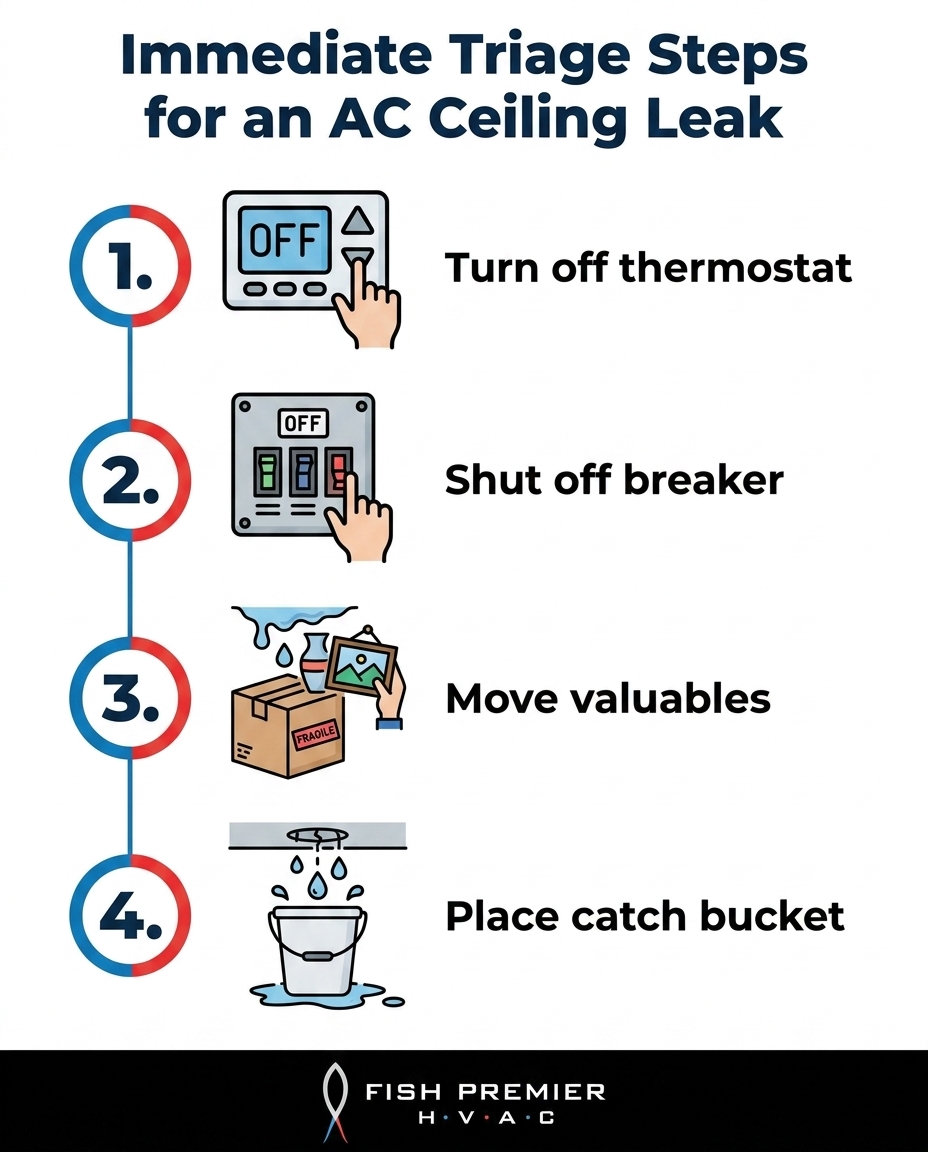
Take these four triage steps within the first five minutes of discovering the leak:
1. Turn off the AC at the thermostat immediately: Switch your thermostat from "Cool" to "Off." This stops the compressor and the evaporator coil from extracting any more moisture from the air, effectively halting the condensation process at the source.
2. Shut off power to the HVAC system at the main breaker: For absolute safety, locate your home's main electrical panel and flip the breaker labeled "AC" or "HVAC" to the off position. Water and electricity are a dangerous combination, especially if the leak is occurring near light fixtures, ceiling fans, or attic wiring.
3. Move valuables, furniture, and rugs away from the drip zone: Clear the area directly beneath the leak. Move electronics, expensive rugs, and wooden furniture out of the splash radius to prevent secondary water damage to your belongings.
4. Place a wide catch bucket or heavy-duty tarp under the leak: Position a large plastic bin, a wide bucket, or a waterproof tarp directly under the active drip to protect your flooring. Towels will saturate too quickly to be effective against a steady flow.
Why Speed Matters During Triage
Taking these steps rapidly is essential because there is a delay between when you shut off the system and when the dripping stops. The secondary drain pan in the attic is likely full of water, and the insulation above your ceiling is already saturated. It may take 30 to 60 minutes for the residual water to finish dripping through the drywall, which is why placing a wide catch basin is so important even after the power is cut.
Why Your Attic AC Unit is Overflowing Right Now
To understand why this emergency is happening, it helps to understand the sheer volume of water your system handles. Central air conditioners do not just cool the air; they condition it by removing moisture. In a humid subtropical climate, extreme regional dew points accelerate this moisture extraction. A standard residential system can produce between 5 and 20 gallons of condensation per day depending on the ambient moisture and the size of the unit.
Normally, this water drips off the cold evaporator coil into a primary drain pan, where it flows down a PVC pipe and safely exits your home. However, the dark, damp environment inside that pipe is the perfect breeding ground for organic growth. During periods of intense July high humidity, algae, mold, and airborne dust combine in the drain line to create severe, sludge-like blockages.
When the primary line clogs, the water has nowhere to go. It backs up and spills over into a secondary drain pan located underneath the entire unit. This secondary pan is designed as a fail-safe, but if the secondary drain line is also clogged, or if the pan itself is compromised, the water eventually overflows directly onto the attic floor and your ceiling joints.
Condensation Volume Factors
Several variables influence how quickly a clogged system will overflow into your home. Understanding these factors highlights why a clogged AC condensate drain line escalates from a minor maintenance issue to a major property threat so rapidly.
• Mild Spring Weather (Low Humidity) — Moisture Extraction Rate: 1-3 Gallons / Day — Overflow Risk Level: Low (Slow drip, easily caught by secondary pan)
• Standard Summer Heat (Moderate Humidity) — Moisture Extraction Rate: 5-10 Gallons / Day — Overflow Risk Level: Moderate (Pan fills within 48 hours of a clog)
• Peak Summer Heat (High Dew Points) — Moisture Extraction Rate: 15-20+ Gallons / Day — Overflow Risk Level: Severe (Rapid overflow, high risk of ceiling damage)
The Hidden Risk of Drywall Collapse and Structural Damage
The urgency of an AC leak cannot be overstated because of the materials used in modern home construction. Standard half-inch drywall acts like a rigid sponge. When dry, it is strong enough to hold heavy light fixtures and texture. When saturated with water, it loses its structural integrity rapidly. The gypsum core dissolves, and the heavy paper backing begins to tear under its own weight.
In many DFW and Fort Worth TX homes, the attic space above the ceiling is filled with blown-in fiberglass or cellulose insulation. When a condensate pan overflows, the water first soaks this insulation. Wet insulation becomes incredibly heavy, pressing down on the weakened, saturated drywall below. This combination of water weight and compromised gypsum is what leads to a sudden, catastrophic ceiling collapse.
A ceiling collapse can cause thousands of dollars in secondary damage to the home's interior, ruining hardwood floors, destroying furniture, and requiring extensive structural repairs. Furthermore, FEMA water damage timelines indicate that mold and severe degradation begin within 24 to 48 hours of initial saturation. Stopping the leak is only step one; professional water mitigation and HVAC repair must follow immediately to dry the cavity and prevent hazardous mold growth.
Identifying the Warning Signs of Collapse
If you are monitoring a water stain, watch for these critical warning signs that indicate the drywall is nearing the point of failure:
• Bowing or sagging: The ceiling takes on a convex shape, drooping downward under the weight of the water.
• Blistering paint: The latex paint forms large, water-filled bubbles as the moisture pushes through the drywall paper.
• Seam separation: Straight lines appear on the ceiling as the tape holding the drywall joints together begins to fail.
• Dripping dirty water: The water changes from clear to brown or yellow, indicating it has fully saturated the insulation and the gypsum core.
Why Didn't the AC Float Switch Prevent the Leak?
A common question homeowners ask during this crisis is why the system's safety mechanisms failed to prevent the flood. Modern HVAC systems are typically equipped with a float switch—a small electronic device installed on the side of the primary or secondary drain pan. These switches are designed to detect rising water in the pan. When the water lifts a small buoyant float, it triggers a sensor that automatically shuts down the system, stopping condensation before an overflow occurs.
Unfortunately, these safety devices are not foolproof. Float switches can fail mechanically due to age, intense attic heat, or electrical faults. During periods of July high humidity, the same thick algae that clogs the drain line can encase the float mechanism, gluing it to the bottom of the switch housing so it cannot rise with the water level.
In some cases, float switches were improperly installed by previous unqualified technicians. If the switch is mounted too high on the pan, the water will spill over the sides before it ever reaches the sensor. Additionally, older metal secondary drain pans are highly susceptible to rust. A rusted or cracked secondary drain pan can leak water straight through the bottom, completely bypassing a perfectly functional float switch.
How Concierge-Level Professionals Resolve Attic AC Leaks
Resolving an overflowing attic unit is not a DIY project. Navigating a 130-degree attic requires specialized safety protocols. One wrong step off a ceiling joist can send a homeowner crashing through the drywall, turning a water leak into a major medical and structural emergency. Professional technicians are trained to work safely in these extreme environments, identifying the root cause of the overflow without causing further damage.
When concierge-level professionals arrive at a DFW or Fort Worth TX home, the focus is entirely on protecting the property. Technicians lay down drop cloths, wear shoe covers, and use specialized containment strategies to ensure the messy reality of attic plumbing does not ruin high-end home interiors. They use professional-grade suction and flush equipment to clear the primary and secondary drain lines safely, ensuring the PVC pipes are not cracked or blown apart by improper pressure.
Once the lines are clear, the system undergoes a comprehensive inspection. The technician will verify the integrity of the secondary pan, test the float switch for proper electrical continuity, and check the pitch of the drain line to ensure gravity is pulling the water away effectively. This premium approach to comprehensive HVAC services guarantees that the system is not just un-clogged, but fully restored to safe operating standards.
Frequently Asked Questions About AC Ceiling Leaks
When water is threatening your home, you need fast, accurate answers. If you live within the Fort Worth service area and are dealing with a sudden condensate overflow, review these common questions to understand the severity of the situation and the necessary next steps.
Is an AC leaking through the ceiling an emergency?
Yes, an AC leaking through the ceiling is an active threat to the home's structural integrity. Saturated drywall can collapse under the weight of wet insulation, causing severe damage to the living space below. Immediate shutdown of the system at the thermostat is required to prevent further water production and ceiling failure.
How do you stop an AC from leaking through the ceiling?
Turn off the thermostat immediately to stop the cooling cycle, then flip the main HVAC breaker to the off position for electrical safety. Place a wide catch bucket under the drip zone and move all valuables out of the area. Do not attempt to access the attic unit while it is actively flooding or while the surrounding area is wet.
Who do I call when my AC leaks through the ceiling?
Call a licensed emergency HVAC professional first to stop the source of the water and clear the complex blockages in the attic drain lines. Once the HVAC system is secured and no longer producing water, a water mitigation specialist or drywall contractor may be needed to assess and repair the ceiling damage.
Can I use a wet/dry vacuum to clear the AC drain line myself?
While commonly suggested online, DIY clearing in a hot, cramped attic is highly dangerous and not recommended. The risk of electrical shock, slipping through the ceiling joists, or accidentally cracking the brittle plastic drain pan is extremely high. Professional technicians use specialized equipment that clears the line without risking further damage to the unit or your home.
How much water can an AC unit leak into the attic?
Depending on the system size and ambient moisture levels, a central air conditioner can produce up to 20 gallons of condensation daily. If the drain line is clogged, this massive volume of water is redirected entirely into the attic. This volume can easily overwhelm a secondary drain pan and destroy ceiling drywall in a matter of hours.
Get Fast, Professional Help to Protect Your Home
Discovering what to do when your AC condensate line overflows onto your ceiling is the first step in protecting your property. By turning off the thermostat and shutting down the breaker, you have successfully triaged the situation and saved your ceiling from further immediate damage during this intense July high humidity. However, the crisis is not fully resolved until the root cause is addressed.
Your air conditioning system cannot be turned back on until the severe clog is professionally cleared, the drain pan is inspected, and the safety switches are verified. Do not risk a secondary flood or a ceiling collapse by attempting to restart the unit. Contact your local HVAC experts today for rapid, safe resolution, so you can restore your home's comfort with complete peace of mind.