%201.avif)
How Running Your Pool Pump and AC Simultaneously Impacts Your DFW Electrical Panel
When an older electrical panel trips on hot afternoons, the combined high-amperage draw of an AC and pool equipment is often to blame. Determine if you need HVAC repairs or a panel upgrade.


.svg)
.svg)
.svg)
Diagnosing Simultaneous Electrical Loads on Summer Afternoons
Your cooling system shuts down unexpectedly in the middle of a sweltering July afternoon, leaving the house uncomfortably warm, yet the equipment seems perfectly fine once the power is restored. Understanding exactly how running your pool pump and AC simultaneously impacts your DFW electrical panel is the first step to resolving this frustrating cycle. When our team at Fish Premier HVAC responds to these calls across Fort Worth, we see firsthand how heavy-draw appliances operating concurrently place immense stress on residential electrical infrastructure. This sudden loss of power is not just a nuisance; it is a critical safety mechanism designed to prevent electrical fires and catastrophic equipment damage.
For many homeowners, the primary challenge lies in pinpointing the root cause of the power interruption. You are faced with a complex decision point: determining if the issue stems from a failing air conditioning compressor that is drawing too much power, an outdated electrical panel that can no longer support modern demands, or a simple circuit overload requiring professional load balancing. Making the right diagnostic choice dictates whether you need mechanical repairs or an electrical upgrade.
This dynamic is especially prevalent in older Fort Worth homes, where our technicians often find the original electrical infrastructure was never designed to handle the massive energy requirements of today's high-capacity air conditioning systems running alongside heavy-duty pool filtration equipment. Decades ago, household electrical demands were a fraction of what they are now. As modern appliances have grown larger and more powerful, the invisible strain on your electrical bus bar has multiplied, turning a standard afternoon cooling cycle into a potential electrical bottleneck.
The Technical Reality of Concurrent High-Amperage Draws
To understand why your electrical system struggles, it is necessary to look at the mechanics of amperage draw. Electrical panels do not just measure the total amount of power used over a month; they are constrained by the exact amount of power demanded at any given split second. When a motor—whether in a pool pump or a cooling system—turns on, it requires a massive surge of energy to overcome inertia and begin spinning.
During July's upper 90s to 100+ degree heat across the region, continuous cooling operation makes simultaneous load overlaps with pool pumps entirely unavoidable. You cannot simply schedule around the heat when the system must run for 12 or more hours a day to maintain indoor comfort. In our experience, if your AC circuit breaker keeps tripping during peak summer, it is almost certainly tied to these overlapping surges.
Understanding Locked Rotor Amps (LRA)
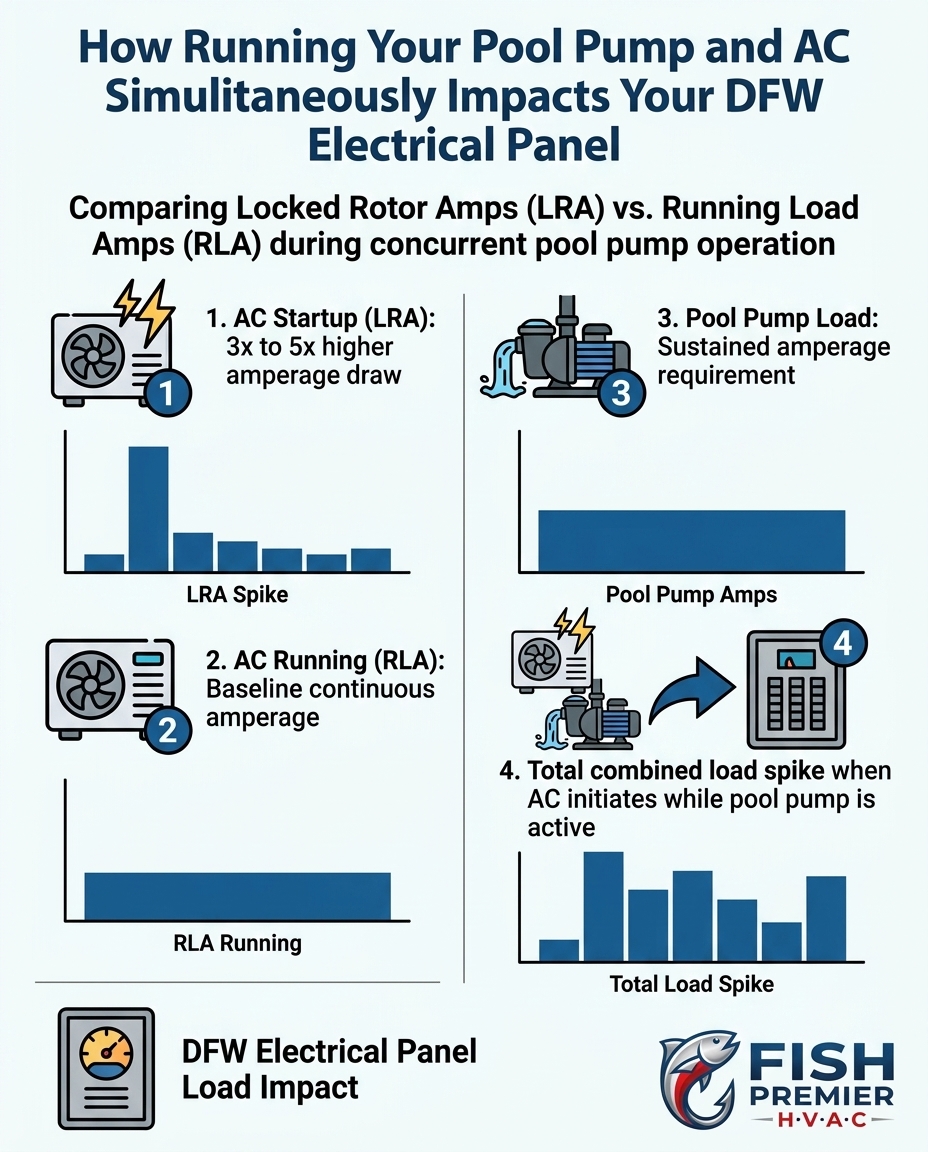
Every air conditioning compressor has a rating known as Locked Rotor Amps (LRA). This metric represents the brief but massive electrical surge required to start the compressor from a dead stop against the high pressure of the refrigerant inside the lines.
• The startup spike: The LRA surge is typically three to five times higher than the system's normal operating power.
• The duration: While this spike only lasts for a fraction of a second, it hits the main electrical bus bar with tremendous force.
• The baseline shift: Once the compressor is successfully spinning, the power requirement drops down to the Running Load Amps (RLA), which is the baseline power required to keep the system cooling.
If the electrical panel is already near its maximum capacity, that split-second LRA surge is enough to push the total amperage over the breaker's safety limit, causing an immediate trip.
The Compounding Effect of Pool Pump Timers
Pool pumps add a significant, sustained load to your electrical panel. Single-speed pool pumps, which our installation crews still see frequently in the DFW area, draw a large and continuous amount of amperage for the entire duration of their filtration cycle. When a pool pump is active, it consumes a large portion of the electrical panel's available bandwidth.
The mathematical reality of this overlap is what causes the infrastructure to fail. If a pool pump is steadily drawing 15 amps, and the rest of the house is drawing 40 amps for lights, refrigerators, and electronics, the panel is already under a heavy load. When the cooling system initiates its LRA surge—requesting perhaps 70 to 100 amps for a fraction of a second—the total combined draw instantly exceeds the capacity of a standard residential breaker, severing the power supply to protect the home.
Distinguishing HVAC Mechanical Failure From Infrastructure Overload
When the power cuts out repeatedly, the most pressing question is whether the cooling equipment is broken or the electrical panel is simply overwhelmed. When we diagnose these issues, we look closely at how the equipment behaves right before the power fails to distinguish between a mechanical failure and an infrastructure limitation.
As an air conditioning compressor ages, internal wear and tear cause it to work harder to compress the refrigerant. This mechanical friction means the motor must pull more amps than its original factory rating just to start up. If a compressor is failing, its LRA spike will grow larger over time. Similarly, a failing dual run capacitor—the component that stores energy to help jolt the compressor awake—can artificially extend the LRA phase. Instead of a fraction of a second, the surge lasts a full second or two, which is more than enough time to trip the breaker. In these cases, AC replacement in Fort Worth or targeted mechanical repairs might be necessary to resolve the excessive power draw.
Conversely, we often find that pure infrastructure issues occur when the HVAC components are perfectly healthy, but the combined electrical load simply exceeds what the panel can handle.
• Timing of the Trip — Likely Mechanical Failure: Trips immediately every time the AC tries to start, regardless of other appliances. — Likely Infrastructure Overload: Trips only in the late afternoon when the pool pump, AC, and other appliances run together.
• Breaker Temperature — Likely Mechanical Failure: Breaker feels normal or slightly warm. — Likely Infrastructure Overload: Breaker is excessively hot to the touch before tripping.
• System Noises — Likely Mechanical Failure: Loud humming, buzzing, or grinding from the outdoor unit before the trip. — Likely Infrastructure Overload: Outdoor unit sounds perfectly normal right up until the power cuts out.
• Age of Equipment — Likely Mechanical Failure: Cooling system is 12+ years old. — Likely Infrastructure Overload: Electrical panel is original to an older Fort Worth home.
To accurately diagnose the issue, our professionals use a multimeter to measure the real-time amp draw on the compressor during startup. If the LRA is within factory specifications but the breaker still trips, the focus must shift to the home's electrical capacity.
Why Historic Neighborhood Infrastructure Struggles With Modern Demands
The root of many simultaneous load issues lies in the original construction of the home. Homes built decades ago were typically equipped with 100-amp or 150-amp electrical panels. At the time of construction, these capacities were more than sufficient to run a few window units, standard lighting, and basic kitchen appliances.
However, these legacy panels were never designed to support the simultaneous operation of central air conditioning and heavy-duty pool equipment. We routinely see cases where adding a pool to an existing older home pushes the electrical load dangerously close to, or past, safe thresholds. The National Electrical Code (NEC) outlines strict load calculation standards for modern residential homes, and today, a 200-amp service panel is widely considered the minimum requirement for a home running dual high-draw appliances.
Legacy Panel Limitations
When you look at the total capacity limits of 100-amp and 150-amp panels, the math quickly reveals the problem.
1. The Baseline Load: A standard home running lights, a refrigerator, computers, and a television might draw 30 to 40 amps continuously.
2. The Pool Pump Addition: A single-speed pool pump adds another 15 to 20 amps of sustained load, bringing the total to 50 to 60 amps.
3. The Cooling Demand: A standard central cooling system might require 20 amps to run, but 80 amps to start.
When that 80-amp startup spike hits a 100-amp panel that is already carrying 60 amps of sustained load, the total demand hits 140 amps. The main breaker will trip instantly to prevent the wiring inside the walls from melting. Physical signs of an overloaded panel include excessive heat radiating from the breakers, frequent nuisance tripping across multiple circuits, and a faint buzzing sound coming from the electrical box.
Reducing Electrical Strain Through High-Efficiency Upgrades
If your panel is struggling to keep up with the demands of peak summer, a full electrical service upgrade is not the only solution. Our team often recommends upgrading the mechanical equipment itself to create enough electrical headroom to safely run a pool pump concurrently without overwhelming the existing infrastructure.
Modern, high-efficiency HVAC equipment utilizes advanced inverter technology to fundamentally change how the system consumes power. Traditional single-stage compressors operate on a simple binary: they are either 100% on or 100% off. This creates the massive LRA startup spikes that cause breakers to trip. Inverter-driven compressors, on the other hand, start up slowly and ramp up their speed gradually.
By eliminating the massive LRA startup spike entirely, an inverter system removes the violent electrical surge from the equation. Furthermore, the continuous Running Load Amps (RLA) of newer systems are significantly lower than those of aging, inefficient units. A high-efficiency system might draw only 10 to 12 amps to cool the home, compared to 20 or more amps for an older unit. This dramatic reduction in power consumption frees up valuable space on the electrical panel, allowing the pool pump and the cooling system to operate in harmony. This approach perfectly intersects improved cooling performance with greatly enhanced electrical safety.
A Holistic Approach to Whole-Home Electrical and Cooling Safety
Solving a tripping breaker requires looking beyond the electrical panel itself. Assessing the home as a complete system, rather than just swapping individual parts, is the most effective way to ensure long-term stability. You cannot simply install a larger breaker to stop the tripping; doing so violates safety codes and creates a severe fire hazard by allowing more current to flow through wires than they are rated to handle.
Evaluating both the mechanical health of the cooling system and the capacity of the electrical panel together prevents dangerous electrical overloads and protects expensive appliances from voltage drops. When a system starves for voltage, the motors run hotter, degrading the insulation on the copper windings and drastically shortening the lifespan of both the pool pump and the compressor.
This is where our premium concierge HVAC service approach makes a significant difference. At Fish Premier HVAC, we look far beyond the tripped breaker to solve the underlying whole-home electrical and mechanical strain. By taking a holistic view of older Fort Worth homes, our professionals can map out the exact amperage draw of every heavy appliance, test the integrity of the aging bus bar, and provide tailored solutions that prioritize long-term safety and whole-home comfort over temporary, quick fixes. The ultimate result is the peace of mind that comes from proper load balancing, knowing your home can handle the hottest days without interruption.
Frequently Asked Questions About Pool Pumps and Electrical Loads
Why does my AC breaker trip on hot summer afternoons?
Your breaker trips on hot summer afternoons because the cooling system runs longer and more frequently, increasing the likelihood that it will start up while other heavy appliances are running. When the AC compressor initiates its massive startup surge (Locked Rotor Amps) at the exact same time your pool pump or electric oven is drawing heavy power, the total demand exceeds the breaker's safety limit. The breaker trips to protect your home's wiring from overheating and catching fire.
How do I know if my AC compressor is drawing too many amps?
You can identify excessive amp draw through physical symptoms like a breaker that feels hot to the touch, a loud buzzing sound from the outdoor unit right before the power fails, or lights that dim severely when the system turns on. However, the only definitive way to know is to have a professional measure the electrical draw with a multimeter. Our technicians will compare the actual startup amps against the manufacturer's data plate on the side of the unit to see if the compressor is failing.
Can running my pool pump and AC at the same time overload my panel?
Yes, running a pool pump and central air conditioning simultaneously is one of the most common causes of panel overload in residential homes. Both appliances require significant sustained amperage to operate, and the cooling system requires a massive additional surge just to start up. If your home has an older 100-amp or 150-amp panel, these two devices alone can consume nearly all of your available electrical capacity during peak summer.
Do I need a 200-amp panel upgrade if I install a pool?
In most cases, adding a pool to a home with central air conditioning will require upgrading to a 200-amp electrical panel to meet National Electrical Code (NEC) safety standards. Older panels simply do not have the bandwidth to support the sustained load of a filtration pump alongside modern household electronics and cooling systems. A professional load calculation is necessary before installation to determine exactly how much capacity your current infrastructure has left.
Will installing a hard start kit stop my breaker from tripping when the pool pump is on?
A hard start kit can sometimes stop nuisance tripping by providing a burst of stored energy to the compressor, which shortens the duration of the startup surge. However, we always advise our customers that it is not a cure-all for an undersized electrical panel. If your home's total electrical demand is genuinely exceeding the panel's maximum capacity, a hard start kit will only mask the underlying infrastructure problem temporarily.
Next Steps for Resolving Simultaneous Electrical Overloads
Ignoring a breaker that repeatedly trips during peak summer is never a safe option. Constantly resetting the breaker forces electricity through stressed components, which can eventually lead to permanent damage to your expensive cooling equipment, pool pump motors, and the electrical panel itself.
The most critical next step is determining whether the root cause is a mechanical failure within the compressor or a genuine infrastructure bottleneck. Resolving the electrical strain requires accurate diagnostics and a comprehensive understanding of your home's total power demands. Scheduling a professional load assessment with our team will give you a clear, definitive path forward, ensuring the safe, uninterrupted operation of all your heavy appliances throughout the hottest months of the year.