%201.avif)
The Reality of Installing a New AC Unit in Keller During Peak Season
Replacing a dead AC in the middle of a Texas summer isn't an instant fix. Understand Keller's permitting timeline and how to keep your home safe while you wait for installation.


.svg)
.svg)
.svg)
When Your Cooling Fails in the Dead of a North Texas Summer
At Fish Premier HVAC, our team typically sees that nearly 75% of emergency HVAC calls happen when the thermometer crosses the 90-degree mark, and the reality of installing a new AC unit in Keller during peak season is that average highs consistently exceed 96 degrees in July. When a central cooling system suffers a catastrophic failure in these conditions, it immediately elevates from a mere inconvenience to a serious life-safety issue. Homes in North Texas are built to retain conditioned air, but without an active cooling cycle, the thermal envelope quickly works in reverse. Within just a few hours of a compressor locking up or an evaporator coil failing, indoor temperatures can spike to dangerous levels.
The initial reaction for most homeowners is understandable panic. You want the house cooled down immediately, and you start searching for the fastest possible replacement. However, setting realistic expectations is necessary for making a sound long-term investment. Replacing a primary cooling system is a major construction project that happens inside your home, not an instant retail transaction. Managing the practical gap between approving a replacement quote and the actual installation requires understanding local logistics, supply chain realities, and municipal requirements.
For immediate assistance with a failing system, explore our comprehensive air conditioning services or review our step-by-step guide to AC installation in Keller.
Before rushing into a hasty decision based purely on who can arrive first, it pays to understand what a proper, code-compliant mechanical changeout actually entails. A mid-July peak summer replacement involves specific local permitting, careful equipment procurement, and strategic temporary comfort measures to keep your family safe while the permanent solution is prepared.
Understanding Peak Season Timelines for Replacement
During the height of summer, the entire HVAC infrastructure in North Texas operates at maximum capacity. Local supply house inventories fluctuate by the hour, and contractor schedules are booked tightly with emergency service calls and planned replacements. This high-demand environment directly impacts how quickly a new system can be sourced, staged, and installed.
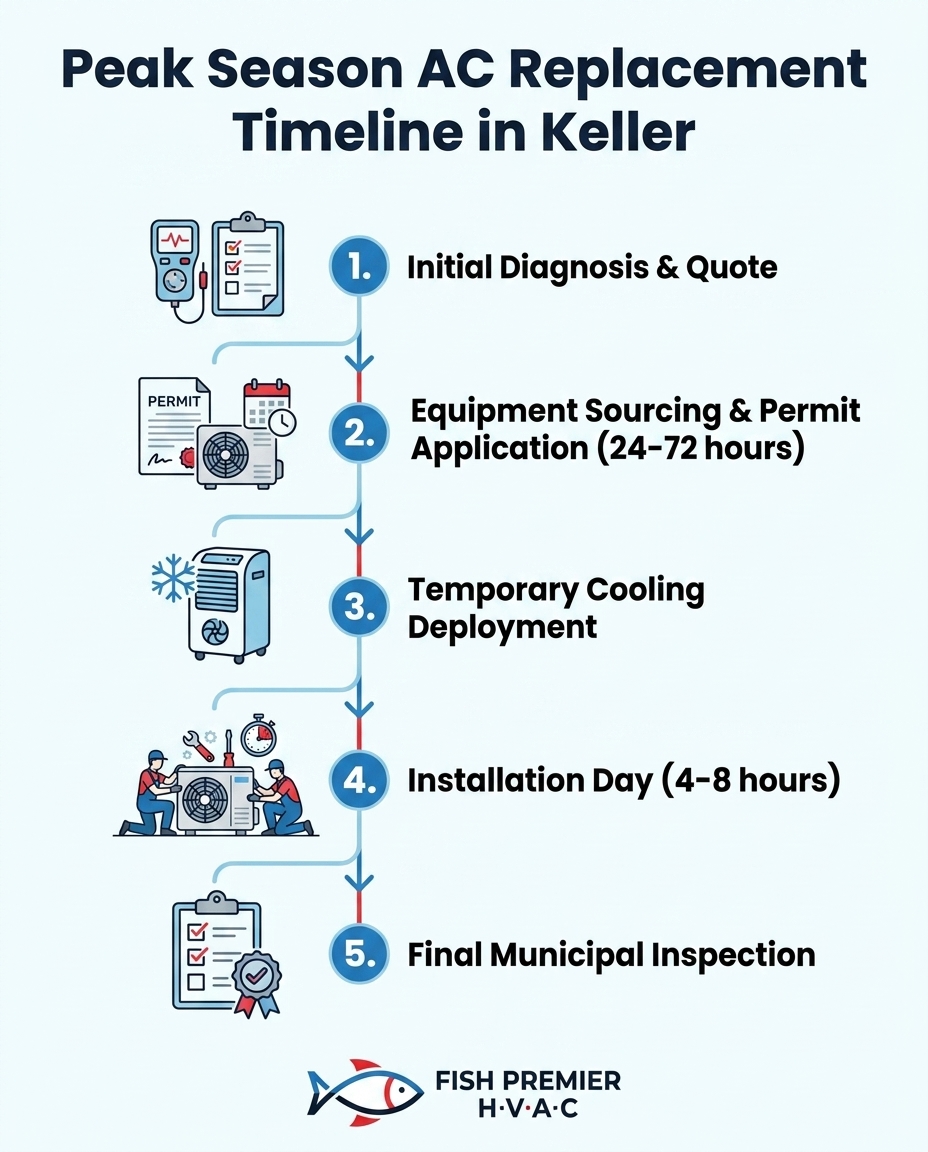
In our years serving the Fort Worth and Keller areas, a pattern we see often is the heavily promoted industry myth of guaranteed "same-day installation." While it sounds appealing when your house is 85 degrees inside, same-day replacements often require compromising on equipment. Contractors promising instant changeouts are typically limited to whatever unassigned equipment happens to be sitting on their truck or at the nearest warehouse, rather than sourcing the exact system engineered for your home's specific load requirements. For a premium, properly matched system, a 24 to 72-hour waiting period is the realistic standard.
• Rushed "Same-Day" — Equipment Selection: Limited to immediate stock; often mismatched — Expected Timeline: Under 24 hours — Long-Term Outcome: Potential short-cycling, higher utility bills, humidity issues
• Proper Procurement — Equipment Selection: AHRI-matched, load-calculated for the home — Expected Timeline: 24 - 72 hours — Long-Term Outcome: Optimized efficiency, valid warranties, proper dehumidification
When high-quality air conditioner installers keller tx dispatch their crews, they operate on highly orchestrated schedules to ensure no steps are skipped during the most demanding weeks of the year. Properly planning the installation allows our team to gather all necessary sheet metal fittings, electrical components, and municipal paperwork before arriving at your property.
The Equipment Procurement Phase
The first 24 hours after you approve a replacement quote are dedicated to procurement. We must source the exact matched system components—the outdoor condenser, the indoor evaporator coil, and the air handler—from regional wholesale distributors.
Why matching matters: Every modern HVAC system requires an AHRI (Air-Conditioning, Heating, and Refrigeration Institute) certificate to prove the indoor and outdoor components are engineered to work together. Sourcing the correct SEER2 rating and exact tonnage prevents long-term inefficiency. Settling for mismatched components just to shave a day off the timeline can cost thousands in wasted energy and premature wear over the next decade.
Navigating City of Keller Municipal Permitting
A major factor that separates a professional installation from a cut-rate job is strict adherence to local building codes. The City of Keller requires a mechanical permit for all HVAC changeouts. This is not an optional suggestion; it is a legal requirement designed to ensure compliance with current energy standards and safety protocols.
Pulling a permit means the installation will eventually be reviewed by a third-party municipal inspector. The inspector verifies that the electrical disconnects are properly sized, the gas lines (if applicable) are securely fitted and pressure-tested, and the primary and secondary condensate drains are routed correctly to prevent future water damage to your home.
Documentation required by the city:
• AHRI Matching Certificates: Proof that the equipment meets federal efficiency standards.
• Load Calculations: Verification that the system is properly sized for the square footage and thermal envelope of the property.
• Texas Mechanical Code Compliance: Assurance that all duct transitions, electrical whips, and refrigerant lines meet state safety regulations.
Navigating this municipal red tape can seem daunting, but our dedicated team handles this entire process on behalf of the homeowner. We submit the applications, pay the necessary municipal fees, and schedule the final inspections. Bypassing the permit process might save a small amount of effort upfront, but it actively jeopardizes your home's resale value and can void the manufacturer's warranty on your new equipment. When selling a home in Keller, TX, unpermitted mechanical work frequently surfaces during the buyer's inspection, forcing the seller to pay hefty retro-permitting penalties.
Bridging the Gap: Temporary Cooling Solutions
Understanding the logistical timeline is helpful, but it doesn't solve the immediate physical discomfort of sitting in a sweltering house. A home absorbs radiant heat aggressively during a mid-July peak summer afternoon. Without active air conditioning, indoor temperatures can easily climb into the upper 80s or 90s, making the environment unbearable and potentially unsafe for vulnerable family members, elderly residents, and pets.
Surviving the 24 to 72-hour wait requires active heat management. Rather than leaving families to suffer through the delay, our concierge-level service approach at Fish Premier HVAC actively minimizes disruption by providing temporary cooling logistics, deploying portable AC units to keep a primary living space safe and comfortable while the permanent equipment is being sourced.
Interim survival strategies for your home:
• Isolate the heat: Close interior doors to unused rooms, bathrooms, and closets to shrink the footprint of the area you need to keep cool.
• Manage window exposures: Draw all blackout curtains, lower blinds, and close shutters, particularly on the east-facing windows in the morning and west-facing windows in the afternoon to block radiant solar heat gain.
• Deploy portable cooling safely: If utilizing portable or window AC units, ensure they are plugged directly into properly grounded wall outlets, never into extension cords or power strips, which can overheat and cause electrical fires.
• Limit internal heat generation: Avoid using the oven, stove, dishwasher, or clothes dryer during the hottest parts of the day, as these appliances dump significant thermal energy directly into your living space.
• Prioritize hydration and safety: Keep ceiling fans running to create a wind-chill effect on the skin, drink plenty of water, and monitor pets closely for signs of heat exhaustion.
What to Expect on Installation Day
Once the equipment is secured and the permits are filed, the physical transformation of your home's comfort system begins. In our experience, installation day is a highly coordinated event that typically takes our crews between four and eight hours, depending on the complexity of the duct transitions and the location of the indoor equipment (such as a tight attic or a cramped utility closet).
Our professional crew will arrive early to begin site preparation. The lead technician will walk you through the day's plan, verify the equipment models against your contract, and begin laying down property protection. Drop cloths, floor runners, and corner guards are deployed to ensure your home remains pristine while heavy equipment is moved in and out.
How our professionals handle the installation process:
1. Safe Extraction: Our team safely recovers the existing refrigerant from the old system using EPA-approved recovery cylinders. The old condenser, coil, and air handler are disconnected and carefully removed from the property.
2. Site Preparation: The outdoor condenser pad is leveled or replaced, and the indoor plenum (the sheet metal box connecting the unit to your ductwork) is modified to perfectly fit the dimensions of the new, often larger, high-efficiency equipment.
3. Setting the Equipment: The new indoor unit is secured, and the outdoor condenser is anchored in place.
4. Refrigerant Piping: The copper lines connecting the indoor and outdoor units are brazed together. As a high-quality ac installer keller tx, we flow nitrogen through the pipes during this brazing process to prevent oxidation and carbon buildup inside the lines, which can destroy a new compressor.
5. Deep Vacuum: A specialized vacuum pump is attached to the system to pull a deep vacuum (measured down to 500 microns). This critical step removes all non-condensables and moisture from the copper lines before the new refrigerant is released.
System Calibration and Testing
Physical installation is only half the job; the system must be precisely calibrated to handle North Texas heat loads. Our technicians will weigh in the exact required charge of refrigerant, measure superheat and subcooling temperatures, and adjust the blower motor speed to ensure optimal airflow across the coil. Finally, they will verify that the primary and secondary condensate drains are flowing freely, testing safety float switches to guarantee the system will shut down automatically if a drain ever clogs, preventing water damage to your ceilings or floors.
Managing the Investment and Final Inspections
Replacing a complete HVAC system is a significant, often unexpected investment. Modern high-efficiency systems represent a major upgrade in technology, utilizing variable-speed compressors and advanced airflow management to reduce monthly energy consumption. To manage this sudden expense without draining emergency savings, we frequently guide homeowners toward accessible HVAC financing options. These programs allow you to break the investment into predictable monthly payments, bridging the financial gap so you don't have to compromise on system quality.
For those researching the broader market variables that influence pricing—such as SEER2 ratings, tonnage, and ductwork modifications—reviewing a comprehensive breakdown of AC replacement cost in DFW provides valuable context on how local market forces shape equipment investments.
The final administrative steps:
• Warranty Registration: We register the equipment with the manufacturer on your behalf, ensuring you receive the full 10-year parts warranty rather than the default 5-year unregistered term.
• Maintenance Scheduling: Reviewing the required annual maintenance schedule to keep those warranties valid and the system operating at peak efficiency.
• The Municipal Wrap-Up: Once the installation is complete and running perfectly, our team will schedule the final inspection with the City of Keller. The inspector will visit your home to review the work, sign off on the mechanical permit, and officially close out the project, leaving you with documented proof of a safe, code-compliant installation.
Frequently Asked Questions About Summer AC Replacement
How long does an AC replacement take during summer?
The physical installation typically takes 4 to 8 hours to complete once the crew arrives at your home. However, during the peak summer rush, equipment procurement and scheduling can add an additional 1 to 3 days to the timeline. Planning for a 24 to 72-hour window from quote approval to final startup is the most realistic expectation.
Do you need a permit for HVAC replacement in Keller?
Yes, a mechanical permit is absolutely required by the city for all HVAC changeouts. This permitting process ensures the new equipment meets current energy codes and is installed safely according to state regulations. At Fish Premier HVAC, we handle the application, fee payment, and final inspection scheduling for you.
What do you do when your AC breaks in extreme heat?
First, turn off the system at the thermostat to prevent further electrical or compressor damage. Close all blinds and curtains to block radiant solar heat, and contact a professional immediately to get on the schedule. Ask your contractor about temporary cooling options, like portable AC units, to keep your family safe while waiting for repairs or replacement.
Can a new system be installed if it's raining?
Light rain may allow our technicians to continue working on the indoor components, such as the air handler or evaporator coil in the attic. However, heavy summer thunderstorms or lightning will delay the outdoor condenser installation, as working with high-voltage electricity in wet conditions is a severe safety hazard.
Does a new AC unit add value to a Texas home?
Yes, an energy-efficient cooling system is a significant asset in the local real estate market. Buyers place a high premium on new HVAC equipment, provided the installation is backed by closed municipal permits and fully transferable manufacturer warranties.
Securing Your Home's Comfort with Confidence
Facing a complete system failure during a mid-July peak summer heatwave is stressful, but understanding the realities of the replacement process takes the panic out of the situation. While peak season replacements require patience for proper equipment procurement and strict adherence to Keller municipal permitting, partnering with the right team makes the transition smooth and predictable.
By utilizing temporary cooling strategies to keep your home livable and trusting professionals who manage every detail—from pulling permits to calibrating the final refrigerant charge—you ensure your new system will perform reliably for years to come. If your system is struggling to keep up with the Texas heat, schedule a thorough inspection with our local experts who can guide you through the reality of installing a new AC unit in Keller during peak season, managing all logistics from start to finish.