%201.avif)
Detailed Guide to High Efficiency AC Cost Comparison in Texas
Is a high efficiency ac worth the extra cost in texas? Discover SEER2 savings, humidity control, and DFW rebates for luxury homes.


.svg)
.svg)
.svg)
Is a High Efficiency AC Worth the Extra Cost in Texas? Here's the Short Answer
Is a high efficiency AC worth the extra cost in Texas? For most DFW homeowners, the answer is yes — and the reasons go well beyond just saving money on your monthly bill.
Texas cooling seasons stretch close to nine months. Air conditioning can account for nearly half of your summer energy bill. And when temperatures regularly push past 100°F, an undersized or inefficient system doesn't just struggle — it runs almost constantly, wearing itself out while your comfort suffers.
Here's a quick summary before we go deeper:
Quick Answer: Is a High Efficiency AC Worth It in Texas?
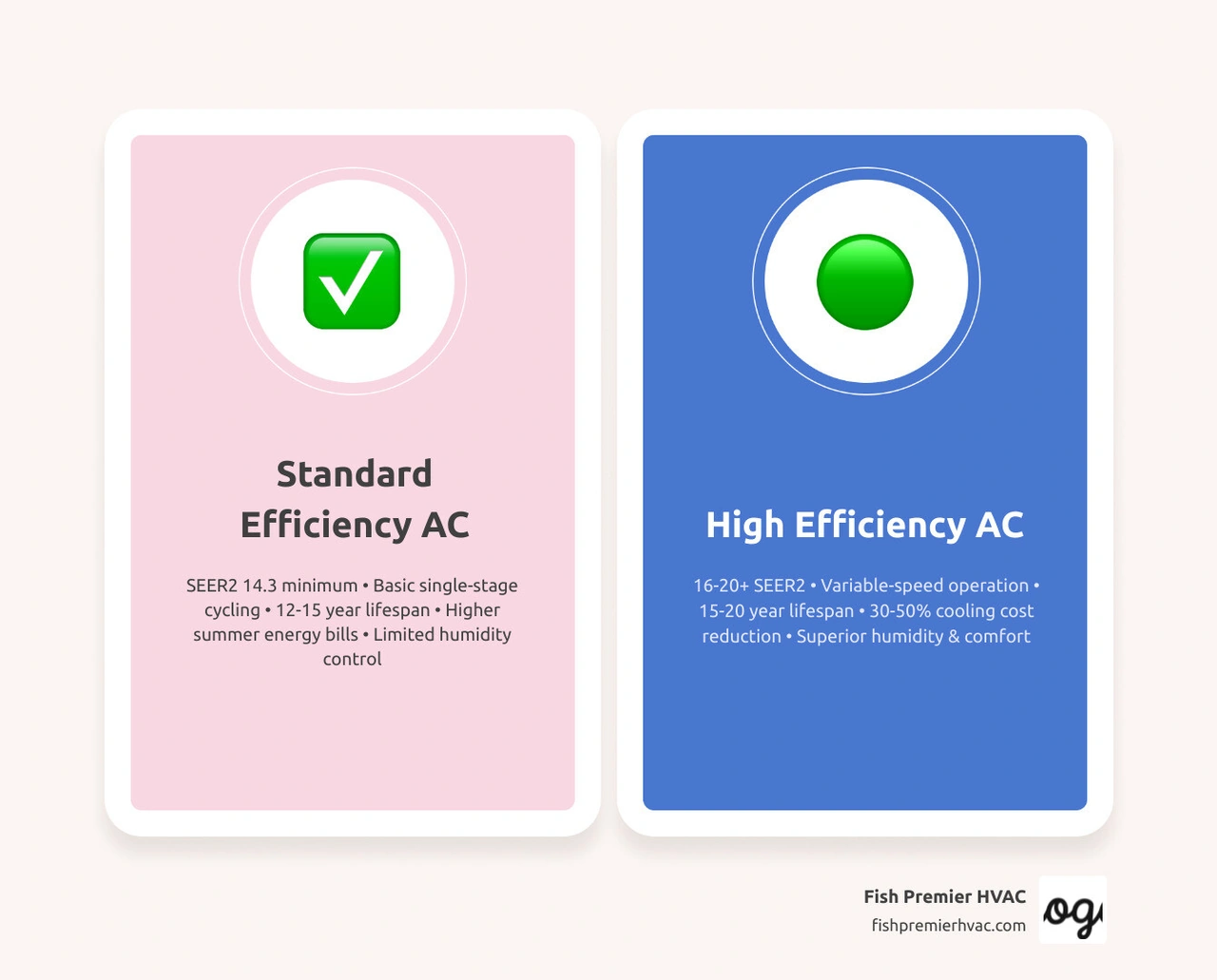
| Factor | Standard Efficiency AC | High Efficiency AC |
|---|---|---|
| SEER2 Rating | 14.3 (federal minimum) | 16-20+ SEER2 |
| Cooling Cost Savings | Baseline | 30-50% less than older low-SEER systems |
| Typical Payback Period | N/A | 5-10 years |
| Humidity Control | Basic (single-stage cycling) | Superior (variable-speed, longer runtime) |
| System Lifespan | 12-15 years | 15-20 years with proper maintenance |
| Federal Tax Credit Eligible | Generally no | Up to $600 (central AC) or $2,000 (heat pump) |
| Best For | Short-term ownership (under 3 years) | Long-term homeowners, luxury comfort, high summer bills |
The short version: if you plan to stay in your DFW home for five or more years, a high-efficiency system typically pays for itself — and delivers a noticeably better experience while doing it. The longer version involves humidity, variable-speed technology, smarter thermostats, and how the Texas climate makes every efficiency point count more than it would almost anywhere else in the country.
Is a High Efficiency AC Worth the Extra Cost in Texas?
When evaluating a major investment in your home's infrastructure, the question of long-term value is paramount. In premium North Texas communities like Keller, Westlake, Colleyville, and Southlake, homeowners often weigh the upfront premium of a high-efficiency system against standard builder-grade units.
To determine if is a high efficiency ac worth the extra cost in texas, we must look at the mathematical return on investment (ROI) alongside the physical comfort of your household.
A high-efficiency air conditioner will typically reduce your cooling energy consumption by 30% to 50% compared to older, low-SEER systems. For example, upgrading from an outdated SEER 10 unit to an 18 SEER2 model can slash your cooling energy consumption by up to 50%. Given that the North Texas cooling season demands over 2,000 run hours per year, those percentage drops convert directly into substantial monthly utility savings.
Over the typical lifespan of a premium system, these operational savings accumulate rapidly. Most homeowners in our local DFW communities see a complete payback period of 5 to 10 years through utility savings alone. Since a well-maintained, high-efficiency system can easily last 15 to 20 years, the system essentially pays for itself and then continues to generate pure savings for the remainder of its operational life.
To make the best decision for your specific property layout, you can read our detailed breakdown on How to Choose a High Efficiency AC System.
Understanding SEER2 and Texas Efficiency Standards
To understand the financial and operational math, we must first look at how modern air conditioners are rated. Historically, systems were measured using SEER (Seasonal Energy Efficiency Ratio). However, as of January 2023, the Department of Energy mandated a stricter, more realistic testing standard known as SEER2.
SEER2 testing utilizes the "M1" testing procedure, which subjects the equipment to five times higher external static pressure than the old SEER tests. This change was designed to mimic real-world ductwork conditions rather than pristine laboratory settings. As a result, SEER2 ratings are typically about 4.5% lower than their old SEER counterparts. For example, a system that would have been rated as a 16 SEER under the old metrics is now rated around 15.2 SEER2.
In the southern region of the United States, including Texas, the federal minimum standard for a new split-system air conditioner installation is currently 14.3 SEER2. Installing anything below this threshold is no longer permitted by law.
While a 14.3 SEER2 system meets the bare minimum building codes, it is often a single-stage unit that operates on a simple "on/off" binary cycle. Mid-efficiency systems typically sit between 15.2 and 18 SEER2, while premium, ultra-high-efficiency systems reach 20+ SEER2. If you are concerned that your current setup is draining your finances, you can learn more about how an AC SEER Rating Costing You Money can silently impact your summer budget.
Furthermore, opting for higher efficiency tiers does more than lower your personal electric bill; it actively contributes to the stability of the Texas power grid. During peak summer afternoons in July 2026, when millions of homes run their air conditioners simultaneously, high-efficiency systems draw significantly less electrical current, reducing the collective strain on our infrastructure.
Why a high efficiency ac worth the extra cost in texas is essential for humidity control
In North Texas, heat is only half of the equation. High humidity levels can turn a hot day into an unbearable, sticky experience. Traditional standard-efficiency systems are designed to cool your home quickly. They cycle on at 100% capacity, rapidly lower the temperature to satisfy the thermostat, and then shut down.
This rapid cycle is known as "short-cycling." While it lowers the air temperature, it does not run long enough to pull moisture out of the air. The result is "cold and clammy" indoor air, prompting many homeowners to lower their thermostats even further—to 68°F or 69°F—just to feel comfortable.
Conversely, a high-efficiency system is engineered for continuous, low-speed operation. By running longer, gentler cycles, the system keeps air constantly moving across the cold evaporator coil. This extended contact allows the coil to extract massive amounts of moisture from the air.
With proper humidity control, you can comfortably set your thermostat to 72°F or 73°F and feel cooler and drier than you would at 68°F with a standard system. This shift in thermostat habits further compounds your monthly energy savings. For a deeper look at which systems excel under these unique atmospheric pressures, explore our guide on the Best High Efficiency AC for Texas Climates.
Beyond the Bills: Comfort, Humidity, and Technology in DFW
When you invest in a luxury home in communities like Westlake or Southlake, home comfort is about creating a seamless, whisper-quiet sanctuary. Standard-efficiency systems operate like a freight train, clunking to life at full blast and shutting off abruptly, creating noticeable temperature swings of 3 to 4 degrees.
High-efficiency systems eliminate this "sawtooth" temperature pattern by utilizing advanced variable-speed compressors. These systems can adjust their cooling output in precise 1% increments, matching the exact heat load of your home at any given moment.
If it is a mild 85°F morning in Keller, the system might run quietly at just 35% capacity, maintaining a perfectly steady indoor climate. As the afternoon sun beats down and temperatures soar past 100°F, the system seamlessly ramps up to meet the demand.
This constant, low-speed air circulation also means whisper-quiet operation. While standard outdoor condensers can produce a loud, disruptive roar of 72 to 80+ decibels, premium high-efficiency units operate between 55 and 70 decibels—scarcely louder than a gentle hum. To learn more about how variable-speed systems transform your living spaces, read about the Variable Speed AC Benefits for Homeowners.
Additionally, this continuous airflow works hand-in-hand with advanced indoor air quality systems. Because the fan runs more consistently at low speeds, your home's air is continuously passed through your filtration systems, air scrubbers, and purification devices, keeping dust, pollen, and allergens at bay. For practical ways to maximize these technological benefits during our hottest months, review our Summer Energy Saving Tips for DFW Homeowners.
How variable-speed technology proves a high efficiency ac worth the extra cost in texas
To truly appreciate why a high-efficiency AC is worth the extra investment, we must look at the mechanics of the compressor. Standard units use single-stage compressors that are either completely off or running at 100% capacity. This constant on-and-off cycling creates immense mechanical stress.
Every time a single-stage system kicks on, it undergoes a "hard start," drawing a massive surge of electricity and subjecting its internal bearings, motor windings, and electrical components to sudden physical shock.
High-efficiency systems utilize variable-speed or multi-stage compressors equipped with "soft-start" technology. Instead of slamming on at full speed, these compressors gradually ramp up, drawing electricity in a smooth, controlled curve. This soft-start capability eliminates the electrical spikes that strain your home's electrical panel and significantly reduces the physical wear and tear on the compressor itself—the most expensive component of your HVAC system.
In our punishing hot climate, standard systems wear out much faster due to these harsh operational cycles. By smoothing out these starts and running at lower, more stable speeds, variable-speed technology directly addresses Why Do AC Units Wear Out Faster in Hot Climates, preserving your system's components and extending its overall service life.
Financial Incentives, Tax Credits, and Long-Term Value
While the long-term operational savings of a high-efficiency system are compelling, federal and local financial incentives make the transition even more attractive.
Under the federal Inflation Reduction Act (IRA), homeowners can take advantage of significant tax credits for energy-efficient home upgrades. For qualifying high-efficiency central air conditioning systems that meet specific SEER2 and EER2 standards, you can claim a 25C federal tax credit of up to $600. If you choose to upgrade to an ultra-efficient heat pump system, that federal tax credit can reach up to $2,000 annually.
Additionally, local electric utility providers in the Dallas-Fort Worth area, such as Oncor, frequently offer residential rebates for upgrading to high-efficiency cooling systems. These rebates are typically structured based on the SEER2 rating of the installed equipment, with higher-efficiency tiers qualifying for larger financial incentives.
These local rebates can often be stacked directly with federal tax credits, drastically reducing the net upfront premium of your upgrade.
Beyond immediate utility savings and tax incentives, upgrading to a high-efficiency system provides a tangible boost to your home's market value. In the highly competitive DFW real estate markets of Colleyville, Southlake, and Westlake, savvy home buyers closely inspect the age, efficiency, and brand reputation of the HVAC systems.
A modern, high-efficiency variable-speed system, complete with smart thermostat integration and a transferrable warranty, is a premium selling point that can ease buyer negotiations and justify a higher asking price. If your current system is showing signs of age, check out our guide on When Should You Replace Your AC in a Hot Climate to make a timely, strategic decision.
Frequently Asked Questions about Texas AC Efficiency
Navigating the technical details of a premium HVAC replacement can raise several practical questions. Below are some of the most common inquiries we receive from homeowners in the Keller, Westlake, Colleyville, and Southlake areas.
What is the typical payback period for a high-efficiency AC in Texas?
For most DFW homeowners, the payback period ranges between 5 and 10 years. The exact timeline depends on your local electricity rates, the efficiency rating of your previous system, and how consistently you maintain the new equipment.
Because we experience long, intense summers with over 2,000 cooling hours per year, our payback periods are significantly shorter than those in milder northern climates.
While a standard system may begin to experience frequent breakdowns after 10 to 12 years of heavy use, a premium high-efficiency system is built to last 15 to 20 years. This extended lifespan ensures you will enjoy many years of pure financial return long after the system has paid for itself. To maximize this longevity, read our expert tips on How to Extend the Life of Your AC in Texas.
How do high-efficiency AC units compare to heat pumps in Texas?
Modern air-source heat pumps are an exceptionally smart choice for our North Texas climate. While a traditional air conditioner only cools your home (relying on a separate gas or electric furnace for winter heating), a heat pump is a reversible system that handles both cooling and heating.
In the summer, a heat pump operates exactly like a high-efficiency central air conditioner, extracting heat from your indoor air and releasing it outside. In the winter, the process reverses: the system extracts ambient heat from the outdoor air and transfers it indoors.
Because heat pumps simply move heat rather than generating it through combustion or electrical resistance, they can achieve up to 300% efficiency during our moderate winter months.
For homeowners in Keller or Southlake who want the ultimate in comfort and efficiency, we often recommend dual-fuel systems. These systems pair a high-efficiency heat pump with a premium gas furnace, allowing the system to automatically select the most cost-effective fuel source depending on how cold it is outside.
Does a high-efficiency AC require special maintenance?
A high-efficiency air conditioning system does not necessarily require more frequent maintenance than a standard unit, but the precision engineering of its components makes regular professional care absolutely essential. To keep your system performing at its rated SEER2 efficiency, we recommend scheduling professional tune-ups twice per year—once in the spring before the cooling season, and once in the fall before the heating season.
During these visits, a certified technician will clean the evaporator and condenser coils, check refrigerant levels, inspect electrical connections, and verify that the variable-speed blower motor is operating perfectly.
As a homeowner, your primary responsibility is to check and replace your air filters every 30 to 90 days, especially during the high-demand summer months when dust and pollen levels are elevated.
Skipping regular maintenance can cause dirt to build up on the coils, forcing the system to work harder, reducing its operational efficiency, and potentially voiding your manufacturer's warranty. To learn more about keeping your system in peak condition, explore the Benefits of Regular AC Maintenance in Texas and consult our Ultimate AC Maintenance Guide Keller TX.
Conclusion
Investing in a high-efficiency air conditioning system is more than just a way to lower your monthly utility bills; it is a commitment to unmatched comfort, whisper-quiet performance, and long-term peace of mind. In the demanding climate of North Texas, where summer heat and humidity test the limits of residential engineering, a premium system is a true game-changer for your home.
At Fish Premier HVAC, we specialize in providing "Whole Home Luxury" and "Expert HVAC Service For Whole Home Comfort." Serving the premium communities of Keller, Westlake, Colleyville, and Southlake, our concierge-level service model is designed for homeowners who demand the very best in luxury, innovation, and residential HVAC installations.
Whether you are looking to upgrade to an ultra-high-efficiency SEER2 system, implement advanced air scrubbers for pristine indoor air quality, install a reliable backup generator, or elevate your living spaces with custom home scenting solutions, we are here to deliver a seamless, premium experience.
Our highly trained professionals possess the deep analytical capabilities and prompt service needed to design a custom comfort solution tailored precisely to your property. We operate Monday through Friday from 8:00 AM to 6:00 PM, and we remain fully available for after-hours emergency services to ensure your home remains a perfect sanctuary no matter the weather outside.
Ready to experience the ultimate in home comfort and efficiency? Contact us today to explore our premium installations, or visit our Air Conditioning Service Page to schedule your custom home comfort consultation.
Fish Premier HVAC — Proudly serving the Dallas-Fort Worth Metroplex. Fort Worth, TX | Texas License #TACLB99535E.