%201.avif)
How a Dirty Condenser Coil Is Killing Your AC Efficiency
Discover how dirty condenser coil and ac performance connection causes inefficiency, short cycling, and high bills. Clean coils now for optimal cooling!

.svg)
.svg)
.svg)
Why the Dirty Condenser Coil and AC Performance Connection Is Costing You More Than You Think
The dirty condenser coil and ac performance connection is one of the most overlooked reasons homeowners across the Dallas-Fort Worth area see their energy bills climb while their homes stay stubbornly warm. Your outdoor condenser coil has one critical job: push the heat your AC pulls from inside your home out into the surrounding air. When a layer of dust, pollen, grass clippings, and grime coats those fins, that heat has nowhere to go — and your entire system pays the price.
Here is what that connection means in plain terms:
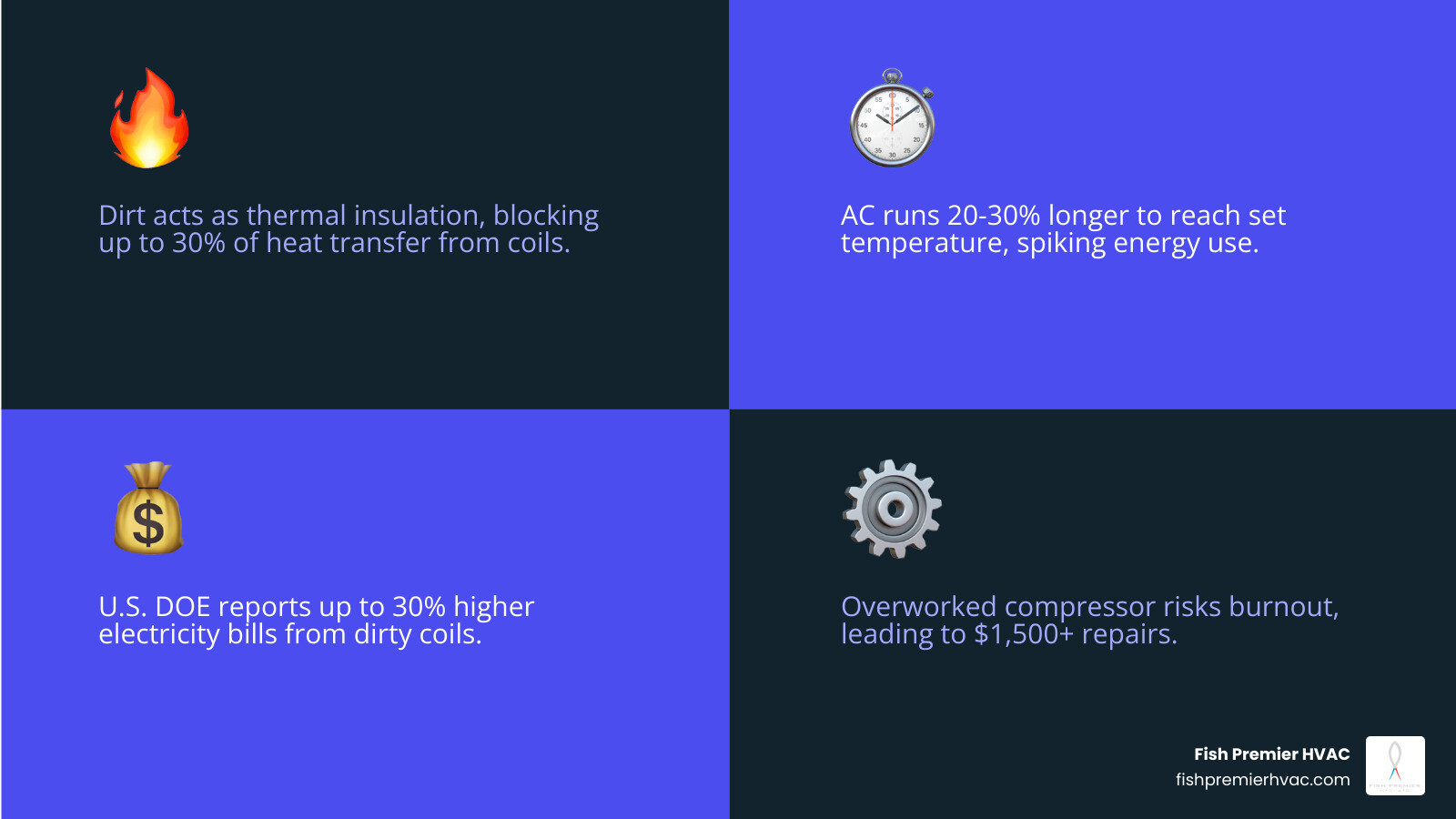
• Reduced heat transfer — Dirt acts like a thermal blanket, trapping heat in the coil instead of releasing it
• Longer run times — Your AC runs longer trying to hit the same temperature, burning more electricity
• Higher energy bills — The U.S. Department of Energy links dirty condenser coils to up to a 30% increase in energy consumption
• Increased system stress — The compressor and fan motor work harder, wearing out faster
• Risk of system failure — Sustained overheating can push the compressor beyond safe operating limits, leading to costly breakdowns
DFW summers are brutal, and your condenser coil is out in the heat, wind, and cottonwood fuzz every single day. Even a modest buildup of debris is enough to start dragging down efficiency. The longer it goes unchecked, the more it compounds — higher bills, hotter rooms, and a system creeping toward an early replacement.
Understanding the Dirty Condenser Coil and AC Performance Connection
To understand why your AC is struggling, we first need to look at how it breathes. Think of your air conditioner as a heat transporter. It doesn't "create" cold; it removes heat. The refrigerant in your system absorbs heat from your living room via the indoor evaporator coil and carries it to the outdoor unit. Once there, the condenser coil must release that heat into the Texas air so the refrigerant can cool down and head back inside for another round.
When we talk about the dirty condenser coil and ac performance connection, we are talking about a breakdown in thermodynamics. Those thin metal fins on your outdoor unit are designed to maximize surface area for heat rejection. However, they are also excellent at catching North Texas "gifts" like oak pollen, lawn clippings, and construction dust.
When a layer of grime builds up, it acts as thermal insulation. Imagine trying to stay cool in July while wearing a heavy wool coat; that is exactly what your AC is doing. This lack of heat rejection leads to a higher amperage draw as the compressor works overtime to force the cooling process. This is a primary reason why you might find your AC Running But Not Cooling effectively, or notice your AC Not Blowing Cold Air even though the fans are spinning.
Why a dirty condenser coil and ac performance connection leads to short cycling
One of the most frustrating symptoms of a neglected system is short cycling. This happens when your AC turns on, runs for a few minutes, and then abruptly shuts off before the house is actually cool. This isn't just a quirk; it’s a cry for help.
Because the dirty condenser coil and ac performance connection prevents heat from escaping, the internal temperature and pressure of the refrigerant skyrocket. Modern high-efficiency systems are equipped with safety sensors. When the pressure becomes dangerously high, the system trips a limit switch to prevent the compressor from literally melting down.
This cycle of starting and stopping is incredibly hard on your equipment. It consumes massive amounts of energy during the "startup" phase and never runs long enough to dehumidify your home. If you are wondering Why Does My AC Short Cycle or why your AC Keeps Shutting Off, the culprit is often a coil so dirty that the system is overheating within minutes of activation.
The impact of airflow restriction on your utility bills
We often see homeowners in Keller and Southlake shocked by their July electricity statements. While rates play a part, the efficiency of your unit is usually the main driver. Research shows that dirty coils can increase electricity costs by 16% to 30%.
When airflow is restricted by a "mat" of dirt on the condenser, the system has to run for significantly longer cycles to achieve the same cooling effect. A system that should run for 20 minutes to cool your home might run for 45 minutes if the coils are fouled. Over a month of 100-degree days, those extra minutes add up to hundreds of dollars in wasted power.
Furthermore, a dirty coil effectively lowers your system's SEER rating. You may have paid for a 18-SEER high-efficiency unit, but with dirty coils, it might perform like a 10-SEER relic from the 1990s. This is a classic case of your AC SEER Rating Costing You Money because the hardware can't perform at its rated capacity. Understanding How Heat Waves Affect AC Efficiency is vital; in extreme heat, your system is already pushed to the limit, and any amount of dirt can be the tipping point that causes an efficiency collapse.
Immediate Signs and Long-Term Risks of Neglected Coils
How do you know if the dirty condenser coil and ac performance connection is currently affecting your home? The signs are usually right in front of you if you know where to look.
First, listen to your outdoor unit. A struggling compressor often makes a louder, more strained humming sound. You might also notice audible fan strain as the motor fights to pull air through a blocked mesh of debris. If you hear AC Noises You Should Never Ignore, it’s time to take a look outside.
Another surprising sign is ice. While it seems counterintuitive for a "hot" component to cause ice, a dirty condenser coil can lead to the indoor evaporator coil freezing over. Because the heat isn't being rejected outside, the whole refrigeration cycle is thrown out of balance, causing temperatures inside the lines to drop below freezing. If you see frost on the copper lines or find your AC Blowing Warm Air, don't just turn the thermostat down—turn the system off and check the coils.
How the dirty condenser coil and ac performance connection impacts your DFW home's humidity
In the Dallas-Fort Worth area, we don't just fight the heat; we fight the humidity. A properly functioning AC acts as a giant dehumidifier. As air passes over the cold indoor coils, moisture condenses and drains away. However, this process relies on long, steady cooling cycles.
When the dirty condenser coil and ac performance connection causes short cycling or reduced cooling capacity, the system doesn't run long enough to remove moisture from the air. You end up with "clammy" air—the temperature might be 72 degrees, but it feels sticky and uncomfortable.
If you find yourself Solving Uneven Cooling issues or noticing that your AC Condensate Drain Line Clogged more often due to sludge buildup from improper cycling, the root cause could be as simple as a dirty outdoor unit. High humidity indoors can also lead to biological growth and poor air quality, making this more than just a comfort issue.
Catastrophic component failure and system lifespan
The most sobering aspect of the dirty condenser coil and ac performance connection is the long-term damage. Your compressor is the "heart" of your AC, and it is also the most expensive part to replace. Operating with dirty coils is like asking a marathon runner to race while breathing through a straw; eventually, something is going to give.
The constant overheating breaks down the specialized oil inside the compressor. Once that oil carbonizes, it loses its lubricating properties, leading to mechanical friction and total compressor burnout. Similarly, the fan motor in the outdoor unit must work against higher static pressure to move air through the dirt. This leads to AC Fan Motor is Failing symptoms, such as slow-spinning blades or a motor that is hot to the touch.
Neglecting your coils also increases the risk of AC Refrigerant Leak Warning Signs. Higher operating pressures put more stress on the copper joints and aluminum fins, eventually causing microscopic cracks that let your refrigerant escape. By the time you notice the leak, the damage to the system's lifespan has already been done.
Best Practices for Maintenance and Professional Care
Maintaining your condenser coil isn't just about a quick spray with a hose; it's about preserving the integrity of your home's luxury comfort system. While some homeowners attempt a DIY approach, there is a significant difference between a surface rinse and a professional deep clean.
• Debris Removal — DIY Surface Cleaning: Removes loose leaves/grass — Professional Deep Cleaning: Flushes deep-seated silt and pollen
• Chemical Application — DIY Surface Cleaning: Water only (usually) — Professional Deep Cleaning: Specialized, non-corrosive coil cleaners
• Component Check — DIY Surface Cleaning: Visual only — Professional Deep Cleaning: Amperage draw and pressure testing
• Fin Integrity — DIY Surface Cleaning: Risk of bending fins with high pressure — Professional Deep Cleaning: Precision fin combing and straightening
• System Health — DIY Surface Cleaning: No diagnostic value — Professional Deep Cleaning: Identifies early signs of motor or capacitor failure
To keep your system healthy between professional visits, we recommend keeping a 2-to-3-foot clearance around your outdoor unit. Trim back any bushes, remove tall weeds, and ensure that mulch isn't piled up against the base of the unit. For our neighbors in Westlake and Colleyville with beautiful landscaping, this is a crucial step to ensure your "greenery" isn't choking your AC.
For a comprehensive look at how to protect your investment, refer to our AC Maintenance Keller TX Guide or our AC Tune-Ups Keller TX Complete Guide.
When to call a specialist for your DFW cooling system
There are times when a garden hose simply won't cut it. If you look at your coils and see a "blanket" of grey or brown material that doesn't wash away easily, it’s likely a combination of grease, pollen, and pollutants that requires professional-grade foaming cleaners. These chemicals are designed to expand between the fins and push the dirt out from the inside.
You should also call us if you notice:
• Bent or crushed fins: These restrict airflow and require a specialized fin comb to repair without causing further damage.
• Corrosion: If you see white "ash" or pitting on the coils (common in areas with high salt or chemical exposure), a professional needs to assess the coil's structural integrity.
• Frequent Tripping: If your circuit breaker keeps popping, this is a sign of a high amperage draw caused by the dirty condenser coil and ac performance connection.
Our technicians are trained to spot the AC Problems Found During Tune-Ups that most homeowners miss. Following the Best AC Tune-Ups Keller TX Guide ensures that your system doesn't just "run," but performs at the peak of its engineering.
Frequently Asked Questions about AC Coil Performance
How often should I clean my outdoor condenser coils in Dallas-Fort Worth?
In the DFW area, we recommend a professional cleaning at least once a year, ideally in the spring before the heat hits. However, if you live in a high-pollen area (like those with heavy Oak or Cedar coverage) or near a new construction site in Southlake or Westlake, you may need to rinse your coils every few months to prevent heavy buildup.
Can I use a pressure washer to clean my AC coils?
No! This is a common mistake that can ruin a system in seconds. The aluminum fins on your condenser are incredibly delicate. The high-pressure stream from a pressure washer will flatten the fins, permanently blocking airflow and requiring a costly coil replacement. Always use a gentle "shower" setting on a standard garden hose.
Will cleaning my coils really lower my monthly energy bill?
Absolutely. By restoring the dirty condenser coil and ac performance connection to its optimal state, you allow the system to reject heat faster. This results in shorter run times and lower amperage draw. Most homeowners see a noticeable drop in their utility costs—sometimes as much as 30%—immediately following a professional deep clean.
Conclusion
Your air conditioning system is one of the most significant investments in your home. In the April 2026 climate of North Texas, a functioning AC isn't just a luxury—it's a necessity for health and comfort. Don't let a simple layer of dirt "kill" your system's efficiency and lead to a premature, expensive failure.
At Fish Premier HVAC, we provide more than just a quick fix. We offer concierge-level maintenance designed for homeowners who demand the best in residential comfort. Our premium AC performance restoration goes beyond the surface, ensuring every component of your system is optimized for the brutal DFW summers.
Stop letting dirty coils drain your wallet and compromise your comfort. Whether you are in Keller, Westlake, Colleyville, or Southlake, our team is ready to restore your system to its peak performance.
Schedule your premium AC performance restoration today and experience the difference that expert care makes.