%201.avif)
Common Reasons Your AC Quits When the Sun Gets Serious
Discover why your AC struggles when your ac cant keep up with the heat. Learn fixes for dirty coils, humidity, and more in Texas heatwaves!


.svg)
.svg)
.svg)
When Your AC Cant Keep Up With the Heat: What's Actually Going On
When your AC cant keep up with the heat, you're not imagining it — and you're definitely not alone. Every summer across the Dallas-Fort Worth area, homeowners set their thermostats lower and lower, only to watch the indoor temperature keep climbing. It's one of the most frustrating experiences a homeowner can have, especially when you've invested in what you thought was a reliable system.
Here's a quick look at the most common reasons your AC struggles on the hottest days:
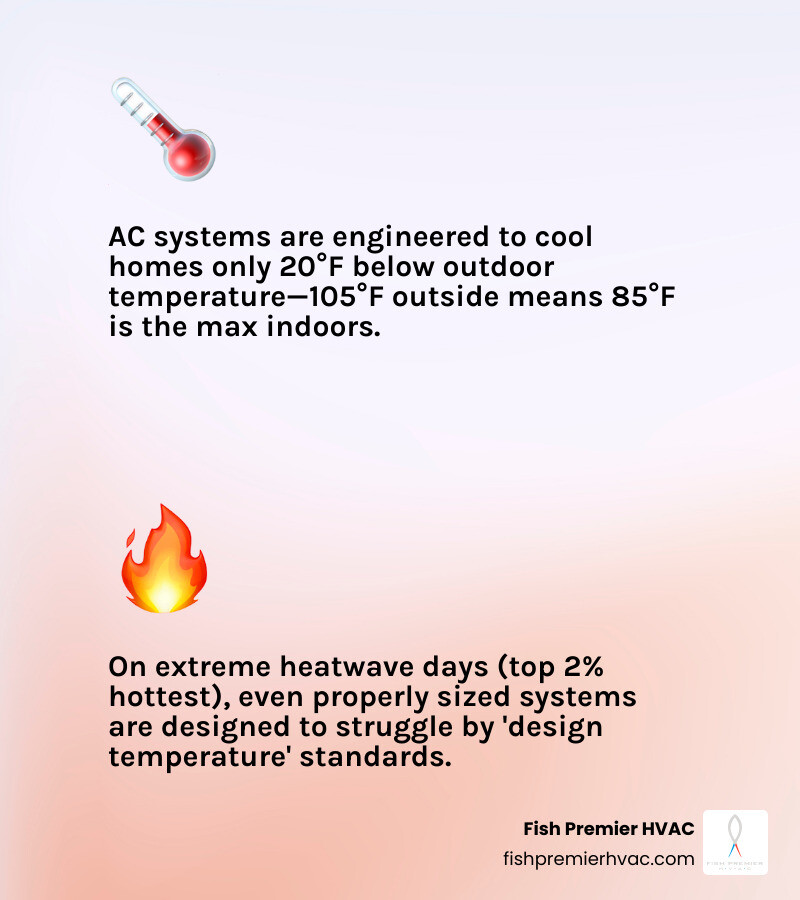
• The 20-degree rule — AC systems are only engineered to cool your home about 20 degrees below the outdoor temperature. When it's 105°F outside, 85°F inside may be all your system can physically deliver.
• Dirty or clogged air filter — Restricted airflow is one of the top causes of poor cooling performance.
• Dirty condenser coils — A grimy outdoor unit can't shed heat efficiently, which tanks cooling capacity fast.
• Leaky ductwork — Duct leaks can rob your system of up to 30% of its cooled air before it ever reaches your rooms.
• Low refrigerant — If your refrigerant is low, it always means a leak — and your system simply can't cool properly without the right charge.
• Undersized or aging equipment — A unit not sized for your home, or one past its 10-to-15-year lifespan, will struggle even on a mild day.
• High indoor humidity — Humidity makes your home feel warmer than the thermometer reads, and it forces your AC to work harder.
• Poor insulation or solar heat gain — Up to 30% of unwanted heat enters through windows alone, overwhelming even a healthy system.
The good news is that most of these problems are diagnosable — and many are fixable. The sections below break down each cause and what you can do about it.
Is it Normal When Your AC Cant Keep Up With the Heat?
As we move through April 2026, we are already seeing the early signs of a scorching North Texas summer. Many residents in Keller and Southlake ask us: "Is it actually normal for my house to stay at 78 degrees when I have the thermostat set to 72?"
The short answer is often yes. Most residential air conditioning systems are designed based on what we call "design temperatures." In our region, systems are typically sized to handle 98% of the typical high temperatures for our climate. This means that for the most extreme 2% of the year—those brutal 105°F days—your system is technically "undersized" by design.
The "20-degree rule" is a fundamental principle of HVAC engineering. An air conditioner is generally capable of creating a 20-degree difference between the outdoor ambient air and the indoor air. If it is 100°F outside in Colleyville, and your home is holding steady at 80°F, your system is actually performing exactly as it was engineered to do. Understanding how heat waves affect AC efficiency helps manage expectations; during peak load, the system isn't "broken," it's simply at its physical limit.
Furthermore, late summer AC performance issues often stem from the cumulative stress of operating at these limits for weeks on end. If your system was already borderline, the sustained heat load of a Texas July or August will expose every minor inefficiency in your home's thermal envelope.
Mechanical Culprits Behind Poor Cooling Performance
When the system truly fails to meet that 20-degree differential, we look toward mechanical failures. The outdoor unit, or the condenser, is the heart of the heat-rejection process. If the condenser coils are caked with dust, grass clippings, or North Texas pollen, the unit cannot "shed" the heat it gathered from inside your home. This causes the compressor to run hotter and longer, eventually leading to a total shutdown.
Another common mechanical failure involves the indoor evaporator coil. When airflow is blocked or refrigerant levels are off, the coil can drop below freezing, leading to AC evaporator coil ice buildup problems. Once ice forms, it acts as an insulator, preventing the system from cooling the air at all. You might see the AC running but not cooling, which is a clear sign that the mechanical heat exchange process has stalled.
To illustrate the impact of maintenance, consider the following comparison:
• Well-Maintained — Cooling Efficiency: 100% — Average Monthly Energy Increase: $0 (Baseline) — Estimated Lifespan: 15+ Years
• Neglected (Dirty Coils/Filter) — Cooling Efficiency: 75-80% — Average Monthly Energy Increase: 30% - 50% More — Estimated Lifespan: 8 - 10 Years
Why a dirty filter means your ac cant keep up with the heat
It sounds simple, but the air filter is the most common reason when your ac cant keep up with the heat. Your HVAC system requires a specific volume of air to pass over the coils to function. A dirty filter increases "static pressure," forcing the blower motor to work harder while delivering less cool air to your living spaces.
In the dusty environment of Westlake and surrounding areas, we recommend a 30-60 day replacement cycle during the peak of summer. When choosing a filter, balance is key. While high MERV ratings (11-13) trap more allergens, they can also be too restrictive for older systems. Regular AC maintenance in Keller, TX ensures that your filter choice matches your system's blower capacity, preventing unnecessary strain.
Signs of an aging or undersized system
Even the best-maintained systems have an expiration date. Typically, air conditioning units last between 10 and 15 years. As a system ages, its components—specifically the compressor and fan motors—lose efficiency. If your home has undergone renovations, such as a room addition or a converted garage, your original unit may now be undersized.
HVAC professionals use a "Manual J load calculation" to determine exactly how many BTUs of cooling your specific home requires. If the unit is too small, it will run 24/7 and never reach the setpoint. If it is too large, you may experience why does my AC short cycle, where the unit turns on and off rapidly. This prevents proper dehumidification and wears out the hardware prematurely. If you find yourself constantly calling for repairs, it might be time to look into AC replacement in Keller, TX to restore your home's comfort, or read our guide on whether to replace vs. repair an aging AC system.
Environmental Factors and Home Efficiency Gaps
Sometimes the AC is working perfectly, but your home is "leaking" coolness. Solar heat gain is a massive factor in North Texas. Up to 30% of unwanted heat enters your home through the windows. If you have large west-facing windows in Southlake and leave the blinds open during the afternoon, you are essentially fighting a losing battle against the sun.
Insulation in the attic also plays a vital role. If your attic isn't properly sealed, the 140°F air above your ceiling will radiate directly into your living space. Furthermore, AC duct problems that reduce cooling are incredibly common. Statistics show that leaky ducts can result in a 30% loss of efficiency. You are paying to cool your attic or crawlspace instead of your bedroom. If you suspect your vents aren't blowing as hard as they used to, seeking AC repair in Keller, TX for a duct inspection is a wise move.
How humidity makes it feel like your ac cant keep up with the heat
In the Dallas-Fort Worth area, humidity is often the "silent" reason when your ac cant keep up with the heat. Your AC has two jobs: lowering the air temperature (sensible heat) and removing moisture (latent heat). If the humidity inside is above 50%, your sweat won't evaporate, making you feel sticky and hot even if the thermostat says 72°F.
High humidity forces the AC to spend more energy wringing water out of the air and less energy lowering the temperature. If your home feels muggy, it could be a sign of fixing low refrigerant issues, as a system low on "Freon" cannot effectively dehumidify. Professional AC service in Keller, TX can help determine if you need a specialized dehumidification solution or a simple system recharge.
Thermostat mismanagement and sensor errors
Your thermostat is the "brain" of the system, but it can be easily fooled. If your thermostat is mounted on a wall that receives direct sunlight or is near a heat-generating appliance like a lamp or TV, it will register a "ghost reading." This causes the AC to run much longer than necessary.
Conversely, if your AC is not blowing cold air, the issue might be as simple as a calibration error or dead batteries in the thermostat. We often see cases where the AC is blowing warm air simply because the "Fan" setting was switched from "Auto" to "On," which circulates uncooled air even when the compressor is off.
Proactive Steps to Help Your System Survive the Summer
While some issues require our "concierge-level" professional touch, there are several steps you can take to help when your ac cant keep up with the heat:
• Switch Ceiling Fans to Counter-Clockwise: This creates a downdraft that can make a room feel 4 degrees cooler through the wind-chill effect.
• Close the Blinds: Keep curtains and shades closed, especially on the south and west sides of the house during the day.
• Schedule Heat-Heavy Tasks: Avoid using the oven, dryer, or dishwasher during the hottest part of the day (2 PM to 7 PM). Using a stove can raise indoor temps by 10 degrees!
• Clear the Outdoor Unit: Ensure there are at least two feet of clearance around your outdoor condenser. Trim back shrubs and remove debris to allow the unit to breathe.
• Check the Vents: Ensure that furniture or heavy drapes aren't blocking your supply or return vents.
• Address Short Cycles: If your AC keeps shutting off before the house is cool, turn it off and call for AC repair in Colleyville, TX immediately to prevent compressor burnout.
Frequently Asked Questions
Should I lower my thermostat to 60 degrees to cool the house faster?
This is a common myth. Your AC does not work like a garden hose; it doesn't "spray harder" if you turn the dial down. It delivers air at a constant rate (usually about 15-20 degrees cooler than the air it sucks in). Setting it to 60°F just means the system will run longer without a break, potentially leading to frozen coils and excessive wear on components.
Why does my air conditioner work fine at night but struggle during the day?
At night, the "thermal load" on your home drops significantly. There is no solar radiation hitting your roof and windows, and the outdoor temperature often drops into the 70s. This allows the AC to finally "catch up" and remove the heat stored in your walls and furniture. During the day, the sun adds heat faster than most standard systems can remove it.
When is it time to stop DIY fixes and call a professional?
If you have changed the filter and cleared the outdoor unit, but the temperature is still rising, it's time to call for air conditioning services. Specifically, call us immediately if you notice:
1. Burning Smells: This indicates electrical failure or a seizing motor.
2. Loud Buzzing or Grinding: These are signs of a failing contactor or compressor.
3. Ice Formation: If you see ice on the copper lines or the indoor unit, turn the system off immediately to let it thaw.
Conclusion
At Fish Premier HVAC, we understand that "good enough" isn't an option when the Texas sun gets serious. We specialize in providing the Dallas-Fort Worth area with concierge-level service that goes beyond simple repairs. Whether you are in Keller, Westlake, Colleyville, or Southlake, we offer luxury comfort solutions tailored to your home's specific needs.
From high-efficiency HVAC installations and advanced air scrubbers to whole-home generators that keep you cool during power outages, our mission is to ensure your home remains a sanctuary. If you feel like your current system is losing the battle against the heat, don't wait for a total breakdown. Contact us for professional air conditioning services and experience the premium comfort you deserve.