%201.avif)
Why Your Keller Home's Second Floor Won't Cool Down in July
Your downstairs thermostat reads 72 degrees, but the upstairs bedrooms are baking. Understand the structural reasons behind this frustrating Texas reality and how to fix it.


.svg)
.svg)
.svg)
The 100-Degree Texas Reality: When Your AC Runs Constantly But the Upstairs Bakes
Your thermostat downstairs reads a perfectly comfortable 72 degrees, but the moment you walk up the stairs, the air grows heavy, stale, and uncomfortably warm. If you are trying to figure out why your Keller home's second floor won't cool down in July, you are experiencing one of the most frustrating summer realities for local homeowners. In our years of providing cooling solutions throughout the Fort Worth area, this is one of the most common complaints our team at Fish Premier HVAC hears every summer. By the time you reach the upstairs bedrooms, it feels like you have entered an entirely different climate zone. Your system is running constantly, blowing air through the vents, yet the second floor continues to bake.
This creates an immediate and uncomfortable decision point. You have to decide whether to keep trying temporary band-aids—like setting up noisy box fans, running portable window units, or constantly adjusting the downstairs thermostat—or seek a permanent airflow solution that actually addresses the root cause of the temperature imbalance.
The hard truth is that when your system runs non-stop without making a dent in the upstairs heat, a basic filter change or routine checkup is not going to solve the structural issue at play. When you need professional air conditioning services to address a severe temperature differential, you need a strategy that looks beyond the outdoor compressor and examines the entire thermal envelope of your house.
The Illusion of a Broken Air Conditioner
Many homeowners assume that a hot second floor means their air conditioner is failing. However, if the first floor is perfectly chilled, the equipment itself is likely doing exactly what it was designed to do: produce cold air. The problem lies in how that cold air is distributed—or rather, how it fails to distribute—throughout a multi-level space during the peak heat of summer.
The Architectural Flaw in Many Local Two-Story Homes
To understand why the upstairs feels like a sauna, you have to look at how these houses were constructed. In our extensive experience working on homes across Fort Worth, Keller, and Southlake, we constantly see the same architectural flaw. During the housing booms of the 1990s and 2000s, sprawling neighborhoods of two-story homes were built at a rapid pace. To keep construction costs manageable, many of these large-square-footage homes were equipped with a single-zone HVAC system. This means one thermostat, located on the first floor, dictates the temperature for the entire house.
Furthermore, the ductwork installed during these rapid building phases was often "builder-grade." Builder-grade materials are designed for minimum compliance with building codes, not for optimal thermal performance or long-term efficiency. The duct runs stretching to the second floor are often exceptionally long, snaking through tight spaces with multiple bends that naturally restrict airflow.
According to Department of Energy (DOE) data, a significant percentage of cooled air is lost to leaks, poor connections, and inadequate insulation in attic ductwork before it ever reaches the registers. When homeowners search for AC maintenance in Keller, we often see them misdiagnose this fundamental structural flaw as a simple need for a refrigerant charge. Or worse, they assume they need a massive, expensive ac repair keller contractors might quote them for, when the actual outdoor unit is functioning perfectly fine.
The Limitation of a Single Thermostat
The sensor location matters: A single thermostat on the ground floor only reads the temperature of the hallway or living room where it is mounted. Once that downstairs area reaches the target temperature of 72 degrees, the thermostat shuts the entire system down. It has no way of knowing that the upstairs master bedroom is still sweltering at 82 degrees. The system cycles off prematurely, leaving the second floor completely unconditioned for long stretches of the afternoon.
How Extreme Heat Overwhelms Your Attic Ductwork
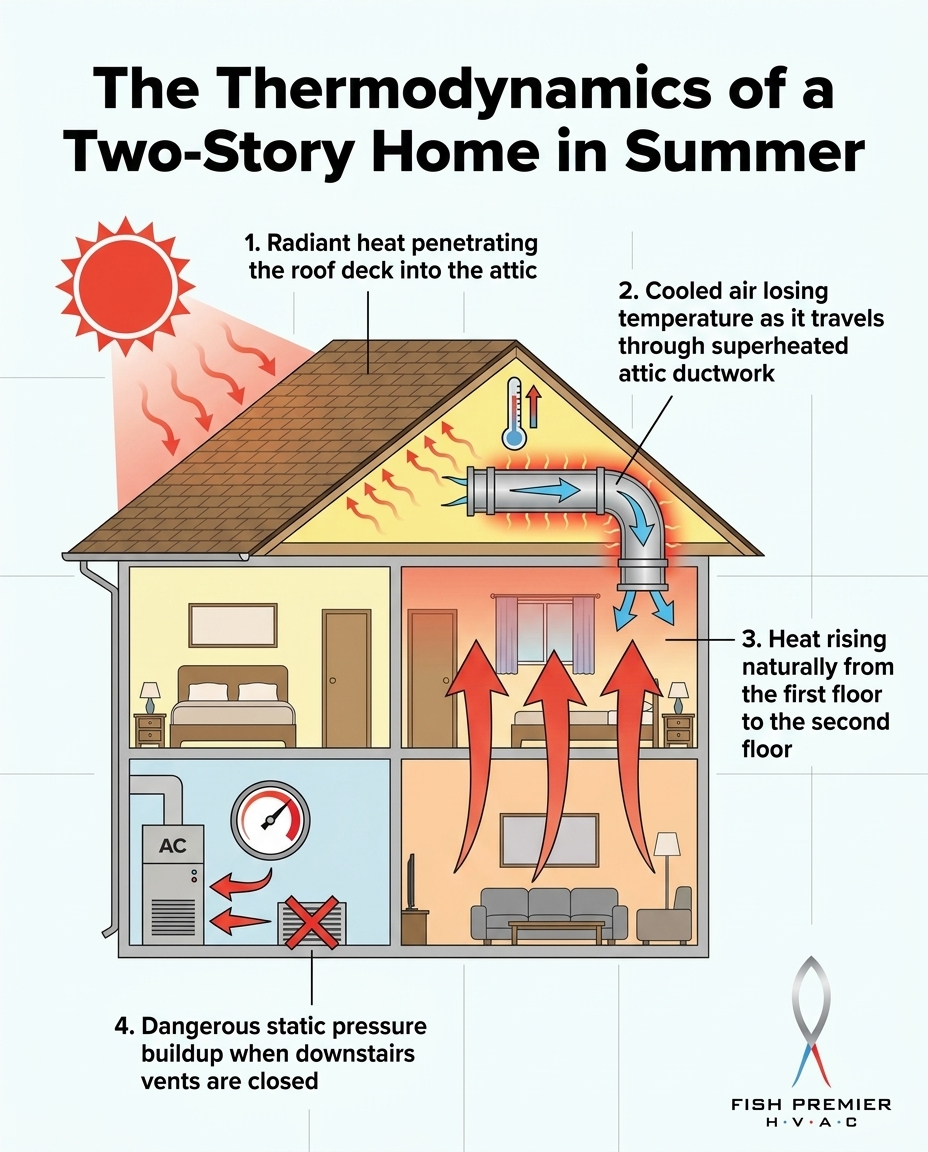
The layout of your ductwork is only half the battle. The other half is the brutal reality of the Texas climate. The basic thermodynamics of a multi-level home dictate that heat naturally rises. All the ambient heat generated on your first floor—from cooking, appliances, and large sun-facing windows—slowly drifts up the staircase, compounding the heat already trapped on the second floor.
But the most severe impact comes from above. During the peak summer season, consecutive days of 100-degree North Texas heat in July create a maximum thermal load on your roof. Solar radiant heat penetrates the roof deck and superheats the attic space. Our technicians measure attic temperatures daily, and we routinely find attics in Keller or Southlake reaching 140 to 150 degrees on a sunny July afternoon.
Your ductwork, which carries the 55-degree air produced by your air conditioner, is suspended right in the middle of this hostile, superheated environment. When the attic reaches extreme temperatures, the conditioned air inside uninsulated or poorly sealed ducts absorbs that surrounding heat. By the time the air travels thirty or forty feet through a 140-degree attic, it may warm up to 70 or 75 degrees before it finally pushes through your upstairs ceiling vents. The system is blowing air, but the cooling capacity has been entirely stripped away by the attic oven.
Why Closing Downstairs Vents Damages Your HVAC System
Faced with a hot upstairs and a freezing downstairs, a pattern we see often is homeowners taking the DIY troubleshooting step of walking around the first floor and closing all the supply registers. The logic seems sound: if you block the air from coming out downstairs, it will be forced to travel upstairs, right? Unfortunately, modern HVAC systems do not work this way, and this common myth actually causes severe damage to your equipment.
Closing vents in a single-zone system dangerously increases static pressure. Your blower motor is calibrated to push a very specific volume of air through a specific amount of open ducting. When you close registers, you are forcing the blower motor to push the same volume of air against a literal wall. Imagine trying to sprint while breathing through a cocktail straw—that is exactly what your HVAC system is experiencing.
According to ASHRAE guidelines regarding residential airflow and static pressure, restricting airflow in this manner leads to a cascade of expensive mechanical failures. The restricted air cannot move across the indoor evaporator coil fast enough to absorb heat. As a result, the coil drops below freezing, and the condensation on it turns to solid ice.
The consequences of high static pressure include:
• Frozen evaporator coils: The system encases itself in ice, completely stopping the cooling process and potentially causing water damage when it thaws.
• Duct leakage blowouts: The excessive pressure seeks the path of least resistance, often blowing out the seals and tape on your attic ductwork, dumping cold air directly into the attic.
• Premature blower motor failure: The motor overheats as it strains against the blocked vents, leading to a sudden and expensive breakdown.
Instead of risking expensive mechanical damage, you need a professional AC repair service in Southlake or Keller to address the actual airflow imbalance safely.
Advanced Diagnostics: Finding the Root Cause of Airflow Issues
Because the root cause of a hot second floor is structural and thermodynamic, a standard summer "tune-up" will never fix a ductwork or zoning flaw. Simply washing the outdoor coil, changing the filter, or topping off the refrigerant does absolutely nothing to change the way air moves through your two-story home in July.
Complex airflow issues require a concierge-level approach to uncover the root cause rather than applying a temporary band-aid. At Fish Premier HVAC, our team specializes in premium diagnostic assessments that go far beyond the basic checks performed by average technicians. In our experience, to truly solve a second-floor cooling deficit, we must measure the unseen forces at play inside your ductwork.
An advanced diagnostic assessment typically involves:
1. Static Pressure Testing: Technicians use specialized manometers to measure the exact pressure resistance inside your supply and return plenums, identifying invisible blockages or undersized ducts.
2. Airflow Measurement: Using an anemometer, professionals measure the actual cubic feet per minute (CFM) of air being delivered to the struggling upstairs rooms compared to the downstairs rooms.
3. Duct Run Mapping: A thorough visual and physical inspection of the attic ductwork to identify crushed sections, disconnected collars, or severely degraded insulation that allows thermal heat gain.
4. Manual J Load Calculation: A mathematical assessment of the thermal load on your second floor, factoring in window placement, insulation quality, and square footage, to determine exactly how much cooling capacity those specific rooms require.
This data-backed approach ensures that any recommended solution is guaranteed to work, eliminating the guesswork that leaves so many homeowners frustrated summer after summer.
Permanent Solutions: Zoning and Targeted Cooling Upgrades
Once the advanced diagnostics are complete, the path forward becomes clear. Fixing a hot second floor requires permanent, structural upgrades that directly address the physics of your home. Depending on the layout of your Keller and Southlake two-story homes, there are three primary paths to achieving total indoor comfort.
The most comprehensive solution we recommend is installing an HVAC zoning system. This involves placing electronic dampers inside your existing ductwork and adding a second thermostat upstairs. The dampers act as automated traffic cops for your airflow. When the upstairs thermostat calls for cooling, the system opens the dampers to the second floor and partially closes the downstairs dampers, directing the full force of the air conditioner exactly where it is needed.
If the existing ductwork is too degraded or undersized, ductwork modifications may be necessary. This can involve enlarging the main trunk line that feeds the second floor, adding additional return air vents upstairs to pull the stagnant hot air out of the rooms, or completely sealing and wrapping the attic ducts in high R-value insulation to prevent thermal loss.
Finally, for homes where altering the existing ductwork is not viable, ductless mini-splits offer a highly effective, premium solution. These independent systems provide targeted cooling directly to stubborn upstairs master suites or bonus rooms without relying on the main central air system at all.
• HVAC Zoning System — How It Works: Installs electronic dampers in ducts and adds a second thermostat to control the upstairs independently. — Best Suited For: Homes with accessible ductwork and a system large enough to handle independent zone calls.
• Ductwork Modifications — How It Works: Enlarges trunk lines, adds return vents, and heavily insulates attic duct runs to improve air delivery. — Best Suited For: Older homes with crushed, leaky, or severely undersized builder-grade ductwork.
• Ductless Mini-Splits — How It Works: Installs an independent, wall-mounted air handler connected to a dedicated outdoor compressor. — Best Suited For: Stubborn master bedrooms, room additions, or homes where duct access is impossible.
When our technicians evaluate these options for local homeowners, we find that exploring ductless cooling solutions often proves to be the least invasive and most energy-efficient way to rapidly cool a specific zone that the main system simply cannot reach.
Frequently Asked Questions About Hot Second Floors
Why is my upstairs so hot when the AC is running?
Heat naturally rises, and attic ductwork absorbs extreme heat before delivering air to the second floor, overwhelming a single-zone system. The air conditioner is producing cold air, but that air is losing its cooling capacity as it travels through the superheated attic. Additionally, the single thermostat downstairs shuts the system off before the second floor ever reaches a comfortable temperature.
Does closing downstairs vents help cool the upstairs?
No. It increases static pressure, which can damage your blower motor and cause your evaporator coil to freeze. Modern HVAC systems require a specific volume of airflow to operate safely. When you block that airflow by closing registers, the trapped air backs up, creating severe mechanical strain that often leads to expensive breakdowns rather than better cooling.
How do I cool down the second floor of my house in the summer?
Permanent solutions include installing a zoning system, modifying ductwork, or adding a ductless mini-split for targeted cooling. Temporary fixes like fans only move hot air around. To actually lower the temperature, you must address the physical delivery of conditioned air by having our team measure your static pressure and thermal load.
Is it normal for the upstairs to be hotter than the downstairs?
A slight difference is normal due to physics, but a massive temperature gap indicates a systemic airflow or zoning flaw. It is common to see a one or two-degree variance as heat rises. However, if your upstairs is five to ten degrees hotter than your downstairs, your ductwork and single-zone configuration are failing to meet the thermal demands of the home.
Will adding more attic insulation fix my hot second floor?
While insulation helps reduce the thermal load on the house, it will not fix undersized ductwork or a lack of proper HVAC zoning. Upgrading your attic insulation is a great step for overall energy efficiency, but if the ductwork itself is leaking or the blower motor lacks the power to push air upstairs, the rooms will remain uncomfortably warm.
Stop Sweating Upstairs: Schedule a Premium Diagnostic Assessment
Living with a hot second floor is not something you just have to accept as part of a Texas summer. Standard tune-ups and refrigerant top-offs cannot fix structural airflow issues, and closing your downstairs vents will only lead to costly mechanical failures. The architecture of Keller and Southlake two-story homes requires a tailored, data-backed approach to overcome the intense July heat.
You deserve a clear, locally-grounded explanation of why your system is struggling and actionable steps to permanently fix the temperature differential. If you are dealing with an AC running but not cooling the spaces where you sleep, it is time to stop guessing. Schedule an advanced diagnostic assessment with our team at Fish Premier HVAC today, and let our experts uncover the root cause of your airflow issues so you can finally sleep comfortably upstairs.